King Henry I died before his Abbey was complete and was buried here in 1136 in front of the high altar. For 400 years it was a site of international significance. The Abbey owned the town of Reading and the Abbot was its lord. The Abbey developed the town laying out new streets and properties including present-day Broad Street, Friar Street, London Street and Market Place. .
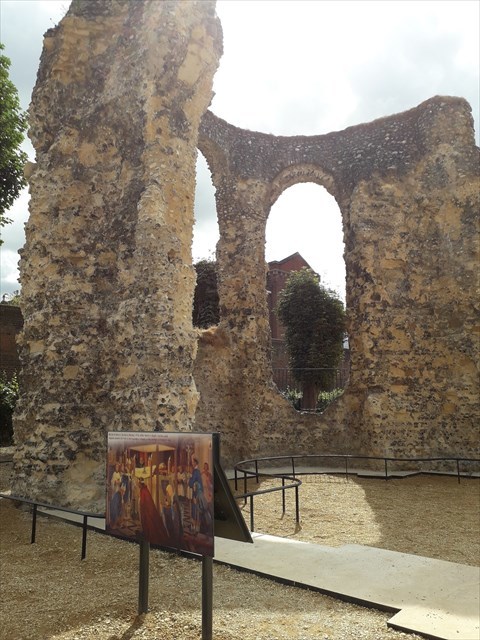
Most of what remains of Reading Abbey is dark, grey flint. However, when the Abbey was built this would not have been exposed and would have been encased in white limestone or in a lime-wash. On this white canvas, features and details would have been decorated in colourful paint.
Flint is a hard, sedimentary cryptocrystalline form of the mineral quartz, categorized as a variety of chert. The formation of flint is a complex process which began in the chalk seas millions of years ago. Organisms such as sponges and radiolaria/diatoms use silica from sea water to manufacture the biogenic opal which forms their skeletons. When the organisms die and the organic parts decay the microscopic silica is scattered on the sea bed. It occurs chiefly as nodules and masses in sedimentary rocks, such as chalks and limestone and is a fine-grained silica, very hard and impervious. The typical small irregular nodules are black with a white crust when freshly extracted from chalk but in its weathered form it can vary in colour from blue and grey to yellow brown and orange.
Flint has been used to build walls for hundreds of years, particularly in Southern and Eastern England. Flint is a common, local building material, which originates in chalk. Flint is a hard form of the mineral quartz and it occurs as banded nodules of various sizes and shapes, particularly in the Seaford Chalk Formation (Upper Chalk). Inside each nodule, the flint is usually dark grey, black, green or brown in colour, and it often has a glassy or waxy appearance. A thin layer on the outside of the nodules is usually white and a rougher texture. The impervious nature of flint, its unwieldy shape and small size can lead to problems within the constructions it is used in. Its characteristics can give rise to poor bonding that may be weakened further by rain penetration due to a lack of maintenance.
Lime was used in the construction of nearly all old buildings. At reading Abbey it was used as a mortar and plaster to hold the flint. Lime-based mortars give the best results. Their porous nature allows walls to ‘breathe’, moisture to evaporate and fine cracks to ‘heal’. The word 'lime' refers to quicklime or slaked lime, widely used to form the binder for mortars, plasters, renders and washes prior to the mid-19th century. Quicklime is produced when limestone is heated in a kiln. Lime-based products harden by absorbing carbon dioxide to revert back to calcium carbonate (‘carbonation’). Chemically, this is the same as the original limestone.
Further information about building materials can be found from SPAB
Further information about the Abbey Quarter can be found here
To claim this Earthcache you must visit the site of the ruins of Reading Abbey and
- email us / message us through our profile, the answers to the five questions below.
- Send us the wall estimates with your answers
- (Optional) post a photo of you and/or your GPSr in the Abbey grounds.
You may log your find before we reply, but logs without answers sent will be deleted.
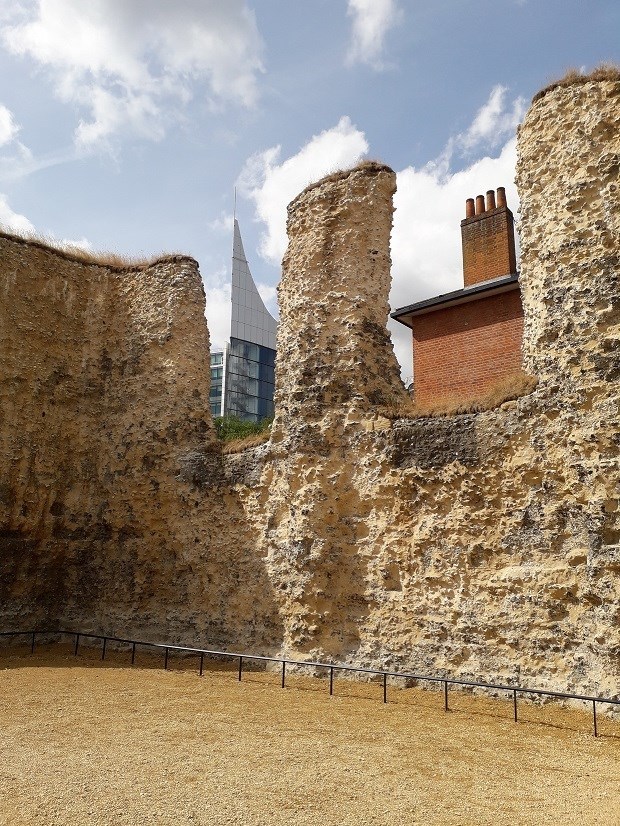
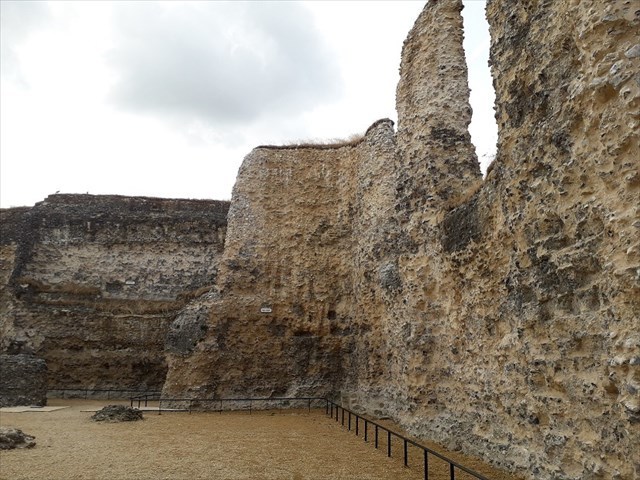
1. Flint was the main building material. Describe the flint remains in the wall in front of you – their size shape and colour?
2. Are the pieces of flint regular? Why do you think that is?
3. What percentage of the walls retain their lime coating? Do you think this is original or repaired lime? Why?
Some of the restoration work involved ‘soft capping’ the walls.
4. What do you think caused the deterioration of the walls?
If you walk down the right hand side of the wall facing you, you will see a display of different types of stone.
5. How do the stones from the inner surround of the arched windows differ from those that formed the niches? What pattern has been carved into some of these stones?
Now go over to the plaque dedicated to Henry Beauclerc and look at the wall that protrudes below it. Estimate the height of the part that sticks out from the wall and the total length of this part.