On September 16th 2018 the Town of Ajax formally unveiled Pat Bayly Square, a new urban hub at the southwest corner of Harwood Avenue and Bayly St. West. Named for Benjamin de Forest “Pat” Bayly, the square features a reflective pool with fountains, a skating rink in winter, a bust of Pat Bayly as well as the first memorial to Women War Workers of Defence Industries Limited.
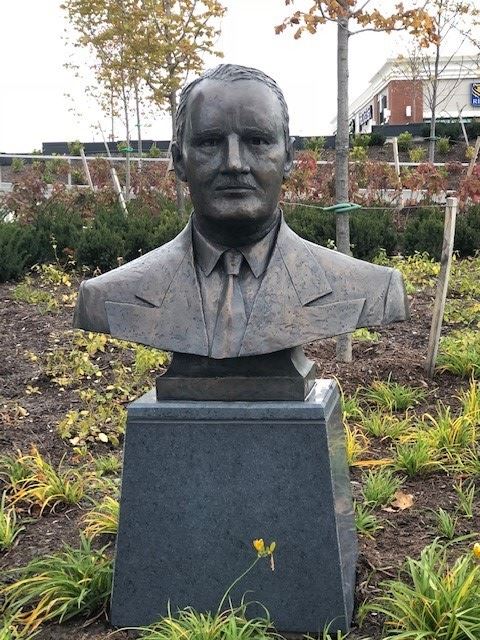
So who was Benjamin de Forest “Pat” Bayly?
First, let me say that finding accurate information about Pat Bayly was difficult to come by as he was a very private individual. His wartime record was considered top secret and many of the official records about his work at Camp X, and his role in the British Security Coordination were destroyed or continue to remain a government secret. I have tried to piece together as accurate a picture of this Canadian communications expert as possible from the following resources.
1. The True Intrepid: Sir William Stephenson and the Unknown Agents by Bill Macdonald. Chapter 19 – Benjamin De Forest “Pat” Bayly
2. The Unknown Canadian – The Life and Times of Benjamin de Forest (Pat) Bayly 1903 – 1994 by William A. Parish, Ajax, ON 2010
3. http://www.campx.ca/patbayly.html
4. https://en.wikipedia.org/wiki/Camp_X
5. https://en.wikipedia.org/wiki/British_Security_Co-ordination
6. Inside-Camp X, book by Lynn Philip Hodgson
************************************************************************
Pat Bayly is considered by many sources to have been the most secret member of Sir William Stephenson’s wartime staff. Recruited by Stephenson, Pat Bayly was a University of Toronto professor in the engineering department and a communications expert prior to the Second World War.
The early years:
Pat Bayly was born in London Ontario on June 20th, 1903. His family moved to Moose Jaw, Saskatchewan when he was a boy where his father was a medical officer. Pat Bayly received some pre-University education in Shrewsbury England before getting his law degree from the University of Saskatchewan where he graduated with his degree at the age of 19.
While in Moose Jaw, he was a member of the Amateur Radio Association and helped start the Moose Jaw radio station called 10AB. The station used to broadcast local church services and events.
After graduating from the Faculty of Law in 1923, Pat began to study electrical engineering at the University of Toronto. His expertise in the field was such that in his 3rd year he was asked to teach 4th year students when a professor in electronics and communications left to move to Hollywood to take a job in the motion picture business. During his 4th year the board of governors decided he did not have to take the exam for the course he was teaching, so he jokingly gave himself an A for that course. After getting his degree he was made a professor at the University of Toronto.
During his university years in Toronto, Pat supplemented his income by working for a commercial radio station where he had his own radio show “Pat at the mike”. When he became a professor at University of Toronto, he was encouraged to drop this second career as unbefitting for a professor.
The war years:
At the outbreak of World War II, in addition to his job at U of T, he acted as a consulting engineer for the Tariff Board of Canada and as a consultant to the National Electric Corporation. He also received military and communications training for a time in Winnipeg before being assigned to covert operations where he worked behind the scenes.
In 1941, Pat was approached by Toronto stockbroker Thomas Drew-Brook, a close friend and confidant of William Stephenson (later made Sir William Stephenson) and was recruited to work for the British Security Coordination where he became Assistant Director. He travelled to England in November of 1941 where he was assigned to learn about British communications and was introduced to the top people in Britain’s intelligence community including the head of the Britain’s Secret Service, Stewart Menzies. Pat also visited the covert decryption centre, Bletchley Park and Whaddon Hall where he met with the code breakers including Gordon Welchman and Alan Turing who were working on breaking the Nazi cipher machine called ENIGMA. Both Welchman and Turing were favorite guests at the Bayly’s home and Turing lived in their home in New York while he was helping to set up a more secure phone line at the Bell labs.
Pat Bayly felt the security of certain allied ciphers was very poor as they were still using the Playfair cipher, which could be broken in two minutes. Pat pointed out the fact that secret communications are critical, and that they would need a decent cipher. He was given the army rank of Lieutenant Colonel and British Identification, partly to circumvent Canadian Law and partly, in Pat’s words “so if they decided to shoot me, they did not have to argue with Canada”.
Pat returned to North America and arrived in New York to report to William Stephenson on December 7th, 1941. His communications agenda quickly changed as earlier that day, Pearl Harbour had been bombed and the United States was now in the war. Pat set up the HYDRA communications centre at Camp X and designed special purpose equipment for networking New York, Washington, Ottawa and the United Kingdom. To handle confidential traffic, he invented ROCKEX, which was a One-Time-Tape cipher device. A later version of this machine was used by British consulates and embassies until 1973.
The Government of Canada has stated that Hydra provided "an essential tactical and strategic component of the larger Allied radio network, secret information was transmitted securely to and from Canada, Great Britain, other Commonwealth countries and the United States".
Of the many examples of great successes directly related to Pat Bayly’s skills in perfecting intelligence speedily and securely are:
a) the Battle for the Pacific, where due to Pat’s communication expertise, radio signals from the Japanese were picked up by allies before the signals were received by the intended Japanese recipients. At the Battle of Midway, Americans knew the instructions before the Japanese fleet. This was a turning point in the Pacific war.
b) Pat’s communications network was able to triangulate Nazi U-boats as the U-Boats were required to report their position twice daily to Germany. Knowing where the U-Boats were twice a day helped re-route convoys for a safer passage and it was Pat’s job to alert the closest allied vessel to track down the U-boats.
c) Pat assisted the British government with the purchase of the largest radio transmitter ever built, a huge 1,000 kw radio transmitter that the FCC refused to license and the US government refused to sell to Mexico. When Pat learned of the transmitter and knowing the British were looking for one large enough to transmit over the channel he told David Bowes-Lyon, brother to Queen Elizabeth, who was in charge of British Propaganda. The transmitter was purchased and erected outside Crowborough. Pat was given the honour of naming the transmitter and asked his wife Margaret who suggested naming it aspidistra, after a song she had heard the previous evening called “The Biggest Aspidistra in the World”. The Aspidistra transmitter aided in the Allied invasion of France by overpowering German radio communications, sending out false information and propaganda.
Post War years:
Pat Bayly’s work doubtless facilitated the Allied victory in the Second World War. However, the full impact of his efforts may never be known. In the years following the war, most documentation related to the British Security Coordination activities was either suppressed or destroyed, and Pat seldom spoke of his wartime involvement. When peace came, he resumed teaching at U of T. In 1946 he formed his own company, Bayly Engineering Limited, located first in Oshawa and later in Ajax, where in 1955 he became the Ajax’s first mayor. Pat also played an instrumental role in securing the obsolete facilities of Defence Industries Ltd. in Ajax, the largest munitions plant in the British Commonwealth, as temporary accommodations for U of T Engineering’s overwhelming post-war enrollment. He died in March 1994, just shy of his 91st birthday.
Benjamin de Forest (Pat) Bayly was recognized with the Order of the British Empire in 1946 and fellowship in the Institute of Radio Engineers in 1947. The University of Toronto inducted Bayly into its Engineering Hall of Distinction in 1989.
Pat has never been recognized by the Canadian Government for his service to Canada or the war effort.
Puzzle:
Fstkl Ydihd Xzjsv wciiq fiqeg hheiz aoaik aurkh isggi pvgqh sapcn tglex dyexk vfanr beuxu dtggv oqiyv iiw