Logging Requirements
This earthcache is located on Doe Island in Stony Lake. You will require a watercraft , either a canoe or kayak, to reach the island. There is a public beach you can launch from. This is not a boat ramp, and you will need to avoid swimmers by launching to one end of the beach and roped off swimming area. It may also be possible to reach the island in the winter if the ice is frozen however if the island is covered with snow or ice, you will not be able to see the chatter marks and answer the questions.
To log this earthcache:
Rules:
Please send me your answers within 4 days of posting your found log. If there is more than one cacher in your party, include the names in your group. Only one person needs to send me the group answers. No spoiler photo's please. Found logs posted without proof you visited the site will be deleted.
Questions:
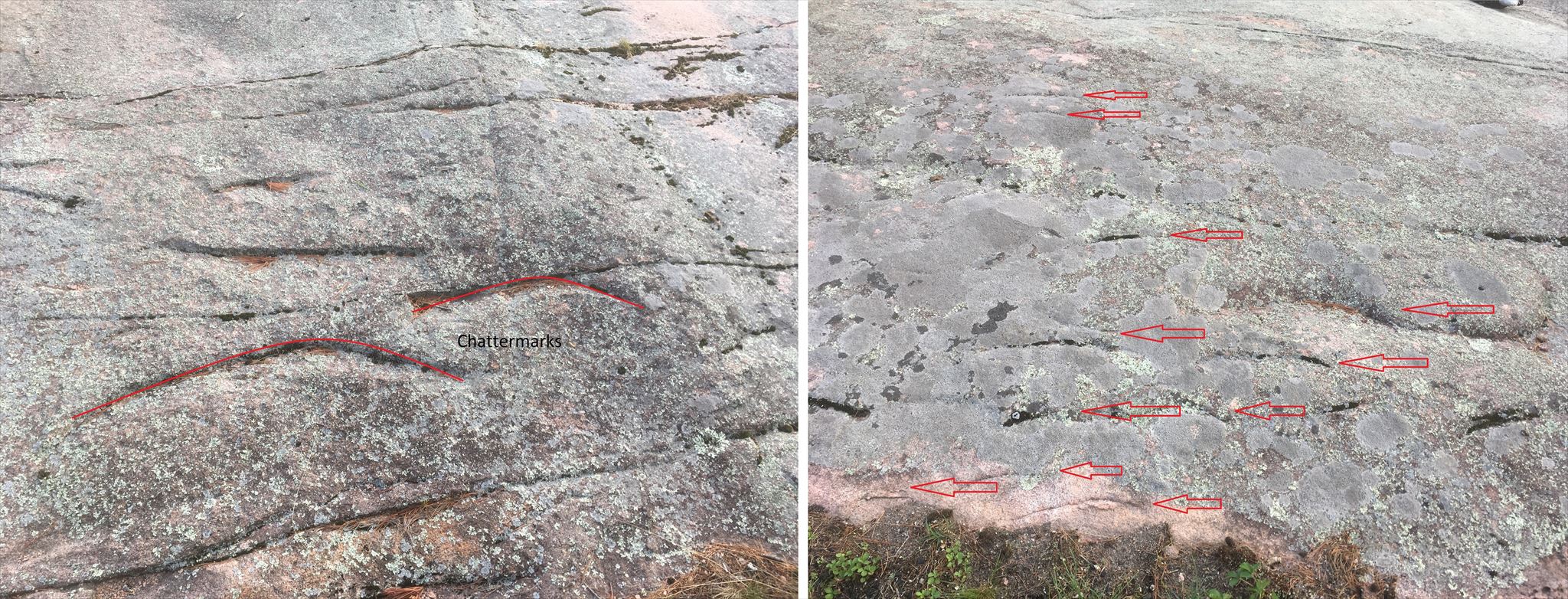
Visit the posted coordinates and look for a series of chatter marks.
1. Are the chatter marks found on the stoss slope of the rock or the lee side?
2. Are these chatter marks consistent with being crescentic gouge, crescentic fractures or lunate fractures?
3. Measure the largest chatter mark. How wide and deep is it.
4. Photos are optional but encouraged. Post a photo of yourself or GPS on Doe Island with an example of a Chatter mark other than the ones at GZ. There are many to choose from.
Chatter Marks are small curved fractures found on glaciated rock surfaces. They normally are found on hard, brittle rocks including granite, sandstone and quartzite. Scientists and geologists have long studied the effects of glacial movement across bedrock surfaces and continue to study more recent erosional effects in retreating glaciers in Iceland and Greenland, however are basically in agreement that these marks were created under the glacier by pressure and impact caused by boulders moving along the rock surface, either by irregular rolling or sliding.
The marks are normally 1-5 centimeters but can be much smaller or as large as 50 cm in length. Sub-glacially formed erosional crescentic markings (either crescentic gouges or lunate fractures) on bedrock surfaces occur locally in glaciated areas and comprise a conchoidal fracture dipping down-ice and a steep fracture that faces up ice.
There are three different types of chatter marks
1.The crescentic gouge is an upstream concave that is made by the removal of a piece of rock.
2. The crescentic fracture which is a downstream concave that is also made by the removal of rock.
3. The lunate fracture is also a downstream concave made without the removal of rock?
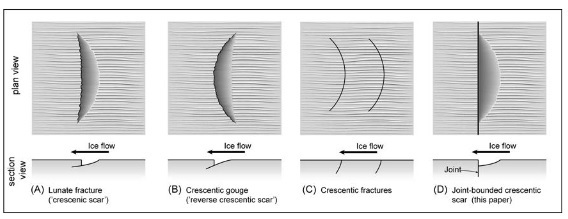
The Kawartha Lakes and Lake Simcoe area was glaciated by the Laurentide Ice Sheet which had a predominantly south to southwest ice flow.

References:
1. Joint –bounded crescentic scars formed by subglacial clast-bed contact forces: implications for bedrock failure beneath glaciers
Krabbendam M, Bradwell T, Everest JD & Eyles N (2017) Joint-bounded crescentic scars formed by subglacial clast bed contact forces: Implications for bedrock failure beneath glaciers, Geomorphology, 290, pp. 114-127
2. Géographie physique et Quaternaire
A Reconnaissance Geophysical Survey of the Kawartha Lakes and Lake Simcoe, Ontario Brian J. Todd et C. F. Michael Lewis

| I have earned GSA's highest level: |
 |