What a Waste: Slumps & Undercuts
As you paddle along the steep shoreline here, you will see a number of places where the trees shrubs and other debris litter the shore line. In some cases, this debris may have washed up on shore. In other cases, the debris may be the result of a large slump, or undercutting from the waves.
Causes of Mass Wasting
Mass wasting occurs when the gravitational pull acting on a slope becomes too much for the hill to resist. Therefore, anything that erodes or impedes the slopes ability to resist this force may become one of the causes of mass wasting. For example, increased slope steepness will make a hill more prone to mass wasting simply because gravity has an easier time pulling materials down a steep slope as compared to a gentle slope.
Too much water or rainfall will also weaken a hillside's ability to resist gravity. This is an example of too much of a good thing. A little bit of water actually makes it easier for soil particles to bond together and keep the slope intact. However, if there is too much rain or water, then the soil particles lose this bond and break apart.
If the slope has decreased vegetation, then it will be more prone to mass wasting because it does not have the protective plant covering above ground or the soil anchoring roots system below ground. Also, disruptive events, such as earthquakes, can cause sections of slope to detach due to the violent shaking that occurs.
Slumps

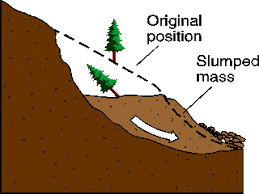
A slump is a type of mass wasting that results in the sliding of materials along a curved surface. In a slump, a portion of the slope moves down a short distance. It's almost like when you stand up straight and tall, and then slump your shoulders forward as if you're too tired to hold up your shoulders. In fact, if you were to look at an actual slump, it might appear to you as if the slope just got tired of holding up that section and let it slip down.
A slump is sometimes referred to as a rotational slide because a portion or block of the slope 'slides' down as it 'rotates' around an axis parallel to the slope. A slump can occur as a single unit or as a number of slumps grouped together, and they form when the base of the slope or hillside is eroded or cut away. For instance, water or waves may undercut a slope, removing the physical foundation holding up the rocky material. Without a base, the block of the hill goes 'kerplunk' and slumps down.
Slumps can also be blamed on human activities. For example, if a road crew cuts away the base of a hill to make room for a road, the structural stability of the slope could be weakened, resulting in a slump.
Under Cutting
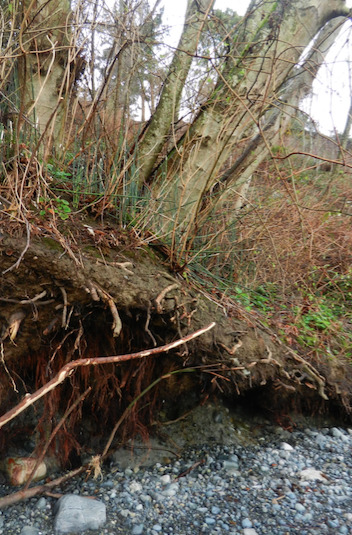
Under cutting is an erosional process, caused by successive waves, at all intensities, washing against the shoreline. The more intense the pounding of the waves, the quicker the undercutting will occur, leading to mass wasting. As the shoreline is undercut deeper and deeper, the ability to support the shoreline and debris above it is weakened, eventually leading to a slump or a shoreline fail, where the weight of the debris falls forward, towards the lake. Under cuts, can be recognized, by exposed roots, below the soils surface, or an overhanging cliff of rock or soil.
Now for a few questions, to see what you learned. Please send the answers to questions 1-3, to the Cache Owner at the top of this page. Questions 4 and 5 should be included in your “Found it” log.
1) What feature is more common along the shoreline here, a slump or an undercut?
2) Near the posted coordinates you will notice a large slump. Identify this location by providing the coordinates.
3) Compare the direction of the fallen trees in a slump, to the fallen trees from an undercut. Yes there is a difference. After reading the information above, and your observations at GZ, explain why this difference exists. (Think about how the mass wasting is moving).
4) Estimate the height of the shoreline, at the posted coordinates.
5) What do you feel might be the main reason why a slump has occurred at this location. The cache description will help you answer this question.
6) In your log, please include a photo identifying the Slump, and and a second of the undercutting from the waves.