Introduction
I was on top of this hill on geocaching business in the not too distant past and having never been here before I planned to check out the site properly. I wanted to see the cairns, tombs, and rock art. While examining cairn V, I realised that it wasn’t just our Neolithic ancestors leaving curvilinear traces of their presence. Two of the orthostats which sit in the middle of this cairn are covered in trace fossils and were I believe placed right here side by side because of their unusual surface features.
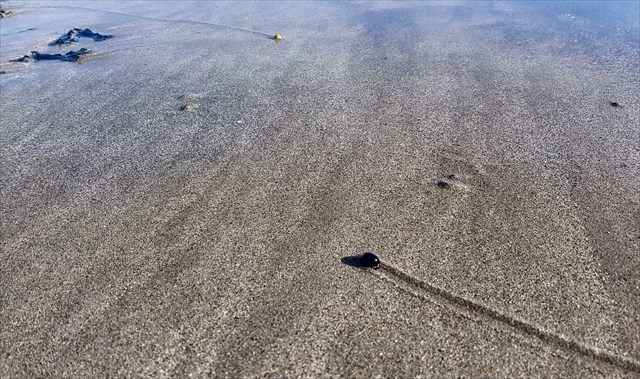
A pair of Flat Periwinkles making traces
Local Geology
The bedrock geology of this area is In part Late Ordovician deep marine greywacke, mudstone, along with Carboniferous limestone and sandstone with scattered sandstone, Greywacke and conglomerate boulders left behind after the last ice age.
The carboniferous period lasted about 60 million years from the end of the Devonian Period 358.9 million years ago, untill the start of the Permian Period, 298.9 million years ago. Most of ireland at that time was a shallow tropical sea south of the equator and over millions of years the Limestones, sandstones, mudstones etc.. were laid down.
Cairn V
During the Neolithic Period (New Stone Age) between 4000 and 3000BC, people began to domesticate animals and set up farming communities and build these large megalithic structures for use as ceremonial and burial sites. They were constructed for the most part using this local Limestone, but also the aforementioned boulders and in the case of this Earthcache a pair of sandstone orthostats.

These monuments are spread over 3 hills in this area, Carnbane West, Patrickstown Hill and this hill Carnbane East. Cairn V is situated SE of the main Cairn T on the top of this hill. Cairn V is about 10m in diameter, surrounded by a uniform ring of kerbstones inside which are several larger upright stones called Orthostats. The purpose of these would have been to divide the structure into chambers. This cairn is aligned with the entrance of the main cairn on the top of the hill.
Ichnology
Ichnology is the study of trace fossils, or ichnofossils from the Greek ἴχνος ikhnos, meaning "trace, track", They provide a fossilised record of biological activity of the flora or fauna where and when they were laid down. They do not include fossils of the organism itself. If any of these organisms remains are preserved, then it is due to different processes (possible mineral preservation of a creatures shell for example).
Ichnofossils are formed by a multitude of activities, from footprints, to crawl marks, borings and burrowings, feeding and grazing, dwelling structures, root cavities, etc….
A Classification
Adolf Seilacher was the first person to devise a method of classifying trace fossils. He observed that most of these traces were created by the different organisms behavioural activities. He divided them into 5 categories.
- Cubichnia are resting marks on the surface of the sediment, resting, hiding from preditors or the opposite waiting to ambush, etc...
- Domichnia are dwelling burrows and borings showing how they lived and often with reinforced walls.
- Fodinichnia are traces made by feeders within the sediment, where the organism tunnels, moves and excavates in search of food.
- Paschichnia are grazing traces on the sediment surface with an emphasis on feeding and locomotion.
- Repichnia are crawling, walking or tunnelling traces where the main emphasis is on locomotion, and less on feeding.
Another Classification
Another way to classify them is to examine their relationship with the sediment of origin. Martinsson described such a system, coming up with four distinct categories.
- Endichnia are traces that are found wholly within a layer of sediment, and therefore can only have been made by an infaunal (beneath the sediment surface, within) organism.
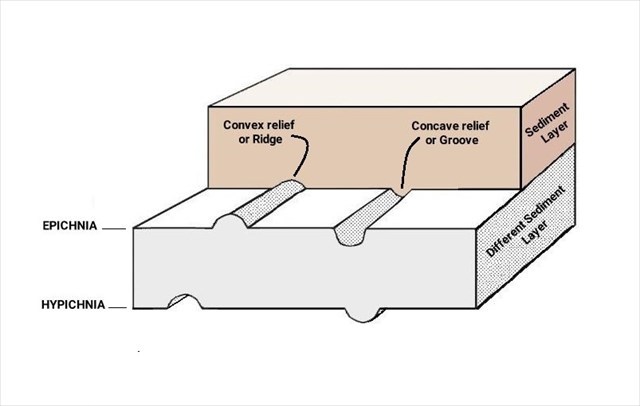
- Epichnia are found on the surface of a layer of sediment, being those ridges and grooves that were formed by organisms on the sea bed or infaunal burrows that have since been exposed by erosion.
- Exichnia are traces that are made of a material that is different from the surrounding sediment, having either been backfilled by the organism or eroded out and replaced by later sediment.
- Hypichnia are ridges and grooves found on the base of the beds of origin where they interface with a different layer of sediment, the opposite of epichnia.
What To See Here
For this Earthcache the fossil traces on the front and rear façades of the pair of fine-grained sandstone orthostats appear as meandering semi-cylindrical irregularly curving parallel sided traces. They are also fine-grained and are the same sandstone. These tracks were possibly made by some sort of worm like creature moving on the sand surface.
From the above classification, the terms associated with this Earthcache would be Repichnia for behaviour and Epichnia or Hypichnia due to their relationship with the sandstone and because both façades have these traces.
Logging Requirments
You will have to examine the pair of orthostats in the above image, take some measurments and collect some information for me, also visit a few other locations on this site in order to answer all the questions.
You will need some sort of measuring device.
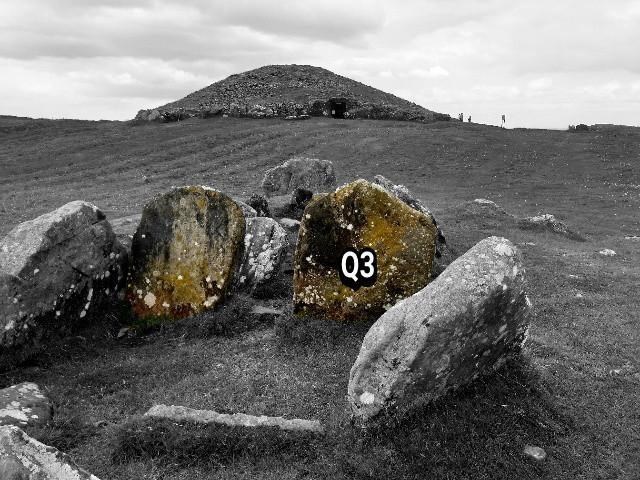
Position of Orthostats
Questions.
Q1. How wide were the creatures making these tracks? (width of the traces)
Q2. Describe the traces, are they Raised (Convex) or Grooved (Concave) or flat?
Q3. Height & width of larger orthostat (Q3) on right when facing the main Cairn?
Q4. What is the size of the Cross inscribed on the seat of the Hag's chair?
Q5. From the information panel, what did excavators find in 1943 in Cairn H?
Please send the answers using the message center and not by email because I may miss them there.
Also please don't upload any spoiler pictures.
