This is a Reincarnation of a Multi-Cache by the same name. Due to the Muggles of the area, the 1st Stage had to be sidestepped. For those who are interested, the original 1st Stage reference (Rose Island) can be found at N 40° 42.826' W 89° 34.473'.
This Hidden History Cache is dedicated to Chipmunk77. Thanks for suggesting that I take a second look at this area to find these forgotten places of interest.
While Glen Oak Park, in and of itself, does not qualify as a Hidden History, there are lost realms of this once pristine landscape that have been inexorably wiped from the landscape. Sunken Gardens (1910-1954) and Rose Island (1897-1960), there is very little information that can be found regarding either of these places. However, I will try to impart what information I could find in this description.
Work began on Glen Oak Park in April 1895. It was dedicated just four months later with an estimated 30,000 people in attendance. More than 2,500 public school children attended the first Field Day held in 1897. A miniature railroad opened at Glen Oak Park, ground was officially broken for a ride along Prospect Heights (later to become Grand View Drive and listed on the National Historic Register in 1996).
The park had a total of 7 kiddie rides, a petting zoo, picnic area and concession stands.
Rose Island (1897-1960)
During the early years of Glen Oak Park, the Stone Fort was linked by an arch bridge to Rose Island. Heavily landscaped, Rose Island housed a shelter, a boat rental and other amenities. Boats were rented for fifteen cents per hour, allowing park users to oar around the lagoon. Electric Lights were strung around the lagoon providing for nighttime boating and ice skating. A stone warming house was later constructed to provide a respite for ice skaters. In the 1930’s, pens for peacocks, golden pheasants, quail and doves were also located on Rose Island. In the later years (sometime around 1960), Rose Island was annexed by filling in the “lake” and made into what is now the Glen Oak Amphitheater.
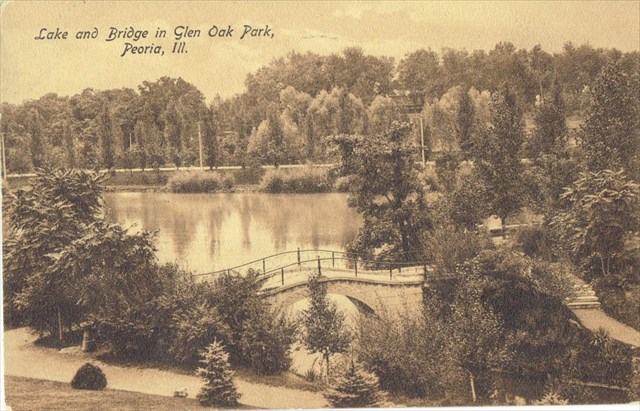
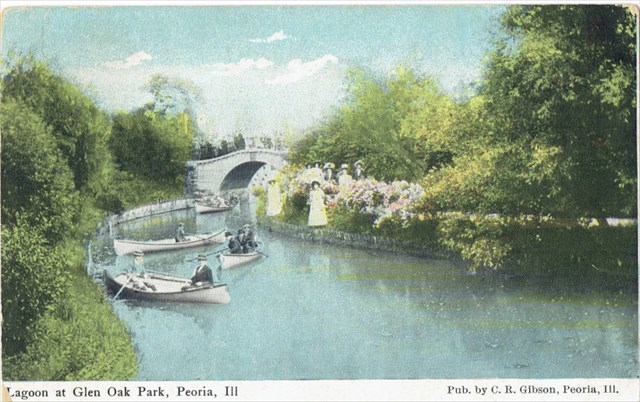
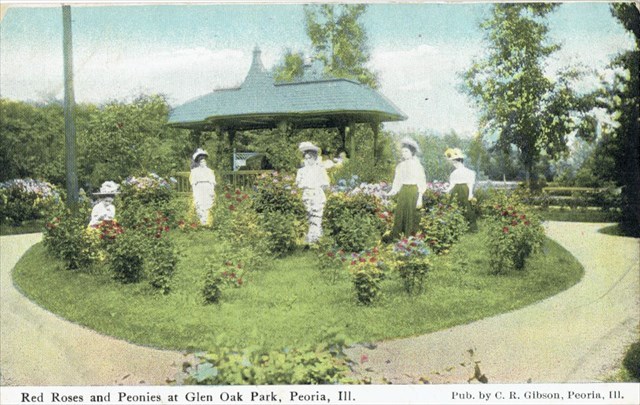
The Amphitheatre was developed and constructed through an agreement between the Peoria Park District and the Peoria Municipal Band Commission. In 1960, the site formerly known as Rose Island, adjacent to the Glen Oak Park Lagoon, was filled in by the Park District to make room for a free-form concrete bandshell and stage. It replaced the original Glen Oak bandstand, which was constructed in 1896.
Sunken Gardens (AKA Ernest H. Wilson Garden) (1910-1954)
During the early 1900’s, the Park District completed several landscape beautification projects in lower Glen Oak Park. By 1920, a sunken garden, an electric fountain and pool, ornamental pedestals, vases, concrete steps and walkways were all constructed in lower Glen Oak. The sunken garden had a newly constructed Pergola built in 1912 that overlooked the garden. From that point forward, the Pergola and sunken garden were often mentioned together.


It was within Glen Oak Park that a small group from the Peoria Garden Club began their civic project, a sunken garden, to be later dedicated in honor of E.H. Wilson. The Dr. E.H. Wilson Plant Study Club was founded in 1931. The original Wilson Garden was located at the lower park entrance at Perry Street, an area which is now used for tennis courts. (See map above). The garden consisted of trees, shrubs and long, lush perennial borders featuring over 300 regal lilies. Also featured were an electric fountain and a long, domed pergola.
The following pictures confirm the former location of the Sunken Garden (in 1939) and the same area today: 

As a remembrance of Dr. Wilson, The Arnold Arboretum sent from Massachusetts a dove-tree [Davidia involucrata] to be planted in the new garden. The garden was dedicated June 26, 1934 and was maintained by the Plant Study Club at the Perry Street location for 20 years.
The Wilson Garden was prone to flood damage because it was sunken, so after the new Glen Oak Conservatory was built in 1951, the club began to move the garden to its current location north of the Conservatory. In those days the park grounds consisted of roses, oak trees and little else. The 1953 Wilson Garden was much larger than today's. It was later "subdivided" into smaller gardens including the Yellow and Grey Garden, the Purple Garden, the Cottage Garden, and the Herb Garden.
For the purposes of this Hidden History Geocache, I am considering the "Sunken Garden" as lost forever, along with the beauty and majesty that the original gardens portrayed.
While I was placing this cache, I happen to come upon the original stairs from the Sunken Gardens, still pretty much intact.
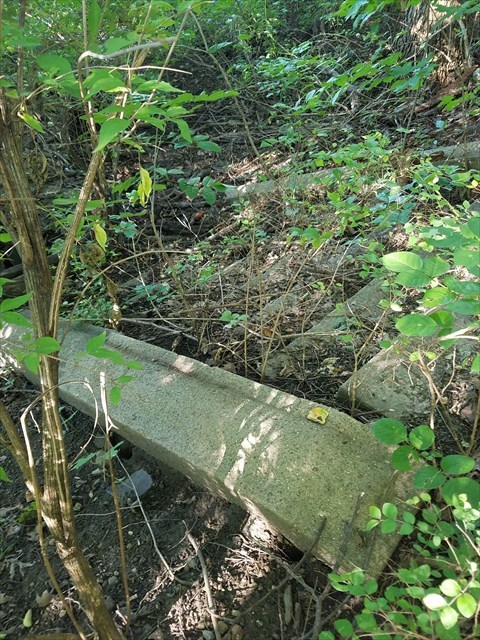
Permission granted by Peoria Park District.
If you liked this bit of History, and want to visit more, go to my Facebook page and [Like] it to receive updates to new Hidden History Caches