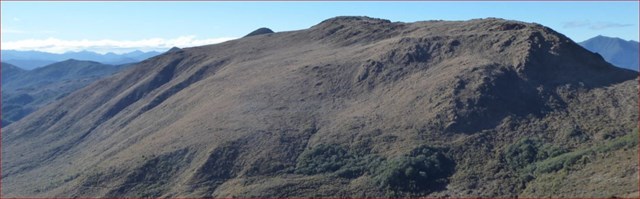
Dunite was named by the German geologist, Ferdinand von Hochstetter in 1859 after he climbed Dun Mountain (the highest peak close to Nelson city) to visit the chromite workings. Hochstetter found that the mountain was made of dense igneous rock, composed mainly of two minerals – interlocking grains of yellowish-green olivine with tiny black grains of chromite. Olivine is a silicate mineral rich in magnesium and iron. Surface weathering of the underlying ultramafic igneous rocks oxidizes the iron in olivine resulting in the rust brown colour. The mountain was given its name by the early settlers due to this dun/brown colour. Because of the peculiar rock composition, the soils lack plant nutrients and so, apart from stunted shrubs and grasses, are mainly devoid of vegetation. The name Dunite has been applied to rocks of this type throughout the world and in more tropical climates results in a deep red soil.
Geology
Dunite is an ultrabasic igneous rock dominated by essential olivine (>90% volume), often with accessory clinopyroxene, orthopyroxene, spinel, ilmenite, and magnetite. Dunite is usually coarse- to medium grained and is a peridotite. Dunite forms either as a cumulate within layered intrusions or as a residue after extraction of partial melt from a pre-existing ultrabasic rock in the mantle. Dunite cumulates and mantle rocks are found as xenoliths in a wide range of mantle derived magmas.
Dunite and other peridotite rocks are considered the major constituents of the Earth's mantle above a depth of about 400 kilometers. Dunite is rarely found within continental rocks, but where it is found, it typically occurs at the base of ophiolite sequences where slabs of mantle rock from a subduction zone have been thrust onto continental crust by obduction during continental or island arc collisions (orogeny). It is also found in alpine peridotite massifs that represent slivers of sub-continental mantle exposed during collisional orogeny. Dunite typically undergoes retrograde metamorphism in near-surface environments and is altered to serpentinite and soapstone.
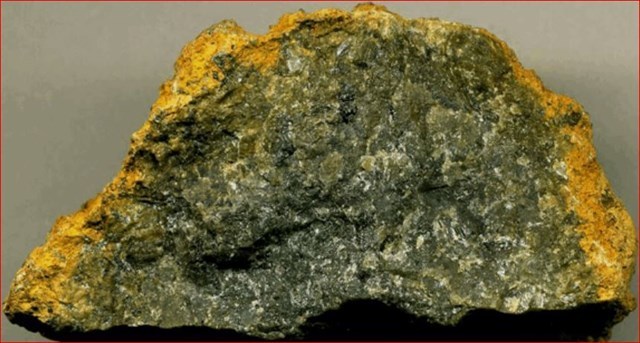
Dunite (4.9 cm across) from the Permian of the dunite type locality: Dun Mountain, New Zealand.
Geologic unit & age: Dun Mountain Ophiolite Belt (= suture zone between a terrane and the ancient New Zealand margin of the Gondwana supercontinent), Early Permian, 275-285 m.y.
Locality: Dun Mountain, Bryant Range, ~15 km southeast of the city of Nelson, northwest of the Pelorus River, northern South Island, central New Zealand.
Future use
Dunite could be used to sequester CO2 and help mitigate global climate change via accelerated chemical rock weathering. This would involve the mining of dunite rocks in quarries followed by crushing and grinding as to create fine ground rock that would react with the atmospheric carbon dioxide. The resulting products are magnesite and silica which could be commercialized:
To log the cache:
The given coordinates are a good place to park. This is so the icon doesn’t obscure that of BigglesNZ’s Brook Stream Multi GC39AHC . Make your way to S 41° 18.656 E 173° 17.565. This will take you to a memorial to C. I. Kidson, Nelson’s City Engineer from 1939 to 1962. This memorial includes a fascinating display of many of the rocks that make up Nelson’s Mineral Belt. Then answer the following:
1. Locate the sample of Dunite. Describe the size, colour, shape and any other distinguishing features.
Describe the position of the Dunite in the display.
2. There is also a sample of at least one of the other rocks/minerals mentioned above. Send me the name/s.
3. Several of the specimens also have names linking them to the Nelson region. Name one of these.
Please send me your answers. You may log this as a find before hearing back from me. I will contact you if there are any issues with your answers and I will delete any logs if the required email has not been received.
Special thanks to BigglesNZ for generously agreeing for me to place this earthcache here.
References:
http://www.alexstrekeisen.it/english/pluto/dun.php retrieved 5/10/18
https://teara.govt.nz/en/rock-and-mineral-names/page-2 retrieved 5/10/18
http://www.jsjgeology.net/Dun-Mountain-dunite.htm retrieved 5/10/18
https://nelsontrails.co.nz/dun-mountain-trail/ retrieved 7/10/18