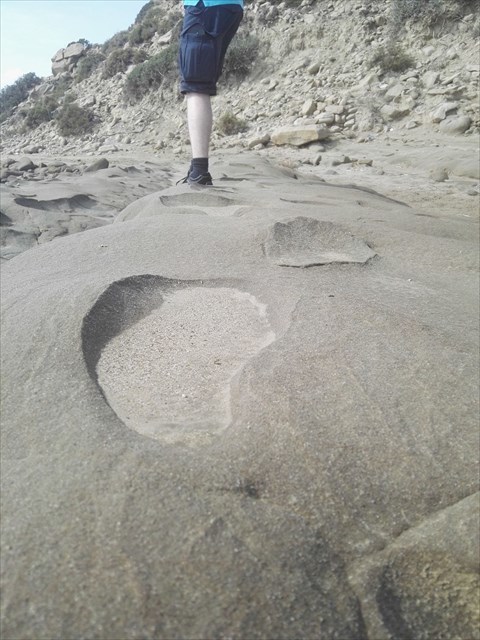
This earthcache is about the the strange footprints at the shore of cyprus. Who left them?
During high tide this cache might only me available with wet feet/shoes. The cache consists of a short hike of 400m round trip on rocky ground.
Concretion is a hard mass of matter formed by precipitation of mineral cement within spaces between particles of sedimentary rock or soil. Concretions are often ovoid or spherical in shape, but other shapes still may also occur.
In general, the concretion forms after layers of sediment have formed but before they hardened to sedimentary rock. In the time after layers have formed and before pressure cements the sandstone dissolved minerals precipitate around a nucleus in in the sediment. This concretionary cement often makes the concretions harder than the surrounding. Thus, giving it more resistance to later erosion.
Conglomerate is a coarse-grained clastic sedimentary rock that is composed of a substantial fraction of rounded to subangular gravel-size clasts, e.g., granules, pebbles, cobbles, and boulders, larger than 2 mm (0.079 in) in diameter. Conglomerates form by the consolidation and lithification of gravel. Conglomerates typically contain finer grained sediment, e.g., either sand, silt, clay or combination of them, called matrix by geologists, filling their interstices and are often cemented by calcium carbonate, iron oxide, silica, or hardened clay.
The size and composition of the gravel-size fraction of a conglomerate may or may not vary in composition, sorting, and size. In some conglomerates, the gravel-size class consist almost entirely of what were clay clasts at the time of deposition. Conglomerates can be found in sedimentary rock sequences of all ages but probably make up less than 1 percent by weight of all sedimentary rocks.
In general conglomerates form like sandstone. The formation of sandstone involves two principal stages. First, a layer or layers of sand accumulates as the result of sedimentation, either from water (as in a stream, lake, or sea) or from air (as in a desert). Typically, sedimentation occurs by the sand settling out from suspension; i.e., ceasing to be rolled or bounced along the bottom of a body of water or ground surface. Finally, once it has accumulated, the sand becomes sandstone when it is compacted by the pressure of overlying deposits and cemented by the precipitation of minerals within the pore spaces between sand grains. The difference to conglomerate is that at conglomerate during that process other gravel, pebble or cobble is deposited into that sand. At conglomerate these alien doposits are roundwashed by water in different forms or glacier.
Onsite the erosion forms footprints into the rockhard sand.
The main differences between Concretion and Conglomerate are:
1.) At concretion the harder rock consists of the same material as the surrounding while at conglomerate it is an alien material
2.) At conglomerate the harder parts have been formed before they ended up in the surrounding sedimentary layers while at concretion the harder parts are formed after the layers of sediment have formed.
Logging
To successfully log the Earthcache please send us the following information via the profile:
At Stage 1 (GC coordinates):
a) Look at the at the hill. Find the half visible spheres at the rock in front of you. What average diameter do they have?
b) Describe the spheres in colour, texture and hardness.
c) What do you think, are these concretions or conglomerate? Why?
At Stage 2:
d) Look at the ground. You should see a line of spheres. Dream up: how could these spheres become a conglomerate one day?
e) Which range of size do these future clasts have?
At Stage 3:
f) Here you see the "footprints of history" How do you think these footprints formed?
I would be happy about a voluntary photo. These may also be photographs of the erosion forms, but without the coordinates, of course.
You do not have to wait for an additional permission to log the Eartcache. I will contact you if something is wrong.
Logs without an accompanying e-mail / message will be deleted.
Logs containing the answers will also be deleted.