Adjunte a su registro en línea una foto suya o un trozo de papel con su apodo y la fecha de la visita en las coordenadas de la lista.
Ahora a las tareas:
Adjunta a tu diario en línea una foto tuya o un trozo de papel con tu apodo y la fecha de tu visita a las coordenadas de la lista. Teamlogs - ¡Cada registro una foto!
Toca la piedra arenisca y describe cómo se siente!
Echa un vistazo más de cerca a la arena! Describe sus propiedades (tamaño, composición y colores)!
Utilice la imagen de spoiler para ayudar! ¿Este revestimiento de paredes ha evolucionado naturalmente (yeso de la pared)? Qué altura puedes medir aquí?
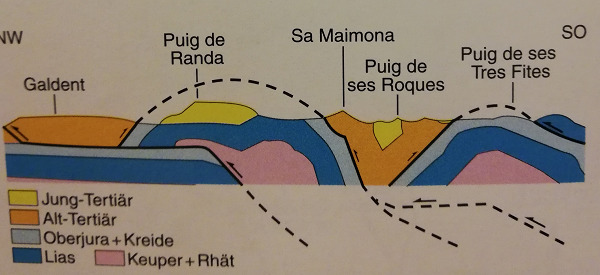
Geologically, the massif of Randa and its surroundings have a lot to offer. The profile shows that the rock sequence reaches from the Jurassic to the Tertiary. This is only about sandstone.
Sandstone is a sedimentary rock made of sand grains cemented together, which consist primarily of quartz. Since quartz is a relatively weather-resistant mineral, which is found also in many rocks, it accumulates during weathering and transport process strongly, while other mineral grains disintegrate. Therefore, the sandstones consist overwhelmingly of this mineral.
The sand grains are 0.063 to 2 mm in size.
Sandstone is formed by cementing (cementation) of loose sand, and therefore has the same origin as these conditions. He is unlike chemical and biogenic, deposited by living organisms rocks such as limestone or coal clastic origin, and thus consists of weathered debris and worn rocks.
As cementing or cementation is defined as the natural hardening of the sand by the precipitation and deposition of minerals in the pore spaces between the sand grains. Depending on the nature of the binder, there are different types:
- bound pebbly sandstones (quartz stones) owe their solidification the pressure solution (quartzite sandstone) as well as the precipitation of quartz in the form of selvage connecting the sand grains together. This type of cement is also referred to as siliceous binder. Previously for the term pebble sandstone was popular.
- clayey sandstones bound as binder clay minerals.
- ferritic bound sandstones (iron sandstone) as binder iron oxides.
- bound carbonate sandstones, calcareous sandstone also called (not to be confused with the man-made calcium silicate) calcite fills the spaces between the sand grains.
The binder is crucial for the strength but also weathering of the sandstone. It may be calcareous / dolomitic clayey or gravelly, with a sandstone with siliceous binder has the highest strength.
The mineral composition and the proportion of non-quartz minerals also affect the strength of a sandstone, not including sorting, grain size distribution and thus grain packing.
The most important development areas for sandstones are the oceans, primarily the shallow coastal seas, the shelves. The sand is but mostly from the mainland and is transported by rivers and ocean currents to its final deposition site. There are also numerous sandstone deposits that have arisen on the mainland. It outweighs the fluvial, ie the Aeolian sandstones deposited by rivers well above the so deposited by the wind.
By the tamper head of the younger, overlying sediments, due to the pressure and the natural chemicals of the sea or ground water and partly by admixtures in the sandstone itself, it is to solidify (diagenesis) of sand. This process occurs at different rates and lasts from a few decades and millions of years.
By its susceptibility weathering wind and water to create, in conjunction with the genesis induced deposition layers a unique and sometimes bizarre extremely eye-catching.
Attach a photo of yourself or a piece of paper with nickname and date of visit at the listing coordinates to your online log!
Now to the tasks:
Attach a photo of yourself or a piece of paper with your nickname and date of visit to the listing coordinates to your online log! Teamlogs - Every log a photo!
Touch the sandstone and describe how it feels!
Take a closer look at the sand! Describe its properties (size, composition and colors)!
Use the spoiler picture to help! Has this wall cladding evolved naturally(wall plaster)? What height can you measure here?
Geologisch gesehen hat das Massiv von Randa und seiner Umgebung viel zu bieten. Das Profil zeigt, dass die Steinfolge vom Jura bis zum Tertiär reicht. Hier geht es nur um Sandstein.
Sandstein ist ein Sedimentgestein aus miteinander verkitteten Sandkörnern, die vorwiegend aus Quarz bestehen. Da Quarz ein relativ verwitterungsresistentes Mineral ist, welches außerdem in sehr vielen Gesteinen vorkommt, reichert es sich beim Verwitterungs- und Transportprozess stark an, während andere Mineralkörner zerfallen. Deshalb bestehen die Sandsteine ganz überwiegend aus diesem Mineral.
Die Sandkörner sind zwischen 0,063 und 2 mm groß.
Sandstein entsteht durch die Verkittung (Zementation) von lockerem Sand und hat daher die gleichen Entstehungsbedingungen wie dieser. Er ist im Gegensatz zu chemischen und biogenen, von Lebewesen abgelagerten Gesteinen wie Kalkstein oder Kohle klastischen Ursprungs, besteht also aus Trümmern verwitterter und abgetragener Gesteine.
Als Verkittung oder Zementation bezeichnet man die natürliche Verfestigung des Sandes durch die Ausfällung bzw. Einlagerung von Mineralen in den Porenräumen zwischen den Sandkörnern. Je nach Art des Bindemittels unterscheidet man verschiedene Arten:
- kieselig gebundene Sandsteine (Quarzsandsteine) verdanken ihre Verfestigung der Drucklösung (quarzitische Sandsteine) sowie der Ausfällung von Quarz in Form von Anwachssäumen, die die Sandkörner miteinander verbinden. Diese Art des Zementes wird auch als kieseliges Bindemittel bezeichnet. Früher war dafür auch der Begriff Kieselsandstein gängig.
- tonig gebundene Sandsteine (Tonsandsteine) enthalten als Bindemittel Tonminerale.
- ferritisch gebundene Sandsteine (Eisensandstein) enthalten als Bindemittel Eisenoxide.
- karbonatisch gebundene Sandsteine, auch Kalksandsteine genannt (die nicht mit den künstlich hergestellten Kalksandsteinen verwechselt werden dürfen) füllt Calcit die Räume zwischen den Sandkörnern aus.
Das Bindemittel bestimmt entscheidend die Festigkeit aber auch Verwitterungsbeständigkeit eines Sandsteines. Es kann karbonatisch/dolomitisch, tonig oder kieselig sein, wobei ein Sandstein mit kieseligem Bindemittel die höchste Festigkeit besitzt. Die Mineralzusammensetzung und der Anteil an Nicht-Quarzmineralen beeinträchtigen außerdem die Festigkeit eines Sandsteines, dazu kommt noch die Sortierung, Korngrößenverteilung und damit Kornpackung.
Die wichtigsten Entstehungsräume für Sandsteine sind die Meere, dabei vor allem die küstennahen Flachmeere, die Schelfe. Der Sand stammt aber meist vom Festland und wird durch Flüsse und Meeresströmungen an seinen endgültigen Ablagerungsort transportiert. Es gibt aber auch zahlreiche Sandsteinvorkommen, die auf dem Festland entstanden sind. Dabei überwiegen die fluvialen, das heißt die von Flüssen abgelagerten Sandsteine deutlich über die äolischen, also vom Wind abgelagerten. Durch den Auflastdruck der jüngeren, überlagernden Ablagerungen, durch den Druck und die natürlichen Chemikalien des Meer- oder Grundwassers und teilweise auch durch Beimischungen im Sandstein selbst kommt es zur Verfestigung (Diagenese) des Sandes. Dieser Prozess läuft unterschiedlich schnell ab und dauert zwischen wenigen Jahrzehnten und mehreren Millionen Jahren.
Durch seine Verwitterungsanfälligkeit schaffen Wind und Wasser in Verbindung mit den entstehungsbedingten Ablagerungsschichten einen einzigartigen und manchmal äußerst skurilen Blickfang.
Nun zu den Aufgaben:
Füge Deinem Online Log ein Foto von Dir oder einem Blatt Papier mit Nicknamen und Besuchdatum an den Listingkoordinaten bei! Teamlogs - Jeder Log ein Foto!
Berühre den Sandstein und beschreibe wie er sich anfühlt!
Sieh dir den Sand genauer an! Beschreibe seine Eigenschaften (Größe, Zusammensetzung und Farben)!
Nimm das Spoilerbild zu Hilfe! Ist diese Wandverkleidung natürlich entstanden? Welche Höhe kannst du hier messen?