
ITALIANO
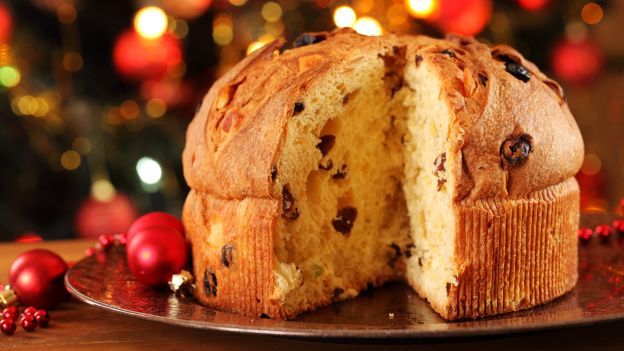
Il panettone (in dialetto: paneton) è sicuramente il piatto milanese più conosciuto in Italia e nel mondo, mangiato da ogni famiglia per celebrare il Natale. E' un dolce dalla tipica forma cilindrica che termina con una cupola, composto da farina, burro, acqua e tuorlo d’uovo, a cui vengono aggiunti, uvetta, frutta candita, scorza d’arancia e di cedro per dargli maggior sapore. Nonostante le varianti ad oggi siano numerosissime, la ricetta classica ha ricevuto il riconoscimento P.A.T, che ne regolamenta le quantità e gli ingredienti.
La diffusione moderna del panettone inizia nel 1919 quando la Angelo Motta inizia una produzione “di massa” destinata al grande pubblico e non soltanto alle famiglie più agiate, subito seguita da Gioacchino Alemagna nel 1925. Motta utilizzò una rudimentale strategia di marketing, mettendo i panettoni appena cotti a raffreddare a testa in giù sul soffitto del negozio, attirando quindi l’attenzione dei clienti e dei passanti.
Con l’industrializzazione e il boom economico negli anni ’50, il panettone si diffuse in tutta Italia come dolce tipico natalizio, entrando anche nella tradizione di quelle zone del mondo con un’alta percentuale di immigrati italiani (Sud America, costa est degli Stati Uniti, Corno d’Africa).
A Milano, tuttavia, il panettone esiste da secoli: la sua origine leggendaria risale addirittura al periodo di Ludovico il Moro, verso la fine del XV secolo. Secondo la leggenda il cuoco che aveva ricevuto l’ordine di cucinare il banchetto natalizio per il duca di Milano, si dimenticò il dolce in forno, lasciandolo bruciare. Non avendo più il tempo di prepararne un altro, decise di servire quello che il suo aiutante, Toni, aveva cucinato per sé stesso usando alcuni avanzi trovati in cucina. Il dolce piacque moltissimo al duca e ai suoi ospiti e il cuoco, per dare il giusto merito al suo aiutante, decise di chiamarlo pan del Toni, da cui oggi deriva la parole panettone.
ENGLISH
Panettone (dialect: paneton) is the most known Milanese dish in Italy and in the world, eaten by every family to celebrate Christmas. It’s a typical sweet bread loaf, with a characteristic cylindrical shape with a cupola on top, made with flour, butter, water and egg yolks; it contains raisins, orange and cedar zests and candied fruits. Although the variations are very numerous, the classic recipe has received the P.A.T recognition, which regulates the quantities and ingredients.
The modern diffusion of panettone began in 1919 when Angelo Motta started a "mass" production for the people and not only for the richest families, immediately followed by Gioacchino Alemagna in 1925. Motta used a rudimentary marketing strategy, storing the just baked panettone’s to cool upside down on the ceiling of his store, thus attracting the attention of customers and passers-by.
With the industrialization and the economic boom in the 50s, the panettone spread throughout Italy as a typical Christmas dessert, also entering in the tradition of those areas of the world with a high percentage of Italian immigrants (South America, East Coast of the USA, Horn of Africa).
In Milan, however, the panettone has existed for centuries: its legendary origin dates back to the period of Ludovico il Moro, close to the end of the XV century. According to the legend, the cook who was ordered to cook the Christmas banquet for the Duke of Milan, forgot the dessert in the oven and thus let it burn. Having no time to prepare another, he decided to serve what his assistant, Toni, had cooked for himself using some leftovers found in the kitchen. The dessert was very much appreciated by the Duke and his guests and the cook, to give the right merit to his assistant, decided to call the newly invented sweet bread pan del Toni (Toni’s bread), from which derives the words panettone still used today.