Swan Lake is located in the City of Shoalhaven on the New South Wales south coast. It is a large brackish coastal lake that is intermittently connected to the sea. It has a surface area of about 4.5 to 5 square kilometres and consists of a broad, shallow basin and a narrow, sinuous inlet about a kilometre long that occasionally opens to the sea. Most of the land surrounding Swan Lake is bushland, reserved as National Park.

Geologic History of Swan Lake
Swan Lake lies within the southern part of the Sydney Basin, a large sedimentary basin formed around 270 to 250 million years ago. The dominant geological unit is sandstone. The underlying geology of the areas is mainly composed of the Permian Conjola formation, a series of sandstone and shale units. This is overlain by large areas of Wandrawandian Siltstone around Swan Lake.
In addition to the old rocks described above, the area has a complex array of surface deposits formed during the past six thousand years. Many of these features are still actively changing. The Cudmirrah dunes form the Swan Lake sand barrier and are of high scientific value. They are the best-developed and highest dune system on the South Coast. Further unconsolidated sediments occur along the creek systems. These comprise alluvial, lagoonal and estuarine clays, silts and sands.
Geological Significance of Swan Lake
Swan Lake is typical of many intermittently opening south coast lakes and lagoons in that:
- It is usually closed to the sea by a sand bar.
- Lake openings tend to only last a few weeks or months.
- Sand is deposited in the entrance area by wave and long shore drift action
Swan Lake is unusual when compared to intermittently opening south coast lakes and lagoons in that:
- The lake is large compared to its relatively small catchment. This means there are insufficient freshwater flows to maintain an open entrance.
- The entrance is opened more often by natural rainfall events than artificially by council using mechanical equipment.
- It has a long shallow meandering channel, which normally passes over a reef when first open to the ocean.
Geological Process at Swan Lake
The condition of the lake’s entrance is controlled by tides, waves, currents, sediment movement, creek flows, floods and human intervention. The interaction and ever changing nature of these factors may cause the entrance to migrate along the coastline, to close up, re-open, etc.
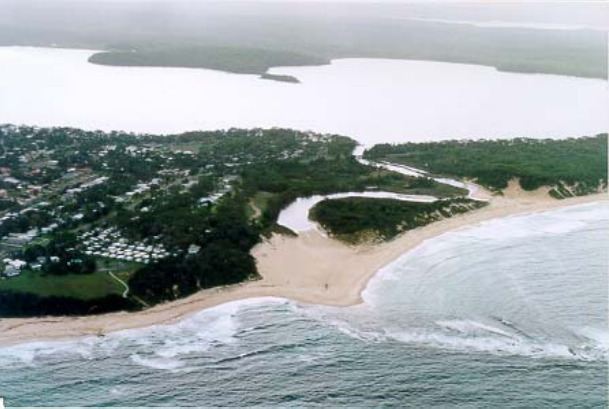
When the lake entrance is closed, the water level may fall due to evaporation, remain stable (either high or low) during periods of balanced evaporation and rainfall, or rise in response to runoff from heavy rainfall in the catchment. Under natural circumstances, if the lake level rises above the height of the sand berm on Cudmirrah Beach, then a break out occurs and the water level drops suddenly (ie, over a few hours) as the lake water drains to the sea. There is then some tidal exchange until the sand builds up at the entrance and the lake is closed again.
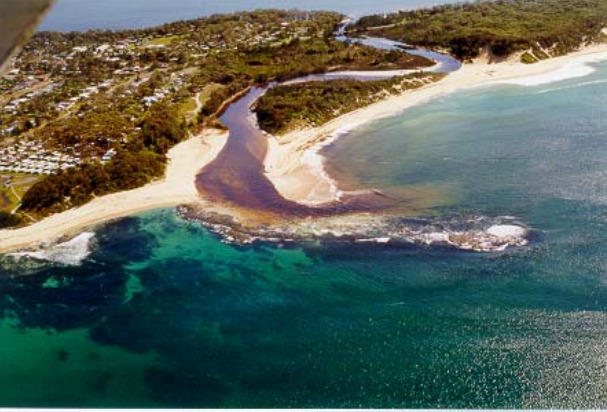
When the lake is open to the sea, tidal inflows are insufficient to penetrate far into the estuary. The discharge is slow and gradual due to the long, narrow and shallow entrance channel. This leaves Swan Lake mostly brackish and never totally flushed by seawater. As a result, this can sometimes produce an unpleasant smell.
To claim this Earthcache:
Visit the Posted Coordinates to answer these questions:
- How many years ago did the sea level rise (to where it is today)?
- What are the main sedimentary deposits that get washed into Swan Lake?
Head to the general area of Waypoint 2 to make some observations:
- At the time of your visit, was Swan Lake open or closed to the sea?
- What is the difference between the land on either side of the entrance?
(Optional) Include a photo of your visit.
Please send your answers to me via the geocaching website - e-mail or message. The answers to these questions should not be included in your log, nor should your log include spoiler photos. You do not need to wait for a reply from me to log your find.
References
NSW Government. (1992). Estuary Management Manual. New South Wales Government
Pollard, D. A. (1994a). Opening regimes and salinity characteristic intermittently open and permanently open coastal lagoons in the south coast Wetlands (Australia), 13(1), 16-35
Shoalhaven City Council (2002). Swan Lake & Berrara Creek: Natural resources management strategy. Retrieved from: http://doc.shoalhaven.nsw.gov.au/Displaydoc.aspx?Record=D11/115647
Shoalhaven City Council (2004). Estuary Management Planning: Swan Lake and Berrara Creek – 2004. Retrieved from https://www.shoalhaven.nsw.gov.au/soe/Region/Indicator%20Results%2004/Estuarymanag%20swanlakeandberraracreek%2004.htm#Natural%20Resource%20Management%20Plan
Shoalhaven City Council (2008). Swan Lake entrance management policy. Retrieved from http://doc.shoalhaven.nsw.gov.au/Displaydoc.aspx?Record=D11/115450