
**This cache is located within an area frequently patrolled by Police. Please avoid acting suspiciously whilst searching for it, and if challenged, explain about geocaching. It may be worth pointing out that it is not a physical box you are looking for, but are simply studying the rocks visible to everyone.**
The learning point of this earthcache is to get the geocacher to become familiar with the Sedimentary rock Conglomerate.
Sedimentary Rocks
Sedimentary rocks are rocks composed of sediment, and are the rocks formed by processes acting on the earth's surface.
Lithification is the “fancy” term for the sedimentary rock-forming process.

Sediment refers to particles and grains of weathered rock or mineral remains. The particles and grains comes in many shapes, sizes and a wide range of compositions. All the sediment types have one thing in common, they were deposited by one or more of Earth's surface geological processes, such as wind, rivers, waves, and glaciers.
The difference between a loose pile of sediment and a sedimentary rock is whether or not the sediment grains are stuck together. The two main ways for sediment to become lithified are by compaction, where the layers' weight squeezes them together into rock, and cementation, where minerals form around the layers and bind them together.
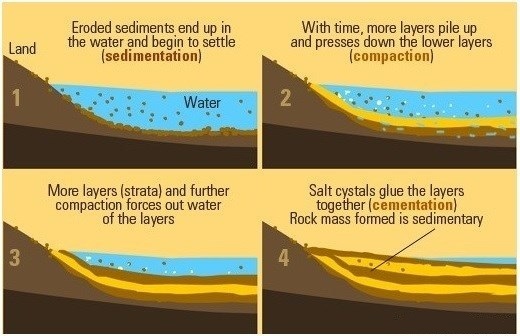
A characteristics property of all sedimentary rocks is that they form in beds, or layers, which are the result of how the sediment was deposited over time. They may also be found in approx horizontal layers, but this only when or if the mountain building or movement has tilted it.
The sedimentary rock can be separated in three different types:
Clastic sedimentary rocks such as breccia, conglomerate, sandstone, siltstone, and shale are formed from mechanical weathering debris.
Chemical sedimentary rocks, such as rock salt, iron ore, chert, flint, some dolomites, and some limestones, form when dissolved materials precipitate from solution.
Organic sedimentary rocks such as coal, some dolomites, and some limestones, form from the accumulation of plant or animal debris.
Conglomerate
Conglomerate is a sedimentary rock formed by the lithification of rounded or sub-rounded gravel (grains larger than 2 mm in diameter) and is strongly related to sandstone. It is actually a type of sandstone, although it may not be technically correct to say so. Conglomerate is composed of clasts larger than 2 mm. (sand is composed of grains smaller than 2 mm).
Conglomerates are differentiated from sedimentary breccias which are composed of angular clasts. Sometimes it may be difficult to say whether the grains are angular or rounded enough, but breccia is composed of really angular, wedge-like clasts with a strong variation in size. Breccias often show clear signs of shattering which is a result of a sudden and energetic event. Conglomerates tend to be composed somewhat more evenly in sized clasts. Conglomerates may be clast-supported (meaning that the clasts are in contact) or matrix-supported (meaning that the clasts are separated from one another by fine-grained matrix that binds the clasts together).
Conglomerate are made in many different ways, and a deposit may be an ancient riverbed or a coastline. Conglomerates form at the base of mountain ranges or even as a glacial deposit. Tillite is a lithified till (poorly sorted glacial debris) which may be called a matrix-supported conglomerate if there are enough granules, pebbles, cobbles, and boulders present. At least 30% of the rock should be composed of clasts larger than 2 mm in diameter in order to call that rock a true conglomerate.
Matrix classification:
Conglomerates are rarely composed entirely of gravel-size clasts. Typically, the space between the gravel-size clasts is filled by a mixture composed of varying amounts of silt, sand, and clay, known as matrix.
If the individual gravel clasts in a conglomerate are separated from each other by an abundance of matrix such that they are not in contact with each other and float within the matrix, it is called a paraconglomerate.
If the gravel clasts of a conglomerate are in contact with each other, it is called a orthoconglomerate.
The differences between paraconglomerates and orthoconglomerates reflect differences in how they are deposited. Paraconglomerates are commonly either glacial tills or debris flow deposits. Orthoconglomerates are tyipically associated with aqueous currents of some sort.
Classification of clast composition:
1.) Monomict, monomictic: the conglomerate consists of one single type of rocks, minerals, or combination of both.
2.) Oligomict, or oligomictic: the conglomerate consists of two types of rocks, minerals, or combination of both.
3.) Polymict or polymictic: the conglomerate consists of three or more different types of rocks, minerals, or combination of both.
Classification of clast size:
1.) Granule - conglomerate size clasts 2-4mm
2.) Pebble - conglomerate size clasts 4-64mm
3.) Cobble - conglomerate size clasts 64-256mm
4.) Boulder – conglomerate size clasts >256 mm
Conglomerates are deposited in a variety of sedimentary environments:
Deepwater marine
Conglomerates can be devoted to deepwater marine in connection with mass streams. The basal part of a bed is typically coarse-grained and sometimes conglomeratic, normally very well sorted, well-rounded
Shallow marine
Marine transgressive conglomerates are typically thin and represent a significant change in the environment.
Fluvial
Conglomerates deposited in rivers and delta. Branched river rains will have a variation in flow rate that could provide this type of deposits. Conglomerates deposited in fluvial environments are typically well rounded and well sorted.
Alluvial
Alluvial deposits form in areas of high relief and are typically coarse-grained. Conglomerates deposited in as alluvial fans and alluvial plains.
Glacial
Glaciers carry a lot of coarse-grained material and many glacial deposits are conglomeratic. Tillites, the sediments deposited directly by a glacier, are typically poorly sorted, matrix-supported conglomerates. The matrix is generally fine-grained, consisting of finely milled rock fragments.
To log this cache.
To get to log this cache you will have to visit and answer the questions which are related to the coordinates given the earthcache.
When answers are collected, send them to CO for verification.
You can log immediately after answers are sent CO. If there are any questions about your answers CO will contact you.
Logs without answers to CO or with pending questions from CO will be deleted without any further notice.
Please do not include pictures in your log that may answer the questions.
Questions:
1. Answer the questions under by visiting the Coordinates.
A. Study the stone at gz, what classification of clast composition do we have in the stone?
B. What average size is the typical conglomerate/clast size?
C. Observe the shape of the conglomerates that you see at the location, from what type of environment are the conglomerates from? (Deepwater marine / Fluvial, or Shallow marine). Describe!
D. What colors are the conglomerate stones representing?
2. (It’s voluntary to post a photo in your online log of your visit)
