Type of EarthCache : Fault Formation
Amateur geologists will be fascinated by the Airport Road Outcrop along the road between Miri and the airport across the road from Taman Awam Miri. This natural outcrop has many layers, and provide geological enthusiasts with an idea of how the land surrounding Miri was formed, as it was pushed out from the seabed some 10-15 million years ago. It is not an outcrop per se, but rather a cliff side formed from cutting for road construction. It exposes the strata or layer of the terrain.
GEOLOGICAL BACKGROUND
The Miri Formation is predominantly arenaceous. The arenaceous rocks (arenites) include all those clastic sedimentary rocks whose particle sizes range from 2 to 0.06 mm, or if silt is included, to 0.004 mm. Some arenites are composed primarily of carbonate particles, in which case they are called calcarenites and grouped with the limestones. In Miri Field according to a research paper, this formation was divided into Lower and Upper Miri formation. The Lower Miri consists of a succession of sandstones and shales which are separated in major, well define bodies of similar size, the shales slightly prevailing. Meanwhile, the Upper Miri is more arenaceous; the alternation of sandstone and shales take place more rapidly and is less regular; the sandstone bodies merge more gradually into argillaceous sandstone and sandy or silty shale.
What are Faults?
Faults are fractures in Earth's crust where rocks on either side of the crack have slid past each other. Faults are cracks in the lithosphere caused by the stresses created as sections of a plate (or two plates) are moving in different directions. In this case, the earthquake event is called a slip.
Three types of faults
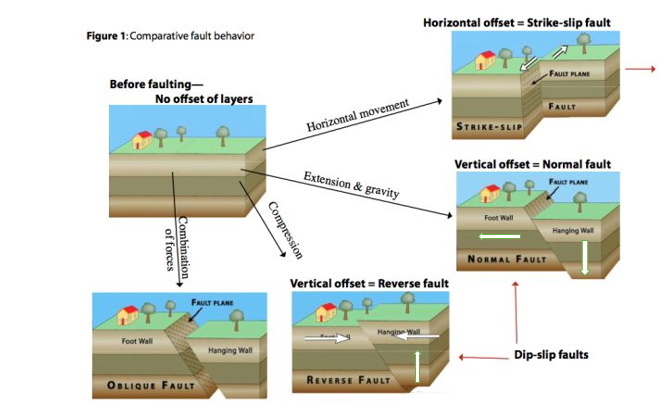
There are three kinds of faults : strike-slip, normal and thrust (reverse) faults, said Nicholas Van Der Elst, a seismologist at Columbia University's Lamont-Doherty Earth Observatory in Palisades, New York. Each type is the outcome of different forces pushing or pulling on the crust, causing rocks to slide up, slide down or slide past each other.
Fault
Strike-slip fault
A strike slip fault occurs in an area where rocks are sliding past each other horizontally. In relation to the ground surface the slip involves sideway movement. Strike-slip faults are found in California, the San Andreas fault being the most famous which has caused many powerful earthquakes. Crustal blocks may also move sideways past each other, usually along nearly-vertical faults. This strike-slip movement is described as sinistral when the far side moves to the left, and dextral, when the far side moves to the right. An oblique slip involves various combinations of these basic movements.
Strike-slip faults are usually vertical, while normal and reverse faults are often at an angle to the surface of the Earth. The different styles of faulting can also combine in a single event, with one fault moving in both a vertical and strike-slip motion during an earthquake.
Normal faults
Normal fault cracks where one mass of rock slides downward and pulls away from another mass of rock creating space. As these plates are slowly splitting apart and pulling away from each other, the normal faults are formed in this way. Normal faults are associated with downward movement on a sloping fault as the two plates move apart. The stretching of the Earth's crust is indicative of this type of event. Deep sea ridges in the Atlantic and Pacific are where the largest normal faults are formed along these ridges. Thrust faults are caused by plates pulling apart and colliding with continental plates. Where the crust is being pulled apart, normal faulting occurs, in which the overlying (hanging-wall) block moves down with respect to the lower (foot wall) block.
Reverse or Thrust faults
A Reverse or thrust fault happens when plates are being pushed together. This involves upward movement as the two plates collide and buckle upwards. This kind of event signifies a compression of the Earth's crust. Where the crust is being compressed, reverse faulting occurs, in which the hanging-wall block moves up and over the footwall block – reverse slip on a gently inclined plane is referred to as thrust faulting.
All faults are related to the movement of Earth's tectonic plates. The biggest faults mark the boundary between two plates. Seen from above, these appear as broad zones of deformation, with many faults braided together. "Plate boundaries are always growing and changing, so these faults develop kinks and bends as they slide past each other, which generates more faults," according to Van Der Elst.
Individual fault lines are usually narrower than their length or depth. Most earthquakes strike less than 50 miles (80 kilometers) below the Earth’s surface. The deepest earthquakes occur on reverse faults at about 375 miles (600 km) below the surface. Below these depths, rocks are probably too warm for faults to generate enough friction to create earthquakes.
Logging Tasks
Send the answers to the following questions via my profile with the Following header : “GC 8080N : Faulty Miri”. I will get back to you if there are problems with your answers.
1. What Type of Fault do you see here? Explain your answer.
2. Is the rock Igneous, Sedimentary or metamorphic ? Explain
3. How many faults with a throw of 10cm or more were mapped by Wouter Van De Zee and what year did he mapped them?
4. Name the 6 (six) deformation features associated with these fault that can be observed at the rock face?
5. Finally, to prove that you have been here, please stand facing the Outcrop. Is the Info signboard to the left or to the right of the Outbrop?
6. As with all earthcaches, a photo from the site is appreciated.

Join us at Geocaching Malaysia
Reference :
1. https://www.usgs.gov/faqs/what-a-fault-and-what-are-different-types
2. https://www.sms-tsunami-warning.com/pages/fault-lines#.Xqb3P2gzbIU
3. https://www.gns.cri.nz/Home/Learning/Science-Topics/Earthquakes/Earthquakes-and-Faults/Different-types-of-Faults