Gabbro
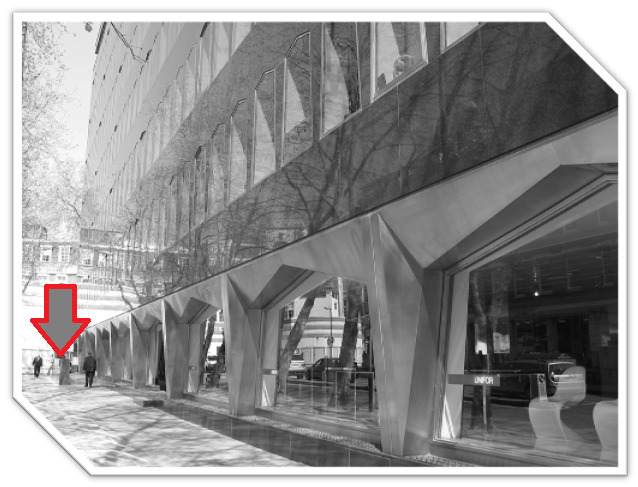
**This cache is located within an area frequently patrolled by Police. Please avoid acting suspiciously whilst searching for it, and if challenged, explain about geocaching. It may be worth pointing out that it is not a physical box you are looking for, but are simply studying the rocks visible to everyone.**
The learning point of this earthcache is to get the geocacher to become familiar with the Igneous rock Gabbro.
Igneous Rocks
Let`s do a little bit of review before we look into the igneous rocks. There are so many different types of rocks to be found around the world. And they all belong to one of the three types: Igneous, Sedimentary or Metamorphic rocks. The igneous rocks are formed from volcanic activity. This means they are either created from cooled magma or cooled lava. The difference between magma and lava is its location - interior versus exterior. (See illustration)
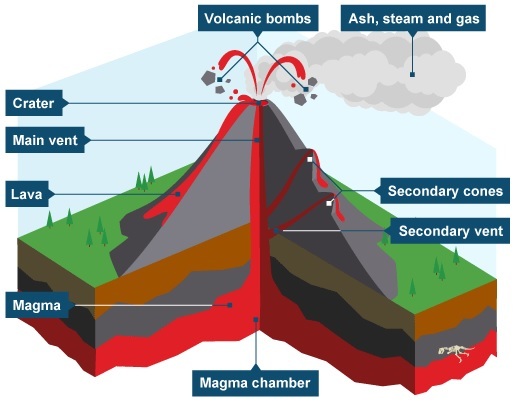
Magma is the molten rock found inside the crust of the earth. Pockets of magma come up from the mantle/main vent and push their way through weak spots and vents in the earth's crust, often under volcanoes. When magma is pushed up through a volcano that's erupting, the magma becomes lava as it exits out of the crater.
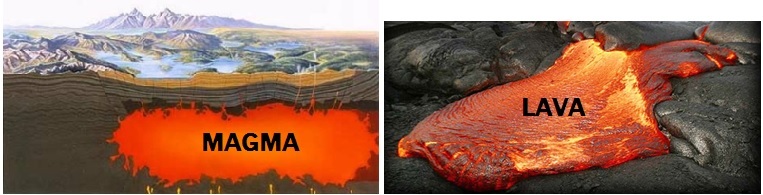
The distinction is important since there is a main difference between if the rock cools from lava or from magma, even that both are volcanic. The formation and difference we are talking about here is important because the rocks that come from magma become intrusive igneous rocks, and the rocks that come from lava become extrusive igneous rocks. The difference is due to how fast the material cools.
The cooling rates/process.
Since magma is located inside the earth, the overlying rock and sediment act as a blanket that keeps the magma warm and allows it to cool slowly. Lava, however, exits the volcano and cools much faster.
An easy way to see and understand this better is to explain the cooling rates by using baking as an example. After baking bread, you turn off the oven and allow the bread to cool before slicing. If you leave the bread inside the oven to cool, it does so very slowly. If you take the bread out of the oven and sit it on the counter to cool, it does so more quickly.

In rocks, the rate of cooling allows mineral crystals to grow, which make up the igneous rocks, to grow. The longer time the rock is allowed to cool, the bigger mineral crystals we get.
Because the magma cools slowly, the ions have time to move around and form mineral crystals. As a result, when you have rocks that cooled from magma, you can easily see the different mineral crystals in the rock. These rocks are intrusive igneous rocks because they cooled slowly 'inside' the earth. These type of rocks are defined as Phaneritic because of their crystal texture.
Because lava cools more quickly, there is not enough time for mineral crystals to form and grow, so you have rocks with very tiny mineral crystals that cannot be seen without the aid of a magnifier. These rocks are considered extrusive igneous rocks because they cooled quickly 'outside' the Earth. These type of rocks are defined as Aphanitic because of their crystal texture.
Gabbro
Gabbro is coarse-grained and usually dark-colored, from black to a dark green igneous rock. It is an intrusive rock that means that it has formed as magma, and cooled slowly in the crust. Igneous rocks with similar composition are basalt (extrusive equivalent of gabbro) and diabase (the same rock type could be named dolerite or microgabbro).
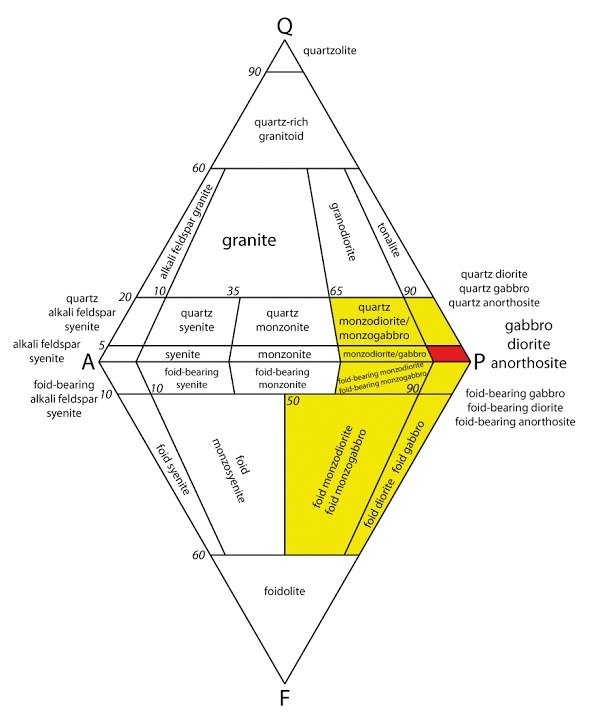
Gabbro (marked red) on the QAPF diagram. The diagram is used to name most of the plutonic igneous rocks. Gabbro in the wider sense (marked yellow) includes adjacent fields as named above in the diagram.
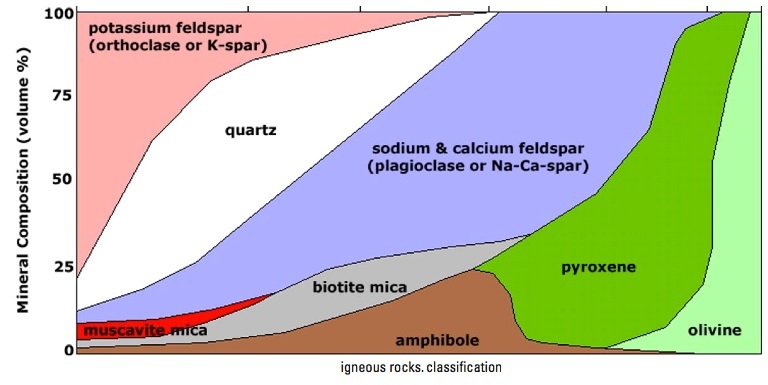
The most important mineral groups that make up this rock type are plagioclase and pyroxene. The mineral group Plagioclase usually predominates over the pyroxene group. Plagioclase is sodium-calcium feldspar. And it contains more calcium than sodium in gabbro. But if there is more sodium in the plagioclase, then the rock type is named diorite. Diorite is usually lighter in color and contains more amphiboles than pyroxenes. Minor amounts of olivine and orthopyroxene might also be present in the rock. This mineral composition usually gives gabbro a black to very dark green color. A minor amount of light-colored mineral crystals may also be present. Unlike many other igneous rocks, gabbro usually contains very little quartz.

Gabbros are equivalent in composition to basalts. The difference between the two rock types is their crystal size. Basalts are extrusive igneous rocks that cool quickly and have fine-grained crystals. Gabbros are intrusive igneous rocks that cool slowly and have coarse-grained crystals.
Gabbro in Oceanic Crust
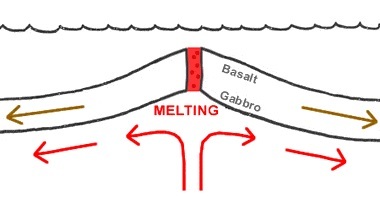
It is often stated that Earth's oceanic crust is made up of basalt. The word "basalt" is used because the rocks of the oceanic crust have a "basaltic" composition. However, only a thin surface veneer of oceanic crust is basalt. Gabbro forms at depth from slow crystallization. The deeper rocks of the oceanic crust are generally coarser-grained gabbro. Basalt occurs at the surface of the crust because the rocks there have cooled quickly. At greater depth the cooling rate is slower, and large crystals have time to develop.
Gabbro in Continental Crust
On the continents, gabbro can be found within thick lava flows of basaltic composition, where slow cooling allows large crystals to form. Gabbro will also be present in the deep plutons that form when magma chambers that feed basaltic eruptions crystallize.
Gabbros form in the crust. This is the magma that did not break to the surface to cool as a basalt. These rocks are not as widespread as granitoids, but they are definitely not rare. Gabbroic rocks are usually equigranular (composed of similarly sized crystals) mixtures of black, brown or greenish pyroxene and white, gray, or greenish plagioclase. Pyroxenite and other ultramafic rocks are darker- and diorite is lighter-colored.
To log this cache.
To get to log this cache you will have to visit and answer the questions which are related to the coordinates given the earthcache.
When answers are collected, send them to CO for verification.
You can log immediately after answers are sent CO. If there are any questions about your answers CO will contact you.
Logs without answers to CO or with pending questions from CO will be deleted without any further notice.
Please do not include pictures in your log that may answer the questions.
Questions:
1. Answer the questions under by visiting the Coordinates.
A. A-1) Go to the coordinates and study the Gabbro closely. What mineral is the one with very low quantity found? A: Olivine, B: Quartz, C: Plagioclase, D: Pyroxene, A-2) Are the crystals phaneritic or aphanitic?
B. What set of colors do the stone contain? And what is the dominating color, and describe the minerals that is found? (The igneous diagram might help for the mineral part?)
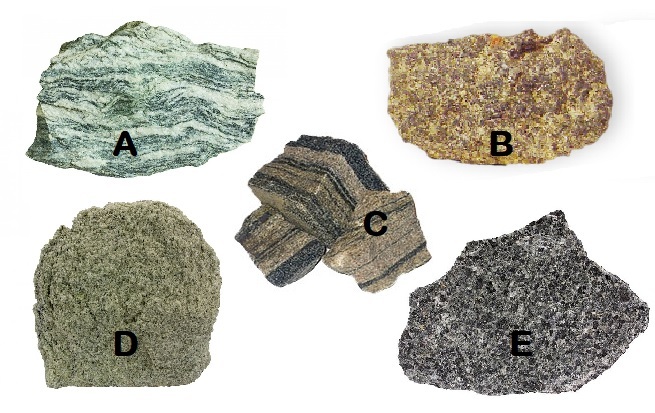
C. Which of the given options: A, B, C, D or E from the photo below is similar to the Gabbro that we find here at ground zero?
2. (It’s voluntary to post a photo in your online log of your visit)
