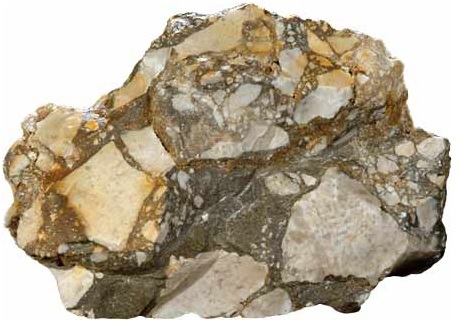
**This cache is located within an area frequently patrolled by Police. Please avoid acting suspiciously whilst searching for it, and if challenged, explain about geocaching. It may be worth pointing out that it is not a physical box you are looking for, but are simply studying the rocks visible to everyone.**
The learning point of this earthcache is to get the geocacher to become familiar with the Sedimentary rock Breccia.
Sedimentary Rocks
Sedimentary rocks are rocks composed of sediment, and are the rocks formed by processes acting on the earth's surface.
Lithification is the “fancy” term for the sedimentary rock-forming process.

Sediment refers to particles and grains of weathered rock or mineral remains. The particles and grains comes in many shapes, sizes and a wide range of compositions. All the sediment types have one thing in common, they were deposited by one or more of Earth's surface geological processes, such as wind, rivers, waves, and glaciers.
The difference between a loose pile of sediment and a sedimentary rock is whether or not the sediment grains are stuck together. The two main ways for sediment to become lithified are by compaction, where the layers' weight squeezes them together into rock, and cementation, where minerals form around the layers and bind them together.
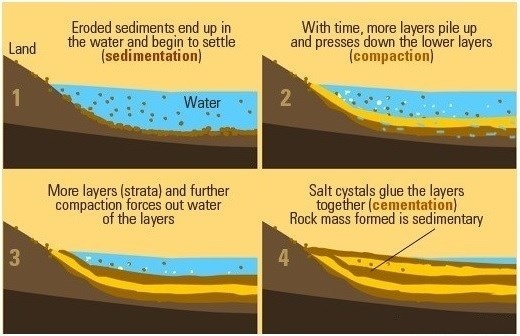
A characteristics property of all sedimentary rocks is that they form in beds, or layers, which are the result of how the sediment was deposited over time. They may also be found in approx horizontal layers, but this only when or if the mountain building or movement has tilted it.
The sedimentary rock can be separated in three different types:
Clastic sedimentary rocks such as breccia, conglomerate, sandstone, siltstone, and shale are formed from mechanical weathering debris.
Chemical sedimentary rocks, such as rock salt, iron ore, chert, flint, some dolomites, and some limestones, form when dissolved materials precipitate from solution.
Organic sedimentary rocks such as coal, some dolomites, and some limestones, form from the accumulation of plant or animal debris.
Breccia
Breccia is a rock formed from angular gravel and boulder-sized clasts cemented together in a matrix. The angular nature of the clasts indicates that they have not been transported very far from their source. There are several modes of formation for breccia. Some represent consolidated material accumulated on steep hill slopes or at the foot of cliffs. Cataclastic breccias are produced by the fragmentation of rocks during faulting. Volcanic breccias (agglomerates) comprise blocks of lava in an ash matrix and are the product of an explosive eruption. Hydrothermal breccias are formed when hydrothermal fluid fractures a rock mass. Impact breccias are formed when a meteor impacts the Earth's surface, fracturing rock at the site of the impact. The cement that binds the clasts in a breccia is generally one of either calcite, silica or iron oxide. The matrix can consist solely of the cementing material, but may also contain sand and / or silt sized clasts cemented together among the coarser clasts.
Breccia can be further divided according to:
Class - breccia can be divided into two broad classes:
Clast supported - where the clasts touch each other and the matrix fills the voids; and
Matrix supported - where the clasts are not in contact and the matrix surrounds each clast;
Clast size - fine (2 - 6mm), medium (6 - 20mm), coarse (20 - 60mm), very coarse (> 60mm);
Sorting - a breccia comprising a mixture of clast sizes is poorly sorted, while one comprising mostly clasts of the same size is well sorted;
Lithology - a breccia where the clasts represent more than one rock type is termed polymictic (or petromictic), while one where the clasts are of a single rock type are monomictic (or oligomictic).
Texture - clastic (coarse-grained).
Grain size - > 2mm; clasts easily visible to the naked eye, should be identifiable.
Hardness - variable, soft to hard, dependent on clast composition and strength of cement.
Color - variable, dependent on clast and matrix composition.
Clasts - variable, but generally harder rock types and / or minerals dominate.
Other features - rough to touch due to angular clasts.
To log this cache.
To get to log this cache you will have to visit and answer the questions which are related to the coordinates given the earthcache.
When answers are collected, send them to CO for verification.
You can log immediately after answers are sent CO. If there are any questions about your answers CO will contact you.
Logs without answers to CO or with pending questions from CO will be deleted without any further notice.
Please do not include pictures in your log that may answer the questions.
Questions:
1. Answer the questions under by visiting the Coordinates.
A. Study the stone at gz, what Lithology of clast composition do we have in the stone?
B. What average size is the typical Breccia/clast size?
C. Study the the Breccia, are the mixture well sorted or poorly sorted?
D. What colors are the Breccia stones representing?
2. (It’s voluntary to post a photo in your online log of your visit)
