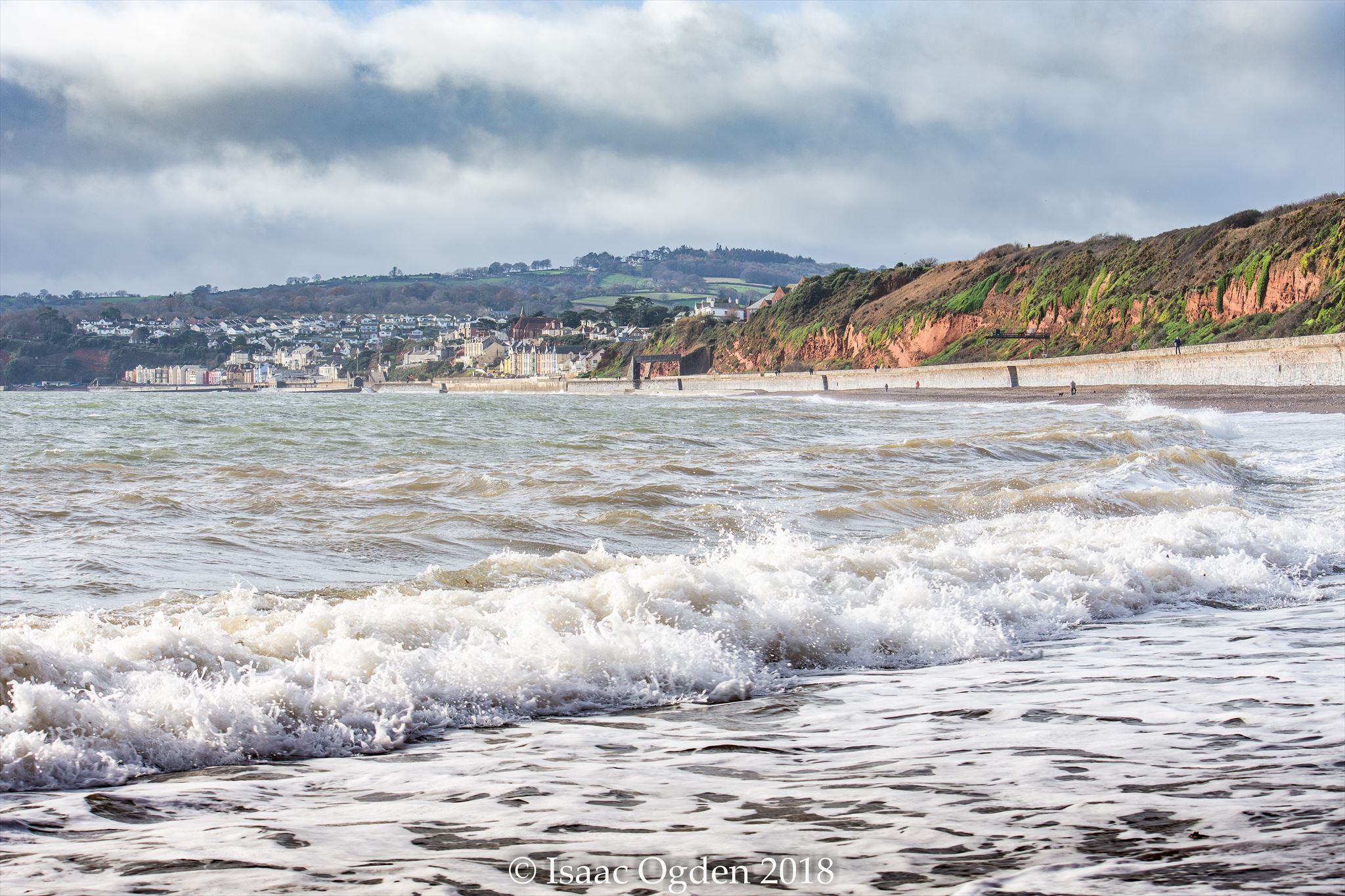
This is an EARTHCACHE, which means there are no physical containers to find. Instead answer the logging tasks detailed below...
This Earthcache will take you to a Very Interesting Geological Place - Langstone Rock, at the northern end of Dawlish beach. It's not necessarily the most straightforward Earthcache in the world, but I hope that (if you choose to do it) it will show you an interesting place, and show you how some of our coastal landforms are created.
You will need a TORCH, and a knowledge of when LOW TIDE is
Firstly, go to the sea cave at the published coordinates
1. Measure the length of the sea cave (if it's less than about 10 metres you're in the wrong one!). Please also measure the height and width of the cave at the entrance and back. Does it get larger or narrower? Why?
2. Next, look at the walls of the cave. Describe the texture of the walls at the entrance, and compare it to the texture at the back.
3. Also, describe the change in size of sediment as you move from the entrance to the back. Is there a reason for this?
4. What is there at the very back of the cave? What is the purpose of it?
Now head to the adjacent arch:
5. In the arch, you will see a wooden board. What is the purpose of this?
Finally...
6. Given time, do you think it is likely that the sea cave will develop into an arch like the one adjacent? Why?
Photos of your visit are welcome but please do not give away the answers.
To log this cache as a find, please send your answers to me (do not put them in your log) through email or the Message Center. There is no need to wait for a reply before logging a find, if there's a problem I'll let you know. If I have not received any answers from you within 24 hours of logging a find, your log is at risk of being deleted...
The rock here is specifically the Dawlish Breccia formation, with reddish brown sands and sandstones cross-bedded, with beds of breccia and mudstone. Breccia is a sedimentary rock made up of angular particles over two millimeters in diameter, with the spaces between the particles filled with smaller particles and mineral cement.
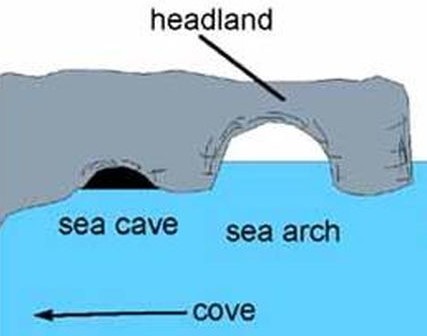
At Langstone Rock, there are several interesting landforms created by erosion.
Firstly, the caves. Erosion is ongoing anywhere that waves batter rocky coasts, but where sea cliffs contain zones of weakness, rock is removed at a greater rate. The hydraulic power of waves begins to widen and deepen small fissures due to the force exerted within a confined space. Adding to the hydraulic power of the waves is the abrasive force of suspended sand and rock. Most sea-cave walls are irregular and chunky, reflecting an erosional process where the rock is fractured piece by piece. However, some caves (typically floored with cobbles) have portions where the walls are rounded and smooth, typically floored with cobbles, and result from the swirling motion of these cobbles in the surf zone.
Secondly, at Langstone Rock you will see an arch. Over time, a cave will be eroded through the cliff into an arch, accessible to the sea on both sides. Weathering will also play a role, with physical weathering processes such as freeze thaw and salt crystallisation and chemical processes such as carbonation weakening the rock and creating cracks in teh rocks surrounding the cave or arch making it more susceptible to mass movement and collapse.
The ability of waves to cause erosion of the cliff face depends on many factors. One of these is beaches, which dissipate wave energy on the foreshore and provide a measure of protection to the adjoining land. There are many factors that determine what kind of beach occurs on any part of the coast. The shape of the coastline, the local geology and the prevailing weather conditions are all significant factors. The size of particles that make up a beach are often a reflection of the energy of the waves that hit the shore. In low-energy environments, such as shallow bays or estuaries, we often see very fine particles such as silt or mud deposited. Higher-energy beaches are often characterised by larger particles, such as pebbles or even boulders.
IMPORTANT NOTES
This Earthcache has been placed with kind permission from Natural England. Please note you undertake this cache at your own risk.

There are a few hazards to be aware of here. As always you are fully responsible for your own safety when doing this cache. As far as I am aware, the arch and cave can only be accessed at low tides. Please also be aware of falling rocks, and take a torch. Inside the cave, the terrain is not difficult - even I did it!! No need for crawling or suchlike.