Introduction
If you've ever taken a walk along the intertidal zone of a sandy beach while the tide is out, chances are that you've seen and likely felt underfoot numerous ripples in the wet sand. Those ripples were formed by the moving water and their shape tells you about the back-and-forth movement of the water currents in that environment at that time. The ripples are a visible current indicator.
The shapes of rocks, and features in them, formed from sediments deposited by moving water often provide a lasting record of how that water moved in that ancient depositional environment.
Paleocurrent indicators provide information about the ancient currents that shaped the sediments that the rocks are made of.
At the cache location you'll find some very nice, large scale paleocurrent indicators called flute casts in the exposed rock face. These particular indicators differ from the ripples you might find on the beach - but they are just as effective at indicating the direction of the water current which produced them long ago, in this case over 400 million years ago during the Silurian Period.
Logging Tasks
IN ORDER TO COMPLETE THESE LOGGING TASKS PLEASE SEND US YOUR ANSWERS USING THE Message this owner LINK AT THE TOP OF THIS PAGE OR USING THE MESSAGE CENTRE OR EMAIL VIA OUR GEOCACHING PROFILE BEFORE SUBMITTING YOUR LOG. PLEASE DO NOT INCLUDE ANSWERS OR SPOILERS IN YOUR ONLINE LOG. YOU CAN GO AHEAD AND LOG YOUR FIND AS SOON AS YOU HAVE SENT YOUR ANSWERS IN ACCORDANCE WITH GROUNDSPEAK GUIDELINES. LOGS WITHOUT ADEQUATE LOGGING TASK EVIDENCE MAY SUBSEQUENTLY BE DELETED.
Based on your on-site study of the exposed flute casts and using the information on the cache page please tell me:
- Most of the flute casts here are roughly the same size. What's the average size?
- One of the flute casts has a large crack running straight through it. The rock on either side of the crack has moved in such a way that we can tell the crack is a reverse fault arising from crustal compression. Using a clinometer* measure the angle in degrees of the fault relative to the horizontal i.e. zero degrees is horizontal and ninety degrees is vertical.
*If you don't have a clinometer there are websites with guides on how to make one but I find that most people these days use a clinometer app on their smartphone.
- Relative to the the rock face as it is today, what was the direction of flow which resulted in these flute casts?
- Optional task: feel free to add any photographs of your visit that do not show the specific features from the logging tasks - no spoilers please. In the interests of allowing everyone to experience the EarthCache fully for themselves obvious spoiler photographs will be deleted.
Background
Clastic sedimentary rocks are composed of rock fragments that have been weathered from pre-existing rocks. Those loose rock fragments are also known as sediments.
Sediments are typically transported by some flowing medium - wind, ice or water before being deposited, compacted and cemented together once again into solid rock in a process called lithification. The action of that flowing medium on the loose sediments sometimes leaves lasting impressions on the resultant rocks, which provide insight into the nature of the paleocurrent - (literally ancient current) in effect at the time.
One piece of information that we can infer from a paleocurrent indicator is the direction of the flow relative to the rock face. Flute casts are a type of paleocurrent indicator that provide information about current direction.
What is a flute cast?
Imagine for a moment you're a forensic detective looking for clues as to the identity of a burglar.
You notice a distinctive footprint in soft mud on the ground close to a broken window and suspect the footprint was left behind by the burglar and you want to keep a lasting record of said footprint. You decide to treat the hollow print in the mud as a mould, and fill it with wet plaster of paris. A few hours later the plaster of paris has set hard and you pull out a perfect cast of the suspect's footprint which you can take away with you. A flute cast is a bit like that - except it's formed by natural rather than manual processes.
How is a flute cast formed?
First, a turbulent current of water scours out a tongue-shaped hollow in a bed of soft mud. This hollow is called a flute mark and is itself a form of paleocurrent indicator - a record of the flow direction of the current which formed it. The shallow end of the flute mark points downstream. The deeper end of the flute mark points upstream.
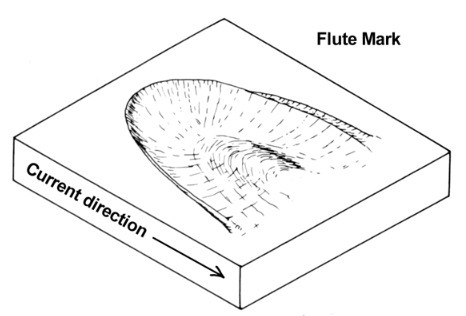
Flute marks are comparable to footprints in the mud. If there's an influx of coarser sediments from above the flute mark acts as a mould for those coarser sediments as they settle onto the mud bed. Once lithified into solid rock, those coarser sediments become a cast of that hollow flute mark.

Above is a photograph of an actual flute cast - taken by my own fair hand  . This one is a very fine example - not all flute casts are as impressive or clearly defined as this one and they do come in a variety of shapes and sizes (see other examples elsewhere on the cache page), but the same parameters apply in terms of indicating paleocurrent direction.
Notice the bulge facing toward the bottom-left corner of the image, reflecting the deeper part of the flute mark which acted as a mould for the loose sediments which became this cast. Notice also that the shallower end points toward the top-right of the image. Clearly the flow direction, relative to this photograph, was bottom-left to top-right.
How are flute casts exposed?
Millions of years ago, when these flute casts were formed - along with the flute marks that moulded them - they were hidden from view, sandwiched together on the sea bed. So how did they come to be exposed here where we see them today?
Simple answer - the land rose, or the sea fell, or both, the land changed shape and the flute casts survived the impacts of later weathering and erosion because they are made of a harder rock than were the flute marks in the underlying layer that acted as moulds.
The impact of quarrying by man here might also have had a part to play in exposing the flute casts by removing the layer of flute marks that hid them, but how did this previously horizontal, downward-facing bed of flute casts end up at the angle it is today? What would have been a fairly horizontal sedimentary bed when it was laid down is very far from being so today - so how did that happen?

The image above shows a bed of flute casts that have been tilted from their original horizontal orientation to near vertical. The direction of flow that formed them is from the top of the image toward the bottom. If we were to rotate that image 90° anti-clockwise though we would describe the direction of flow, relative to the image, to be from left to right.
When beds get tilted like this all we can be sure of is the direction of flow across the bed, relative to the position the bed is in now.
I believe geologists can infer the original compass direction of the flow by working out (or trying to) the original orientation of the bed but even if they can, that's well beyond the scope of this EarthCache .
There's still the question though of how the bed as we see it today came to be tilted so far from its original horizontal orientation? The answer lies in the science of plate tectonics and the Earth's crust being made up of a number of individual plates of rock which move around and bump into each other - incredibly slowly but with enormous force due to their incredible mass.
The individual plates which make up the crust sometimes get stretched (crustal extension) and sometimes get squeezed (crustal compression) - when two plates collide, for example. The stretching and squeezing causes layers of rock to fracture and fold which, in turn, causes individual parts to end up tilted away from their original orientation. In extreme cases layers can become completely overturned!
The Carboniferous is a geologic period and system that spans 60 million years from the end of the Devonian Period 358.9 million years ago, to the beginning of the Permian Period, 298.9 Mya. This EarthCache is in the midst of an area that, during the early Carboniferous, was subjected to crustal extension (stretching). Much later, in the late Carboniferous, this same area was subjected to crustal compression (squeezing). As a result of these processes acting on the bedrock around here it became substantially broken up by joints (cracks with no movement) and faults (cracks with movement).
In fact, I don't think I've visited an area before with so much smashed-up rock, so it's really quite fortunate that these flute casts survived to be seen today, millions of years after they were first formed.
If you've carefully read and digested the information from this cache page your tasks at the cache location should prove relatively straight forward, although you may wish to take a printed copy of the page with you so that you can check your answers while there .
Please submit your logging task responses before posting your log.