As the rural poor migrated to the growing towns in search of a better life, most places had their version of Dick Whittington and Durham was no exception.
Silver Street was once home of one of the wealthiest citizens of Durham called John Duck , whose house was demolished in 1963. His amazing story closely resembles that of Dick Whittington.
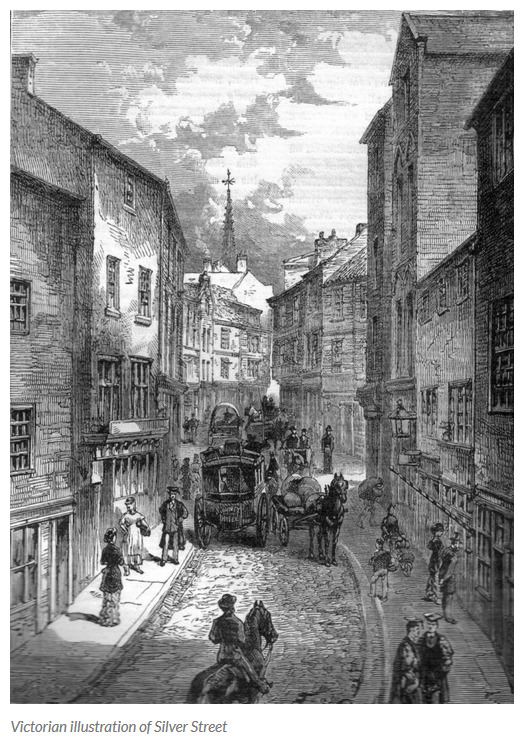
Duck’s early life remains a mystery but he is known to have arrived in Durham in 1655 with the intention of becoming a Butcher’s apprentice. He approached every butcher in Durham but was refused work because he had no details of his place of birth. The concern seemed to be that he may be a Scot, and the employment of such was forbidden by the Butcher’s guild.
When one butcher finally accepted to take Duck on, the Butcher’s Guild persuaded him to change his mind. Legend states that the dejected Mr Duck in a state of misery was wandering by the river side in Durham pondering over his failure to gain an apprenticeship when a passing raven dropped a coin of gold at his feet.
Surtees the Durham historian tells us that this coin was ‘to be the mother of a dozen more’ as with this gold coin John Duck went on to make his fortune, through how exactly is not altogether clear. Evidence suggests that Duck was not always law abiding in the way he accumulated his wealth.
He is known for example to have bought 2 cows from a livestock thief but we do not know enough to pass judgement on him as being corrupt. By whatever means he made his fortune Mr Duck went on to become one of the wealthiest men in Durham, owning both land and collieries in the area. In 1680 he became the Mayor of Durham and ultimately progressed to the rank of a baronet when he became Sir John Duck of Haswell on the Hill.
Upon Duck's death, his fortune passesd to his wife's niece, whose granddaughter married the Earl of Strathmore and their son married Mary Eleanor Bowes, whose descendants, the Bowes-Lyons, produce a daughter, Elizabeth, in 1900, our very own Queen Mum.
Duck is buried in St Margaret's Church -Prominent on the floor of the Nave is a large memorial ledger slab which marks the burial place.
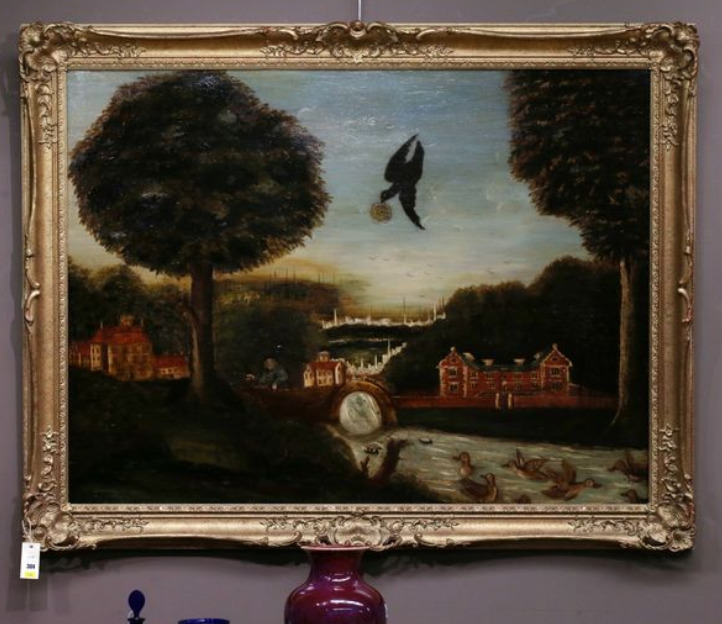
A painting depicting the story, which hung in Sir John’s mansion in Silver Street in Durham and which was missing for a century, was to be sold by Newcastle auctioneers. The oil painting on pine board is estimated at £2,500-£3,500.
When the Silver Street house was demolished in 1963 the painting was found concealed behind wood panelling over the fireplace. The painting dates from the 17th Century. It was an amazing find and is mentioned in Durham's history but had been lost for 100 years. The fascinating painting shows the raven with the coin and Sir John by the river, and also his mansion.
The Cache can be found at N 54° 46.ABC' W 1° 33.DEF'
ABC can be found at the listed coordinates , where
A = Number of letters in the tenth word on the plaque
B = Number of pins holding up the plaque
C = Number of flags on the plaque
DEF can be found from the information above, where
D = The painting dates from the 1Dth century
E = The Silver street house was demolished in 196E
F = Number of cattle Duck bought with the coin
Check Sum of all the individual numbers = 19
.