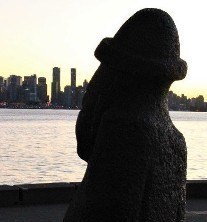
This earthcache is to show a good example of vesicular basalt.
The statue in front of you was a gift from the Port of Incheon Korea to the Port of Vancouver. This statue was quarried and carved on the island of Jeju, Korea, where similar statues serve as guardian and boundary markers on Jeju. This island is volcanic and is known locally for its long lava tubes.
This statue is quarried from vesicular basalt. Basalt is a very common volcanic rock that emanates from volcanoes. If it cools quickly, basalt can become vesicular. Due to the vesicules, the rock is softer and easier to carve than regular basalt.
Vesicules are fossil bubbles that show up as little holes or pock marks on the surface of the statue. So, a volcanic rock that looks like Swiss cheese has a vesicular texture. Vesicules range in shape from spherical to elongated.
The drop in pressure that a magma, which is molten rock, experiences as it flows from underground to the earth's surface allows water and gases in the lava to form bubbles. If the bubbles do not get large enough to pop, they are frozen in the lava as vesicules. If the bubbles get large and form more than 50% of the rock, the rock is commonly called scoria, especially if some bubbles pop.
Your task to log this earthcache is to examine this statue and tell me by email or messenger how big is the largest vesicle you see, and the colour of the rock.
Please send in your answer at the same time as logging. Answers that have not been submitted within a few days will have their log removed.