Granite
Granite is an igneous rock, meaning it is formed by the cooliing and solidification of magma and lava. Igneous rocks can then be further broken down into a few subcategories.
Intrusive vs Extrusive
Intrusive rocks are rocks that cool down and crystallises underground. This results in a slowler and steady cooling process, which causes the crystalline structures of the rock the be larger. These rocks are usually coarse grained, or in geological terms, these rocks are phaneritic.
Extrusive rocks are the opposite, magma flows out and cools above ground, causing the magma the cool and crystallise faster. This causes the crystals to be smaller and fine-grained. In other words, the rock is aphanetic.
Felsic vs Mafic
Felsic is a portmanteau of feldspar and silica, the 2 minerals that are predominant in igneous rocks of this type, with silica being found in the form of quartz. These rocks are generally lighter in colour.
Mafic on the other hand, is a combination of magnesium and ferric, ferric being the latin term for iron (Fe). These rocks are usually darker in colour.
Back to Granite
The walls you see here contain 3 minerals: the pink alkali feldspar, the clear/grey quartz and black biotite. These 3 minerals are the main composition of granite. Strictly speaking, granite has to be 20%-60% quartz and at least 35% feldspar.
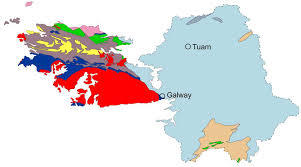
Geological map of County Galway, with the red marked areas showing where granite is found
(Source: Geoschol)
The granite here is mined from Galway. The Galway Granite is found in south Connemara from Galway City through to Roundstone. It is not one single rock type, but was formed by the intrusion of nine or so large granite masses (called batholiths or plutons) about 400 million years ago. It was formed underground and the molten igneous rock cooled slowly. The rocks that covered it have since been eroded away. Galway Granite tends to show mineral layering, showing streaks of biotite, feldspar or quartz.
Questions
Look at the wall and answer the following through my profile.
1) Is the rock intrusive or extrusive? Why
2) Is the rock felsic or mafic? Why
3) Observe the wall. What are the percentages of the minerals that make up this wall.
4) Observe the mineral layering, which of these stands out the most? Do they mostly layer vertically or horizontally? How long is the biggest layer?