The purpose of this Earthcache is to provide you with an opportunity to increase your knowledge about vernal pools and to develop a deeper appreciation and respect for the world we live in. The environmental lessons and related questions are brief, quick to answer and easy to remember for a lifetime! As with all Earthcaches, please be respectful of the land.
CONGRATS to SWOOP for being the FTF!
A. Welcome to Oak Openings MetroPark! Oak Openings MetroPark covers more thatn 4,000 acres; the largest MetroPark in Lucas County, Ohio.
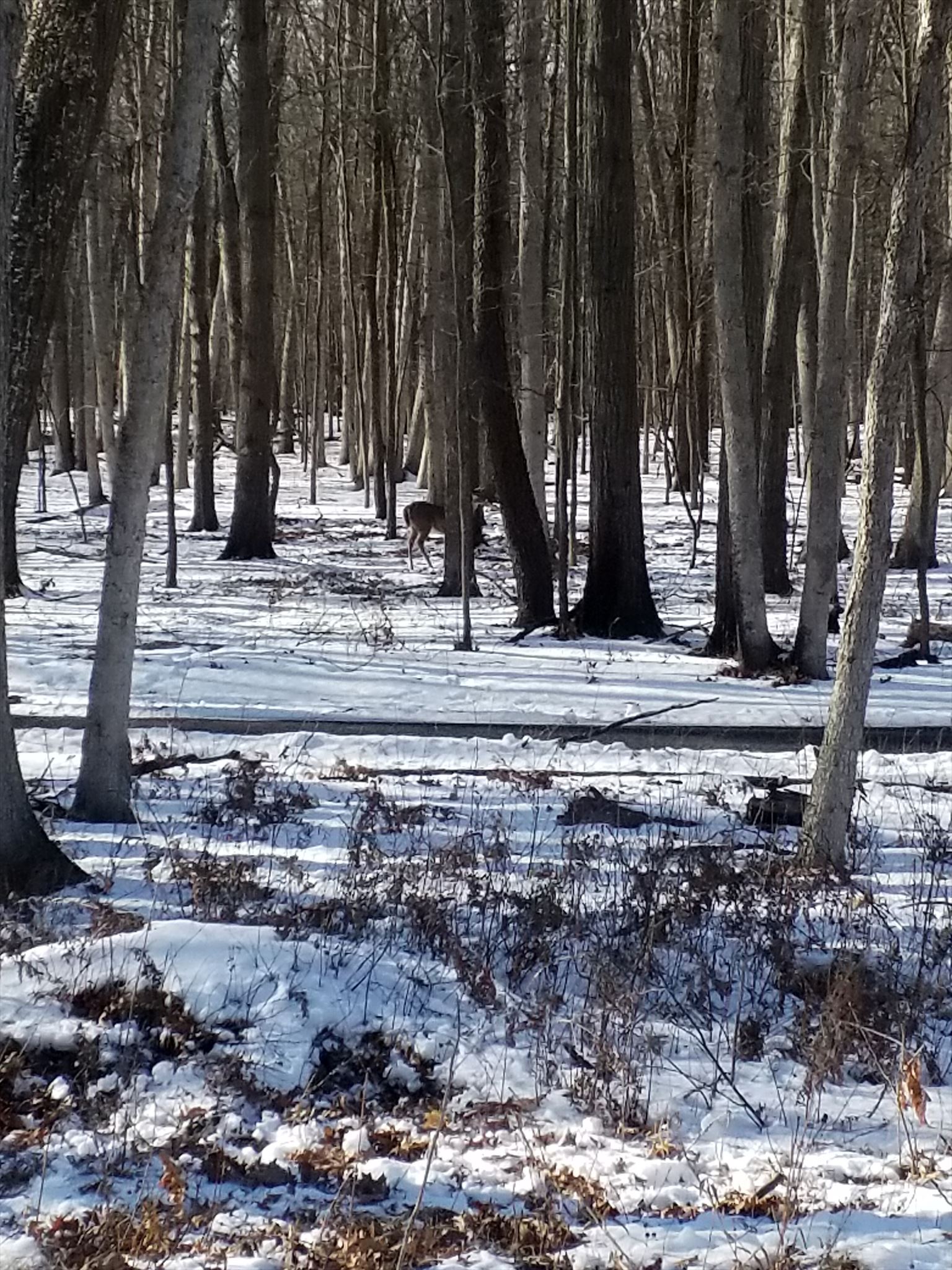
Above is a picture of a deer I encountered while driving down the road. There were several in the area located in an oak grove typical of the area.
At the time of this writing, there are three other Earthcaches in the Oak Openings area worth seeing : Ancient Lake Warren GC40FRV, Prairie GC138Q2 and Glacial Grooves at Blue Creek GC4DJ3N. Completing all four Earthcaches will give you excellent insight into the geological processes that resulted in the formation of this beautiful and unique section of the country.
Metroparks Toledo Official Notice: "The wetlands around you are more than just soggy puddles. Known as vernal pools, they are hot spots for many types of wildlife. Typically wettest in spring, they support all sorts of aquatic critters from fairy shrimp to water scorpions and come alive in spring with the sounds of frogs, toads, and ducks. Appreciate these vernal pools from the trails and you won't disturb critical breeding habitat.”
B. Definition of Terms: The following terms are pivotal when discussing the ingredients to the formation of vernal pools.
- Watershed: an area of land that contains a common set of streams and rivers that all drain into a single larger body of water, such as a larger river, a lake or an ocean. Through our watersheds, pollution is distributed far away from its original source.
- Soil Permeability: is the property of the soil to transmit water and air and is one of the most important qualities to consider for fish culture. High permeability will allow fluids to move rapidly through soil.
- Transpiration: is the process by which moisture is carried through plants from roots to small pores on the underside of leaves, where it changes to vapor and is released to the atmosphere. It is essentially evaporation of water from plant leaves.
- Savanna (or Savannah): a mixed woodland ecosystem characterized by the trees being sufficiently widely spaced so that there are large open grasslands.
- Vernal pools: (also known as ephemeral pools, autumnal pools, and temporary woodland ponds), are depressions in woodland areas that typically fill with water in the autumn or winter due to rainfall and rising groundwater.
Vernal pools remain filled with water through the spring and into summer. They usually dry up completely by the middle or end of summer each year, although some can remain filled for up to a few years. This occasional drying prevents fish from establishing permanent populations. The resulting vernal pool habitat, with its absence of fish, is critical to the reproductive success of many amphibian and invertebrate species that rely on breeding habitats that are free of predators. It also benefits other organisms such as the fairy shrimp, which spend their entire life cycles confined to the vernal pool habitat.
Vernal ponds are good for the physical environment as well. They help protect watersheds by capturing and holding water, allowing time for the water to seep into the surface and recharge groundwater supplies. This reduces the amount of water runoff, lessens erosion and decreases the potential for flooding. Vernal ponds also capture sediment, thereby protecting water quality in nearby streams and rivers.
In general, 90 or more consecutive days of water are needed over the winter and spring to allow insect and amphibian larvae to develop. A shallow wetland with a limited watershed in a sunny location is likely to dry up every year and may not provide enough time for salamander and frog larvae to develop. However, a deep wetland with a large watershed in a shaded location may never go dry. Once the water is gone, it may be difficult to identify the area as a vernal pool. Some clues that may alert you to the presence of a seasonally dry pool include: dark stained leaves, caddis fly larvae cases, fingernail clams, aquatic snails, bright green sedges (grass-like plants), and a lack of trees growing in the depression.
The following factors and their relationship to each other influence how often a pond dries up:
- Water depth
- Annual precipitation and evaporation
- Soil permeability
- Watershed size (amount of water that runs into the wetland from surrounding land)
- Amount of sunlight
- Transpiration from trees, shrubs, and plants growing in and around the wetland
C. Geological factors resulting in the formation of Vernal Pools:According to Pennsylvania Natural Heritage Website, there are several geological factors that can contribute to the formation of a vernal pool.
- Floodplains - when a stream overflows its banks entering the floodplain. Some of the overflow pockets do a good job of retaining water and become vernal pools. If this continues over the years it can lead to the creation of vernal pool habitats in the form of oxbow wetlands.
- Glaciers - glaciers created many isolated depressions through freezing, thawing and erosion that fill with rain water and snowmelt. This process is similar, in fact, to the way in which kettles are created.
- Sag Ponds - sag ponds form when surface water gathers in depressions formed by easily dissolved bedrock (such as limestone) underneath an impermeable soil layer. Eventually the soil sags and water gathers in the depression.
- Pingos – Pingos are formed by freezing and thawing processes on moist mountainous slopes. The upper layers of soil thaw first and slowly slide over the underlying frozen soil. The result is a landscape peppered with crescent-shaped wetlands.
- Human Activities - some vernal pools are created deliberately by people who wish to create wildlife habitat or to replace a seasonal wetland that was destroyed. Other pools are inadvertently created during any kind of surface disruption (mining, roadside ditches, agricultural fields, etc.) that creates shallow depressions that hold water long enough to support seasonal pool wildlife.
D. The Geology of Oak Openings: What contributed to the formation of this unique environment consisting of a mixture of widely spaced oak forests, sand dunes, savannas, tall-grass prairies and swamp forests near Toledo?
According to Jen Dennison, Wildlife Education Coordinator (in an article from 2017 Summer Wild Ohio Magazine) and also addressed in an article in the local newspaper (the Akron-Beacon Journal) Northwest Ohio has a unique sand belt habitat that extends 120 miles to the north. The landscape was created by outwash from glacial lakes that settled in the area after the glacier receded thousands of years ago.
A glacial ice front in southern Canada functioned as a dam. As the front moved back and forth through the process of freezing and thawing, lake levels would rise and fall resulting in the distinctive sand ridges that are characteristic of this area. (Think of the “back and forth movement of the front” as similar to that of a bulldozer moving earth; pushing dirt forward, then backing up only to move forward again with a new collection of dirt.) These ridges occur throughout northern Ohio, but none come close to the surface coverage and sand depth as that found at Oak Openings. It is believed that the size of these sandy deposits is “due to the result of two factors: the deposition of three beach ridges in the same general area and the fact that a large supply of sand was available north of the region during the deposition process”. Dennison, 2017.
In Oak Openings, the sand ridges, or dunes, created by the oscillating back and forth, run parallel to what is now the south shore of Lake Erie and are deposited over a surface of clay-rich glacial till. The result is a perfect environment for the existence of wetlands and vernal pools due to poor soil permeability.
E. The Oak Openings Vernal Pool:The coordinates will lead you to a Vernal Pool in Ohio’s Oak Openings MetroPark in Swanton, Ohio.
The parking coordinates will lead you to an area where you can pull over to the side of the road and park. You will notice a bike path (Wabash Cannonball Trail) that crosses the road. Follow the bike path about 400 feet to a trailhead marker on the right. From the marker, the vernal pool is a brief 100-foot walk with very minimal bushwhacking (waypoints included).
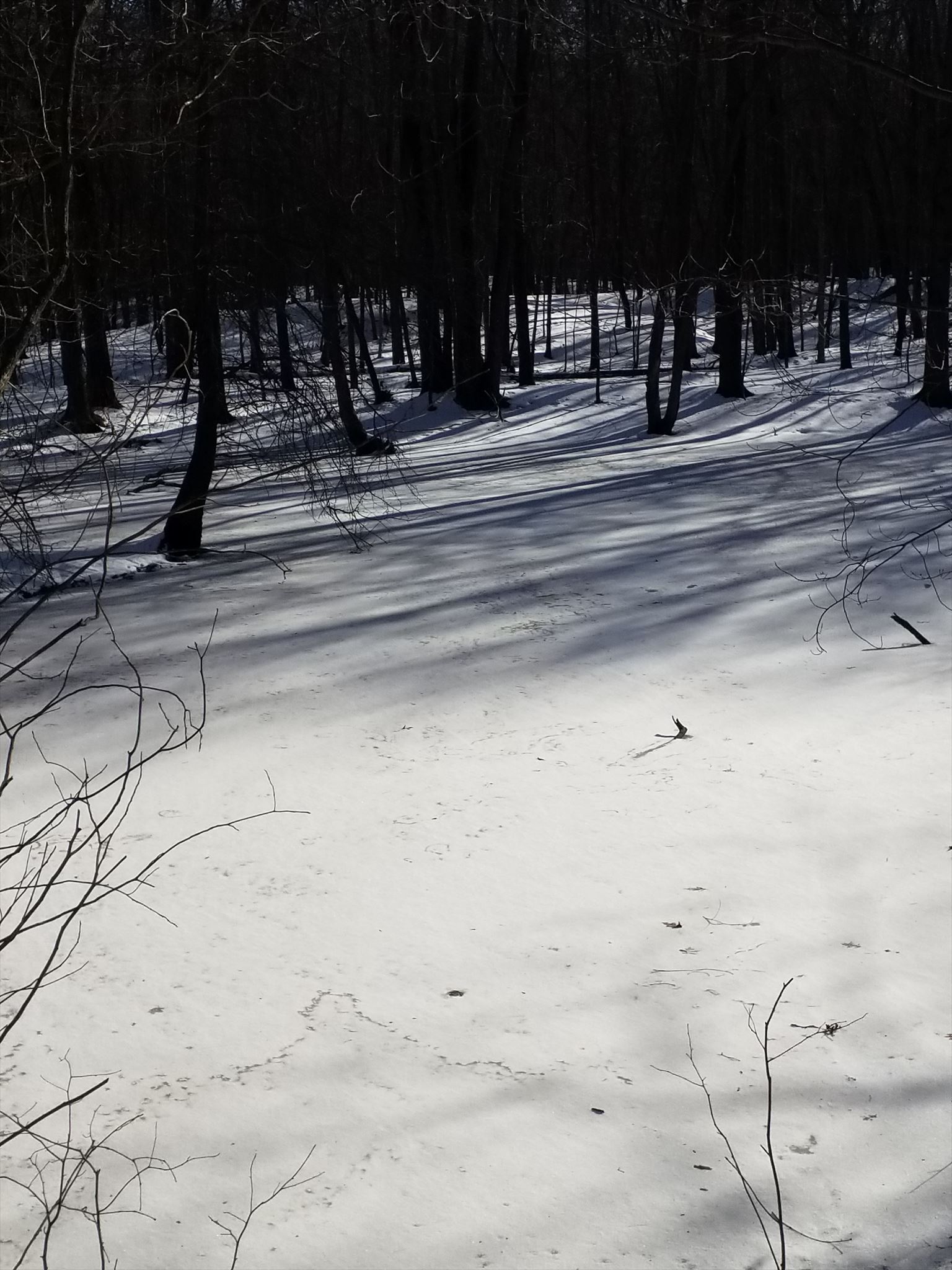
A view of the vernal pool in the dead of winter
When the pool is at its peak, according to a 2010 survey, it is 358 feet in length, 141 feet in width, has a parameter of 968 feet and is 4.5 feet deep at its deepest spot. As the spring turns to summer, the pool typically shrinks and completely dries up until the cycle begins all over again in the fall. Because of its size, according to my hosts, the pool has been known to last into a second year after a period of heavy winter snow storms and seasonal rains.
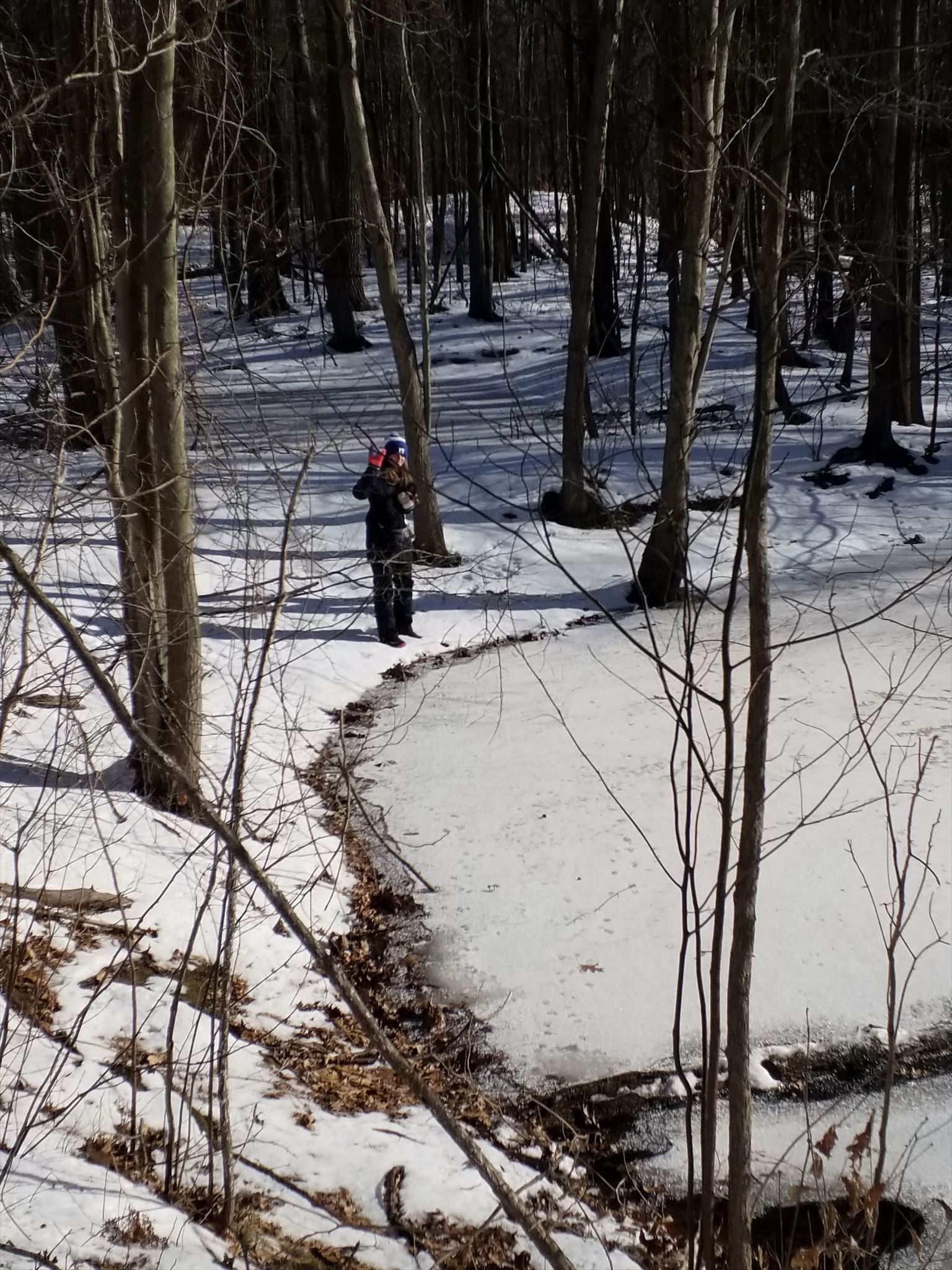
At the Vernal Pool with one of my hosts, Stephanie.
Each season offers a unique view of the pool with its seasonal flora and fauna. This includes more species of rare plants and animals than any other region of Ohio. One species that could not survive without this habitat is the Karner blue (a postage stamp-sized butterfly) that had been extirpated from Ohio in the late 80’s. Thanks to the partnership of several wildlife organizations, this endangered species was reintroduced to the area and has begun to flourish on the wild lupine in the area.
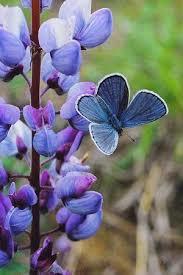
A Karner Blue feasting on wild lupine
The winter season provides a clear view of the pool in all its enormity. It also offers some insight into the pool’s etiology. Persons completing this Earthcache should pay close attention to the slight knolls on the western side of the pool, and the suggestions they provide as to how this pool came into existence. Doing so will give you some evidence to include in your answer to Question 2.
F. The Questions: Please send the CO answers to the following questions in order to earn your smiley for this Earthcache. It will not be necessary to wait for a response from them to log your find. I will contact you if there are any concerns or questions with your responses.
1. About the pool's current appearance at the time of your visit….
a. What is the approximate width and length of the pool?
i. Include the time of year that you visited the pool area, and how that may have impacted the width/length.
ii. What does the current width and length of the pool suggest about soil permeability in that area?
b. Based on your observations of this pool, to what role does transpiration play in water evaporation? What about the environment did you observe that supports your response?
c. If you arrived during the pool’s dry season, what evidence did you observe that verified the existence of a vernal pool?
2. Which geological factor(s) from those listed above has more than likely contributed to the formation of this vernal pool, and what characteristics did you observe to support your choice?
3. What flora and fauna did you see in and/or around the pool?
4. (Optional) Take a picture of you with the pool area behind you OR take a picture of the pool showing its current length and width and the flora and fauna so that visitors to this Earthcache page can see what it looks like at different times of the year.
| I have earned GSA's highest level: |
 |