Grand Anse - La Digue
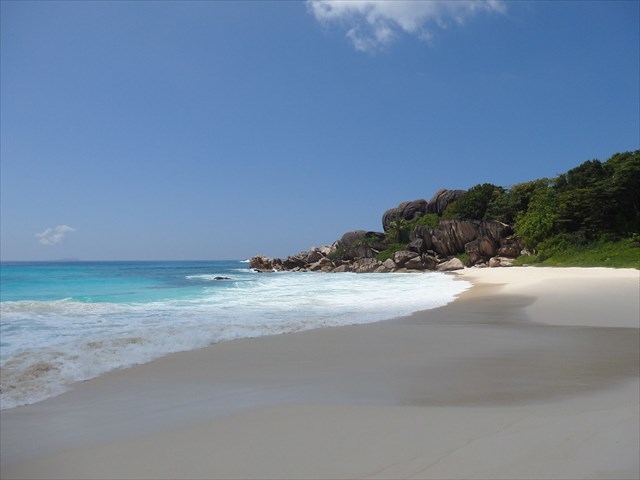
Grand Anse is La Digue's longest beach, located on the southeast coast of the island. It's a stunning and beautiful place, and while busier than nearby Petite Anse and Anse Cocos (both accessed by foot only), it sees fewer visitors than Anse Source d'Argent simply because its further from La Passe.
The beach is formed by white coral sand, surrounded by huge granite rocks at both ends. This situation makes this location to a perfect, unique spot for an earthcache lesson.
Coral sand
Coral sand is a collection of sand of particles originating in tropical and sub-tropical marine environments from bioerosion of limestone skeletal material of marine organisms. One example of this process, like here at the Seychelles, is that of parrot fishes which bite off pieces of coral, digest the living tissue, and excrete the inorganic component as silt and sand. Without the parrot fishes, the Seychelles would be granite rock islands without these white and wonderful sand beaches they are famous for. Because it is composed of limestone, coral sand is acid-soluble.
Grain size
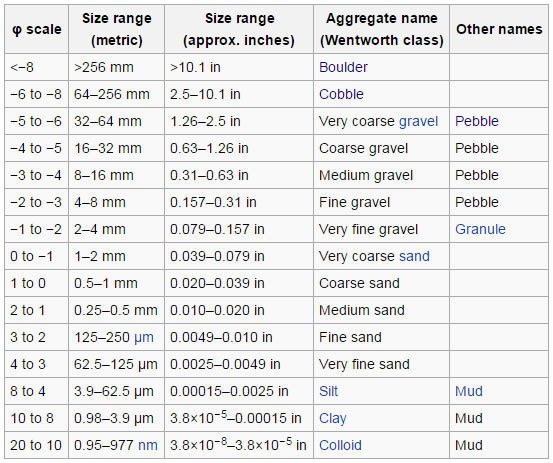
Grain size (or particle size) is the diameter of individual grains of sediment, or the lithified particles in clastic rocks. The term may also be applied to other granular materials. Granular material can range from very small colloidal particles, through clay, silt, sand, gravel, and cobbles, to boulders.
Size ranges define limits of classes that are given names in the international used Udden - Wentworth scale. The Krumbein phi scale is a modification of the Udden - Wentworth scale created by W.C. Krumbein in 1937.
Granite
Granite is a common type of felsic intrusive igneous rock that is granular in texture. Granites can be predominantly gray, pink, or white in colour, depending on their mineralogy. The word "granite" comes from the Latin "granum", grain, in reference to the coarse-grained structure of this crystalline rock.
Granite is an igneous rock with between 20% and 60% quartz by volume, and at least 35% of the total feldspar consisting of alkali feldspar, although commonly the term "granite" is used to refer to a wider range of coarse-grained igneous rocks containing quartz and feldspar.
Granite is nearly always massive, hard, and tough. These properties have made granite a widespread construction stone throuhout human history.
Granite containing rock is widely distributed throughout the continental crust. Much of it was intruded during the Precambrian age, like the granites here at the Seychelles. Outcrops of granite tend to form tors and rounded massifs. Granite has a felsic composition and is more common in continental crust than in oceanic crust. It is also a natural source of radiation, like most natural stones.
Your task to log this Earthcache:
Send me your answers on the following questions via message:
1.) Take a closer look to the sand at the header coordinates! What grain size does it have according to the Krumbein phi scale?
2.) Take a small sample of the sand with you, you will need it for your experiment!
3.) Move on to waypoint 2 and have a closer look at the granite rocks. Give me a short description of the granite (colour, surface, grain size...)!
4.) What do you think - are the rocks and the sand made of the same geologic material?
5.) Now it's time to make an experiment - either you take some vinegar (or 10% hydrochloric acid) with you or you take the sample of sand and a sample of the rock material with you and make the experiment at home. However: Drop some vinegar (or 10% hydrochloric acid) over the two samples, the sand and the rock, and describe me your observations!
6.) Optional: If you like, you can add a picture of you and/or your GPS unit near the location to your log entry!
There is no need to wait for a log permission! You can log immediately after you sent me your answers! If there's something wrong, I'll contact you.
Have fun and enjoy the location!
Sources:
Haldar, S.K. & J. Tišljar (2014): Introduction to Mineralogy and Petrology.
Krumbein, W.C. & L.L. Sloss (1963): Stratigraphy and Sedimentation.
Udden, J.A. (1914): Mechanical composition of clastic sediments. In: Geological Society of America Bulletin 25 (1), 655-744.
Wentworth, C.K. (1922): A Scale of Grade and Class Terms for Clastic Sediments. In: The Journal of Geology 30 (5), 377-392.
wikipedia.org
www.lonelyplanet.com
The pictures were taken by the author.
 The most exciting way to learn about the Earth and its processes is to get into the outdoors and experience it first-hand. Visiting an Earthcache is a great outdoor activity the whole family can enjoy. An Earthcache is a special place that people can visit to learn about a unique geoscience feature or aspect of our Earth. Earthcaches include a set of educational notes and the details about where to find the location (latitude and longitude). Visitors to Earthcaches can see how our planet has been shaped by geological processes, how we manage the resources and how scientists gather evidence to learn about the Earth. To find out more click HERE.