DO NOT ATTEMPT THIS CACHE IF THERE ARE FLASH FLOOD WARNINGS FOR THE SAN LORENZO RIVER! The road is well above the river, but waters and hillsides in the Santa Cruz Mountains are unpredictable during storms! Watch children when the river is high!
One of these old growth stumps that sits in the center of a circle of 150 year old "sprout" trees may well have been the coast redwood’s (Sequoia sempervirens) holotype, the first botanical specimen collected and formally preserved as the herbarium specimen that now sits in the British Natural History Museum of London.
Although known by Native Americans for millennia, the first European to describe the Coast redwood found within the fog belt of the Pacific coast, was the Franciscan missionary Fray Juan Crespi in his 1769 diaries of the Portolá Expedition near Monterey Bay. In 1791, the Czech botanists Thaddeus Haenke and Luis Nee of the Malaspina Expedition collected seeds which became the first redwoods planted in Europe near Granada, Spain. In 1795, Archibald Menzies, a botanist from Aberfeldy, Scotland, with the Vancouver Expedition brought additional specimens back to England which were used by the English botanist Aylmer Bourke Lambert in 1824 to name the coast redwood Taxodium sempervirens, in recognition of its morphological similarities to bald cypress. Later in 1847 Stephen Endlicher changed the genus name to Sequoia, a name with a debated origin.
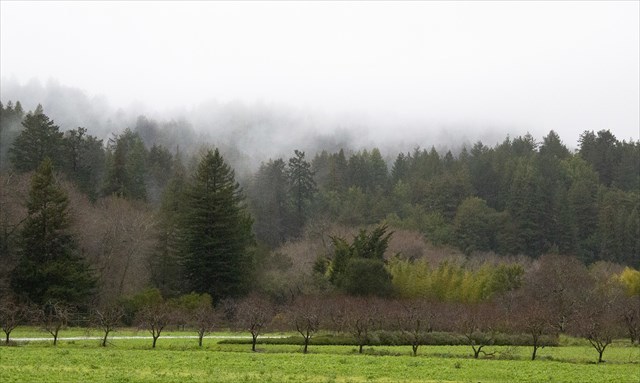
For decades no one knew where Menzies had collected his specimen that was housed at the British Natural History Museum in London, until California's most distinguished early botanist, Willis Linn Jepson, solved the mystery. He wrote in Sequoia sempervirens and Gigantea,1910, “No exact locality has ever been given for the Menzies collection, but while examining Menzies’ original specimen at the British Natural History Museum in London I turned over the sheet and discovered written on the back ‘Santa Cruz, Menzies.’
The botanical explorer, David Douglas (after whom the Douglas fir is named), referred it to the same genus as Lambert; travelling through the Santa Cruz forests in 1830, he wrote to Dr. Hooker in England that “the great beauty of California vegetation is a species of Taxodium, which gives the mountains a most peculiar, I was almost going to say awful appearance – something that plainly tells that we are not in Europe.” It was not until 1847 that Endlicher founded the distinct genus Sequoia and created the binomial Sequoia sempervirens.”