This cache is about alluvial sediments
EDUCATIONAL LOGGING REQUIREMENTS
In order to substantiate your visit and comply with the educational requirement for Earth Caches you have to submit your answers to the following questions to the cache developers via their profile:
For purposes of logging this cache you must answer the following five questions.
1) What is the size of a pebble?
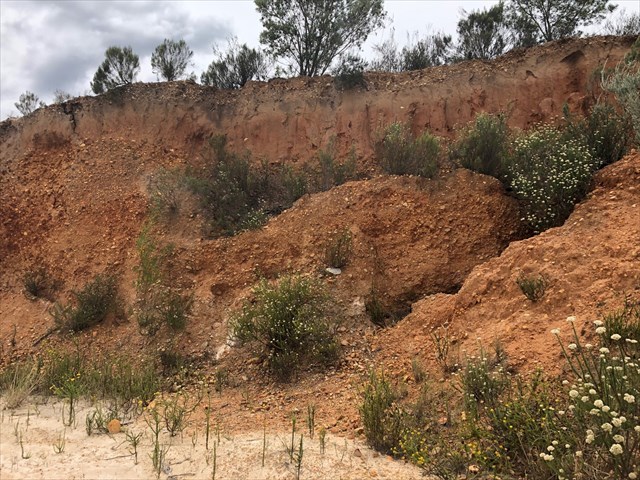
2) What could have caused the red colour in the alluvium?
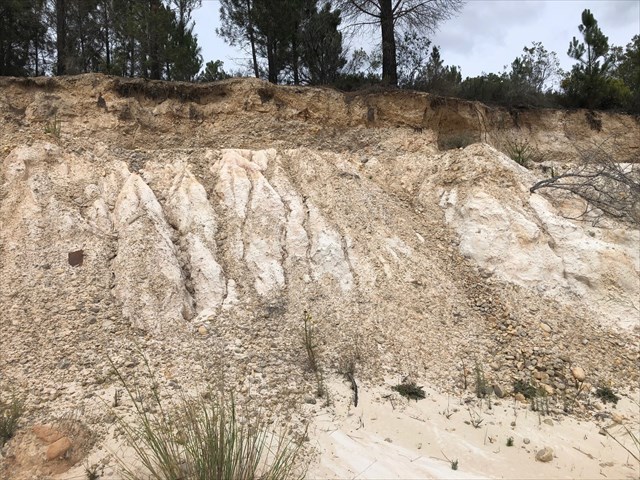
3) On which side is the red alluvium? Closest to the road or furthest from the road?
|
A quarry is always a great place to see the underlying soil and rock structure. The excavation, especially when there are vertical sides, reveals the layers of soil and rock.
The rock in the Loerie, Hankey, Patensie area is part of the Gamtoos and Uitenhage Groups. This quarry does not expose the bedrock but only alluvial sediments.
Alluvial deposit, alluvial sediment or alluvium is clay or silt or gravel carried by rushing streams and deposited where the stream slows down. Most alluvium would have been deposited less than 2,5 million years ago, and is often referred to as "cover" because these sediments obscure the underlying bedrock.
The alluvium in this quarry shows a stark contrast. One one side the quarry the deposit is white and on the other side it is red. The red colour is an indication of the presence of iron oxide or hematite in the alluvium.
There are also pebbles in the alluvium. A pebble is a clast of rock with a particle size of 2 to 64 millimetres based on the Krumbein phi scale of sedimentology. Pebbles are generally considered larger than granules (2 to 4 millimetres diameter) and smaller than cobbles (64 to 256 millimeters diameter).