In 1821 the French geologist Pierre Berthier discovered bauxite near the village of Les Baux in Provence, southern France.
Bauxite is a rock composed mainly of aluminium bearing minerals. Bauxite forms when laterite soils are severely leached of silica and other soluble materials in a wet tropical or subtropical climate. The laterisation process takes millions of years to occur. Bauxite is a mixture of hydrous aluminium oxides and hydroxides, clay minerals, and insoluble materials such as quartz, and iron oxides.
A pisolite is a sedimentary rock made of pisoids, which are concretionary grains – typically of calcium carbonate but sometimes of other minerals including commonly Bauxite. The grains are approximately spherical and have concentric layers reaching up to 10 mm in diameter. The name derives from the Hellenic word for pea.

Pisolites have formed by chemical precipitation. Essentially a nucleus enveloped by irregular layers in a spherical form. Typically composed of iron, aluminium and manganese oxides with minor amounts of quartz and clay, they are widely distributed in tropical to subtropical regions overlying deeply weathered soil profiles. Their formation has never been observed or produced experimentally and current models for their origin are little more than geologist guesses. Pisolites have been observed in Martian soils and are considered evidence of a once wet Mars. One theory is that pisoliths are formed by rain drops during rainfall on a fine mineral sand.
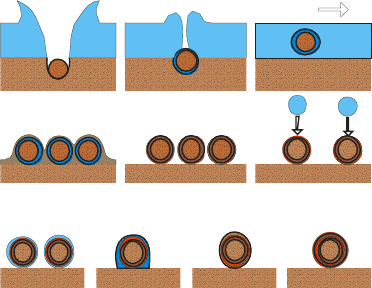
At this earthcache location you are looking at a mounted section of bauxite ore, cut and polished. The bauxite sample is stained red from iron content. The earthscience lesson will encourage you to consider the pisolitic structure of the mineral on display. Please compare the cut face with the uncut back of the rock on display. Estimate the size of the pisoids. Remember the cut profile is at random sections across the grain structure.
Please send your answers for the following questions.
-What is largest size of pea you can see. Are the peas larger on the cut side or uncut side of the stone?
-Do you have a formation theory for the peas? Do you think water is involved? How?