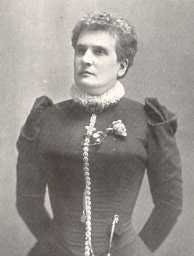
This cache is part of the “Women In History” cache series started by cacher Meandmydogs
***The Cache is not at the posted coordinates***
Answer the questions below to obtain the correct coordinates.
Marilla Ricker
A suffragist, philanthropist, lawyer, and freethinker, Marilla Marks (Young) Ricker (1840-1920) accomplished a remarkable number of firsts during her lifetime. She became the first woman to be accepted into the bar in New Hampshire, the first woman to run for governor in that state, and the first woman to apply for a federal foreign ambassadorship post. She made significant and lasting contributions to the issues of women's rights and irreligion through her actions and her writings.
Marilla Marks Young was born in 1840 in New Durham, New Hampshire. Her mother, Sarah Young, was a devoted Free Will Baptist, and her father, Jonathon Young, was a freethinker. Jonathon taught her to think independently and to be curious, taking her to town meetings and courtrooms.
During the Civil War, Marilla offered her services as a nurse for the Union Army, but she was turned down due to her lack of medical training.
By the time of the war – and indeed since the age of sixteen – she had become a teacher in local schools. She refused to read from the Bible during class, preferring instead the literary works of Thoreau. The school committee approached Ricker and informed her that she was required to read from the Bible in class. Ricker refused to hide her freethought beliefs, and left the teaching profession.
In 1863, Marilla Young married John Ricker, a man 33 years her senior. She became a widow, however, five years later
In 1872, Ricker travelled to Germany and remained in Europe until 1876. Upon her return to Washington, D.C., she decided to study law. In a remarkably short time, she gained prominence as a competent and compassionate member of the profession.
When Ricker applied, in 1910, to run for governor of New Hampshire, and when she applied, in 1897, for the position of ambassador to Colombia, she had no realistic hopes of being granted these posts. Rather, she was attempting to bring public attention to the fact that women were systematically excluded from positions for which they were equally qualified as men. "Whether I secure the appointment or not," she said of her ambassadorship application, "I have established a precedent in asking for it." She justified her application in explicitly egalitarian terms: "there is no gender in brain, and it is time to do away with the silly notion that there is."
In 1869, the year after her husband's death, Ricker attended the first National Woman Suffrage Association convention. This marked a new period of active suffragist work in her life.
Explicitly asserting her belief in the equality of all peoples, Ricker acted upon these beliefs by attempting to vote in her hometown of Dover, New Hampshire, in 1870 – the first woman to do so. She continued to hand in her ballot for consecutive decades until the end of her life. Ultimately, she was willing to "tackle anything" for woman suffrage, "from a buzz saw to a bishop.”
Answer the following questions to solve the coordinates:
N 42 48.ABC W 071 32.DEF
-
Ricker applied in 19XX to run for governor of New Hampshire. XX +3= AB
-
Even though women were still not allowed, she attempted to vote for the first time in 187C
-
She was born in New Durham, NH in the year 18D0.
-
She attended the first National Woman Suffrage Association convention in 18YY. YY-3=EF
/>