To log this earthcache, please don’t stress about answering the questions. Simply send your best attempts in a private message to me, (the cache owner), and then go ahead and log it as found.
You don’t need to wait for my approval. All attempts will be accepted.
Go ahead and have fun learning! 
- [REQUIRED] Please post a photo in your log of yourself or a personal item at the outcrop to prove you visited the site.
- Please describe the differences in colour, type of rock above the unconformity to below the unconformity.
- Is there evidence of folding or tilting?
** Please note that the cliff here is subject to rock fall. This site's significance can, and should, be viewed from a distance.
Unconformity
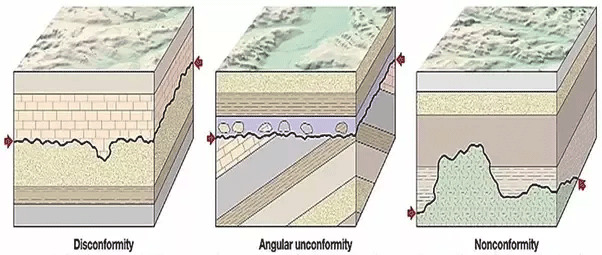
This earthcache will teach you about unconformities. An unconformity is a buried erosional or non-depositional surface separating two rock masses or strata of different ages, indicating that sediment deposition was not continuous. In general, the older layer was exposed to erosion for an interval of time before deposition of the younger, but the term is used to describe any break in the sedimentary geologic record. The significance of angular unconformity is in telling time.
The rocks above an unconformity are younger than the rocks beneath (unless the sequence has been overturned). An unconformity represents time during which no sediments were preserved in a region. The local record for that time interval is missing and geologists must use other clues to discover that part of the geologic history of that area. The interval of geologic time not represented is called a hiatus.
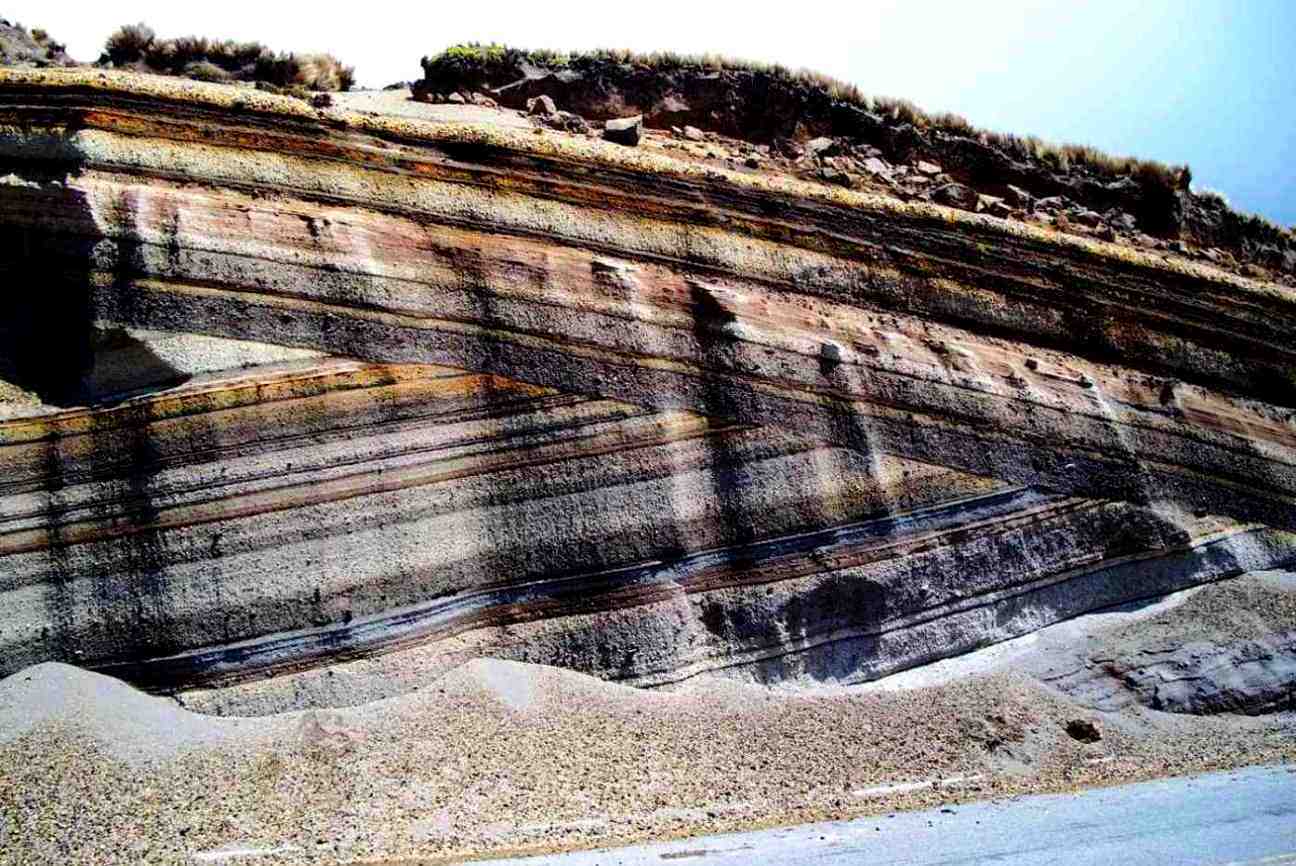
Sample of unconformity above. Not Rainy Cove.
Carboniferous and Permian Periods
The Carboniferous Period lasted from about 359.2 to 299 million years ago during the late Paleozoic Era. The term "Carboniferous" comes from England, in reference to the rich deposits of coal that occur there. These deposits of coal occur throughout northern Europe, Asia, and midwestern and eastern North America. The term "Carboniferous" is used throughout the world to describe this period.
The Permian is a geologic period and system which spans 47 million years from the end of the Carboniferous Period 298.9 million years ago (Mya), to the beginning of the Triassic period 251.902 Mya. It is the last period of the Paleozoic era; the following Triassic period belongs to the Mesozoic era. The world at the time was dominated by two continents known as Pangaea and Siberia, surrounded by a global ocean called Panthalassa.
Unconformities in Nova Scotia
Nova Scotia doesn't have a rock record on most of the drastic geological events, with a gap of about 130 million years extending from early Permian to late Triassic times. Along the shore at Rainy Cove are highly deformed, older rock layers directly below a wedge of younger sandstone. Between the two lines lies an angular unconformity, the surface that represents the missing span of time. The site is visually dramatic.
Below the unconformity in this location, are rocks that are 360 million years old. Above the unconformity are rocks that are 230 million years old. Between the two rock types is an ancient land surface. Where the unconformity intersects the beach, part of the cliff is slightly undercut at its base. Based on their thickness elsewhere, it is likely that as much as 4 kilometres of Carboniferous and Permian sediment lay above the ancient land surface here.