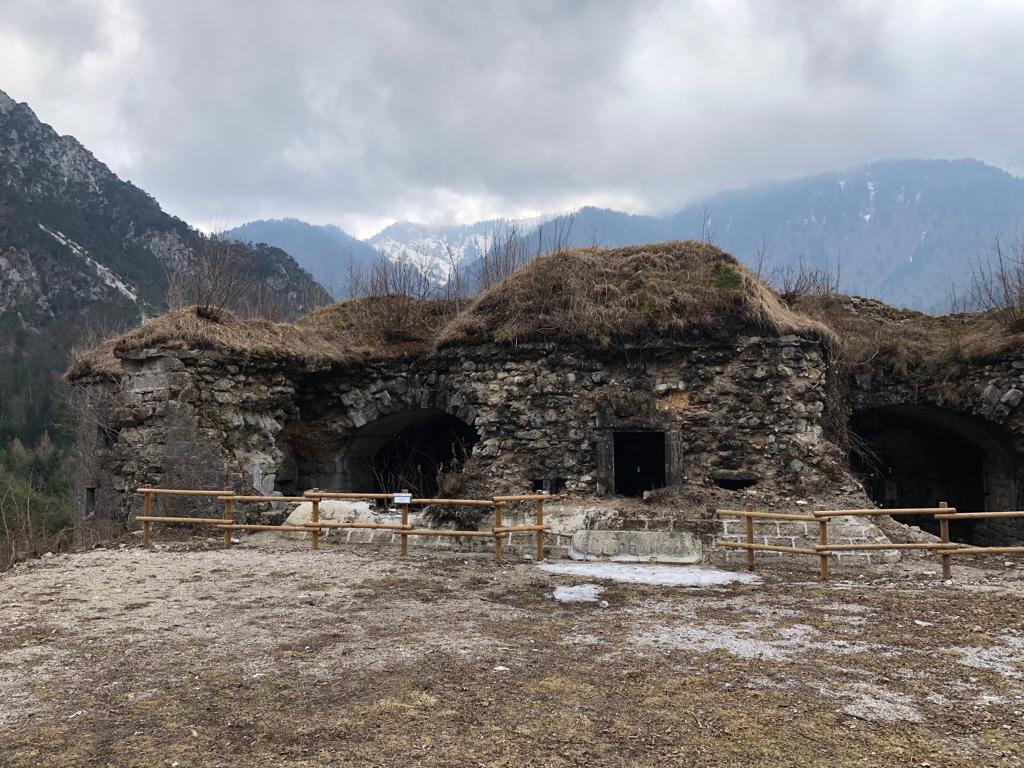
Blocco B
Nella parte bassa del forte, nel cosiddetto "Impianto B", furono posizionate due batterie corazzate: nella parte anteriore del forte una con quattro cannoni da 12 cm e una in due torri con due cannoni da 12 cm ciascuna.
All'inizio della guerra, la batteria anteriore fu rimossa e collocata in alcune grotte del Monte Nebria, mentre un cannone fu rimosso da ciascuna delle due torri. "Impianto B" comprendeva la caserma difensiva a tre piani, la sala di guardia, il deposito di munizioni, e la cucina, i bagni e le sale macchine.
L'artiglieria italiana prese di mira soprattutto la parte bassa del forte, che appariva più armata. Il giorno più triste fu il 22 giugno, quando un colpo colpì "Plant B" e uccise 2 ufficiali, il comandante di "Plant B", il comandante della sezione fotoelettrica e 17 artiglieri. Tutto questo sotto gli occhi dell'erede al trono, l'arciduca Karl, che stava visitando il fronte a Uggovizza.
Dopo la fine della guerra, molte parti rimaste intatte crollarono e alcune furono demolite per la bonifica del ferro, soprattutto la struttura che sosteneva le due cupole e la parte dove rimaneva la corazza della batteria frontale.
Gli abitanti della valle hanno anche riciclato numerose pietre quadrate dai bastioni esterni del forte.
Plant B
In the lower part of the fort, in the so-called "Plant B", two armored batteries were positioned: at the front of the fort one with four 12 cm cannons and one in two towers with two 12 cm cannons each.
At the beginning of the war, the front battery was removed and taken to some caves in Mount Nebria, while one cannon was removed from each of the two towers. "Plant B" included the three-story defensive barracks, the guardroom, the ammunition depot, and the kitchen, bathrooms and engine rooms.
The Italian artillery particularly targeted the lower part of the fort, which appeared more armed. The saddest day was June 22, when a shot hit "Plant B" killing 2 officers, the commander of "Plant B", the commander of the photoelectric section and 17 artillerymen. All this under the eyes of the heir to the throne, Archduke Charles, who was visiting the front in Uggowitz.
After the end of the war, many parts that remained intact collapsed and some were demolished for the recovery of the iron, especially the structure that supported the two domes and the part where the armor of the front battery remained.
The inhabitants of the valley also recycled many square stones of the outer wall of the fort.
Werk B
Im unteren Teil des Forts, im sogenannten "Werk B", waren zwei gepanzerte Batterien positioniert: an der Vorderseite des Forts eine mit vier 12 cm Kanonen und eine in zwei Türmen mit je zwei 12 cm Kanonen.
Zu Beginn des Krieges wurde die Frontbatterie entfernt und in einige Höhlen im Berg Nebria gebracht, während aus den beiden Türmen jeweils eine Kanone entfernt wurde. Zum "Werk B" gehörten die dreistöckige Verteidigungskaserne, die Wachstube, das Munitionslager sowie die Küche, Bäder und Maschinenräume.
Die italienische Artillerie zielte besonders auf den unteren Teil des Forts, der bewaffneter erschien. Der traurigste Tag war der 22. Juni, als ein Schuss das "Werk B" traf und 2 Offiziere, den Kommandeur des "Werkes B", den Kommandeur der photoelektrischen Abteilung und 17 Artilleristen tötete. All dies unter den Augen des Thronfolgers, Erzherzog Karl, der gerade in Uggowitz die Front besuchte.
Nach dem Ende des Krieges stürzten viele intakt gebliebenen Teile ein und einige wurden für die Rückgewinnung des Eisens abgerissen, insbesondere die Struktur, die die beiden Kuppeln trug und der Teil, wo die Panzerung der vorderen Batterie verblieben war.
Die Bewohner des Tals wiederverwerteten auch zahlreiche quadratische Steine der äußeren Ummauerung des Forts.