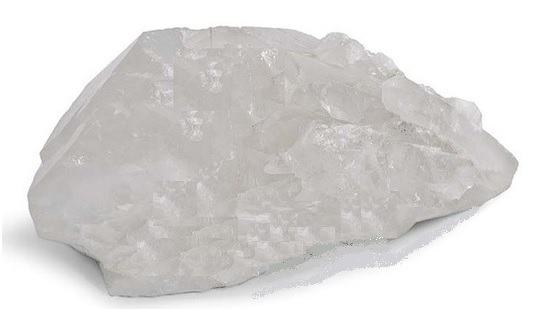
Quartz is a chemical compound consisting of one part silicon and two parts oxygen. It is silicon dioxide (SiO2). It is the most abundant mineral found at Earth's surface, and its unique properties make it one of the most useful natural substances.
As said, quartz is the most abundant and widely distributed mineral found at Earth's surface. It is present and plentiful in all parts of the world. It forms at all temperatures. It is abundant in igneous, metamorphic, and sedimentary rocks. It is highly resistant to both mechanical and chemical weathering. This durability makes it the dominant mineral of mountaintops and the primary constituent of beach, river, and desert sand. Quartz is ubiquitous, plentiful and durable. Minable deposits are found throughout the world.
Quartz use?
Quartz is one of the most useful natural materials. Its usefulness can be linked to its physical and chemical properties. It has a hardness of seven on the Mohs Scale which makes it very durable. It is chemically inert in contact with most substances. It has electrical properties and heat resistance that make it valuable in electronic products. Its luster, color, and diaphaneity make it useful as a gemstone and also in the making of glass.
Quartz an excellent gemstone.
Quartz makes an excellent gemstone. It is hard, durable, and usually accepts a brilliant polish. Popular varieties of quartz that are widely used as gems include: amethyst, citrine, rose quartz, and aventurine. Agate and jasper are also varieties of quartz with a microcrystalline structure.
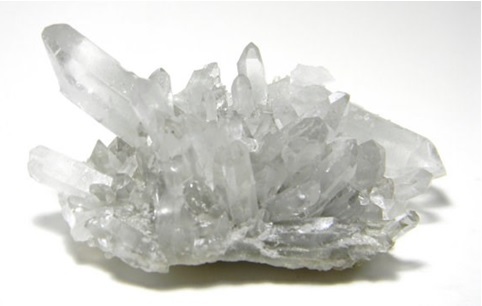
Properties of Quartz:
Chemical classification: Silicate
Colour: Quartz occurs in virtually every colour. Common colours are clear white, gray, purple, yellow,brown,black,pink,green, red.
Streak: Colourness (harder than the streak plate)
Luster: Vitreous
Cleave: None
Mohs hardness: 7
Crystal system: Hexagonal
You will normally find Quartz like this in a stone, and not in a big sized mineral as the photos above, so here is what you will be looking for at the stone at gz. (Example photo under, not from gz)

To log this cache.
To get to log this cache you will have to read the cache text and visit the coordinates given. After that you will have to answer the questions which are related to the text and the coordinates given.
When answers are collected, send them to CO for verification. I will accept answers sent via email or through the Message Centre.
You can log immediately after answers are sent the CO. If there are any questions about your answers CO will contact you.
Logs without answers to CO or with pending questions from CO will be deleted without any further notice.
Please do not include pictures in your log that may answer the questions.
Questions
1. Answer the questions under by visiting the Coordinates.
A.Please describe the quartz in the boulder at GZ, giving the shape and colour of the crystals you see
B. The coordinates have lead you to a boulder. Have a look around it, what percentage of the quartz would you say the stone contains?
C. What is the average size of the transparent mineral of quartz that you see?
D. Please look inside the drilled hole(s) in the boulder - after looking in, do you think there is more / the same / less percentage by volume of quartz within the boulder, compared to the rest of the boulder that you can see?
2. It’s voluntary to post a photo in your online log. Without revealing any answers!
