
Xenolith is a fragment of foreign rock within an igneous rock. Xenolith itself may be whatever type of rock but its host rock has to be igneous. Foreign rocks in other rock types are usually known as inclusions. “Xenolith” means literally ‘foreign rock’, but some xenoliths are not entirely foreign to their hosts. They may be genetically related e.g. gabbro xenoliths in basalt. Such xenoliths are called cognate inclusions or autoliths. They are related because they both crystallized from the same magma.
True unrelated xenoliths are always older than their host rocks because they had to already exist as a solid rock fragment when the magma around them solidified. But this is not necessarily true with cognate inclusions.
Many xenoliths are carried up from the mantle. They are therefore very valuable to scientists because such xenoliths are almost the only way to know for sure what the mantle beneath the crust is made of.
Xenoliths which represent pieces of older rock incorporated into the magma while it was still fluid, may be located near their original positions of detachment or may have settled deep into the intrusion, if their density is greater. Xenoliths can be contrasted with autoliths, or cognate xenoliths, which are pieces of older rock within the intrusion that are genetically related to the intrusion itself. The general term for all such incorporated bodies is inclusions. Xenoliths are usually reconstituted through the processes of contact metamorphism, in which heat and fluids cause mineralogic and chemical changes in the parent rock of the xenolith; a study of these changes can give information on the temperature and composition of the magmatic body.
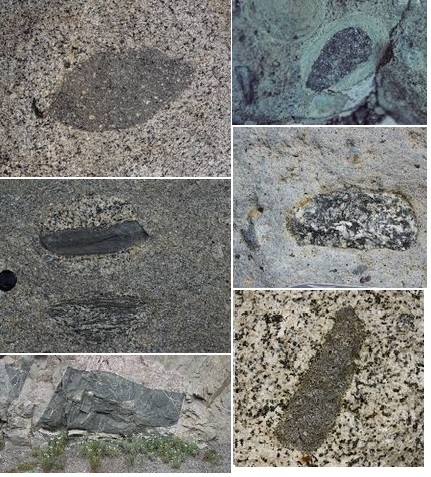
Examples of Xenolith:
To log this cache.
To get to log this cache you will have to read the cache text and visit the coordinates given. After that you will have to answer the questions which are related to the text and the coordinates given.
When answers are collected, send them to CO for verification. I will accept answers sent via email or through the Message Centre.
You can log immediately after answers are sent the CO. If there are any questions about your answers CO will contact you.
Logs without answers to CO or with pending questions from CO will be deleted without any further notice.
Questions
1. Answer the questions under by visiting the Coordinates.
A. Find the xenolith(s), how many are there? And would you say that the xenolith(s) is older or younger than the stone it is found in?
B. What is the size of the smallest and the biggest of the xenoliths?
C. Can we tell if the xenolith is an igneous rock like the rest of the boulder stone?
2. It’s voluntary to post a photo in your online log. Without revealing any answers!
