Basalto de la Playa de los Roques

El basalto ya se menciona en antiguos documentos romanos (Plinio el Viejo), el nombre probablemente proviene del egipcio o más antiguo del etíope.
El basalto es la roca con mayor distribución cuando se consideran tanto los continentes y el fondo del mar. Es una roca efusiva de bajo contenido de SiO2. Consiste principalmente en una mezcla de silicatos de calcio, hierro y magnesio (Pyroxene) y feldespato rico en calcio y sodio (Plagioklas), así como olivino. Cuando sale el magma de baja viscosidad se enfría relativamente rápido a la lava basáltica en la superficie de la tierra o en el océano. Cuanto más lento se produce este enfriamiento, más geométrico y angular es el basalto resultante.
Los minerales arrastrados en el derretimiento del manto terrestre no sólo están distribuidos homogéneamente en la roca solidificada, llamada vulcanita o plutonita por su origen volcánico, sino que también pueden ser reconocidos macroscópicamente como inclusiones en la roca. Ellas se distinguen ademas entre rocas que sólo se solidificaron antes de la misma masa magmática durante la formación de la vulcanita (autolito) e inclusiones de rocas extrañas (xenolito), cuya formación no está directamente relacionada con la formación de la vulcanita o plutonita.
Por ejemplo, las inclusiones de olivino son muy comunes y cuando son jóvenes pueden ser reconocidas por su color verde brillante. Sin embargo, debido al alto contenido de hierro, el olivino se desgasta rápidamente y luego el color cambia a rojizo a marrón. Las zeolitas forman inclusiones blancas en el basalto. Un gran número de minerales con diferentes estructuras cristalinas pertenecen al grupo de las zeolitas.Raramente se encuentran inclusiones de obsidiana, un mineral negro vidrioso, que se forman por el enfriamiento rápido de la lava con un contenido máximo de agua de 3-4 %. Si el enfriamiento es más lento, en lugar de la obsidiana, se forma piedra pez, tambien negra, pero no vidriosa.
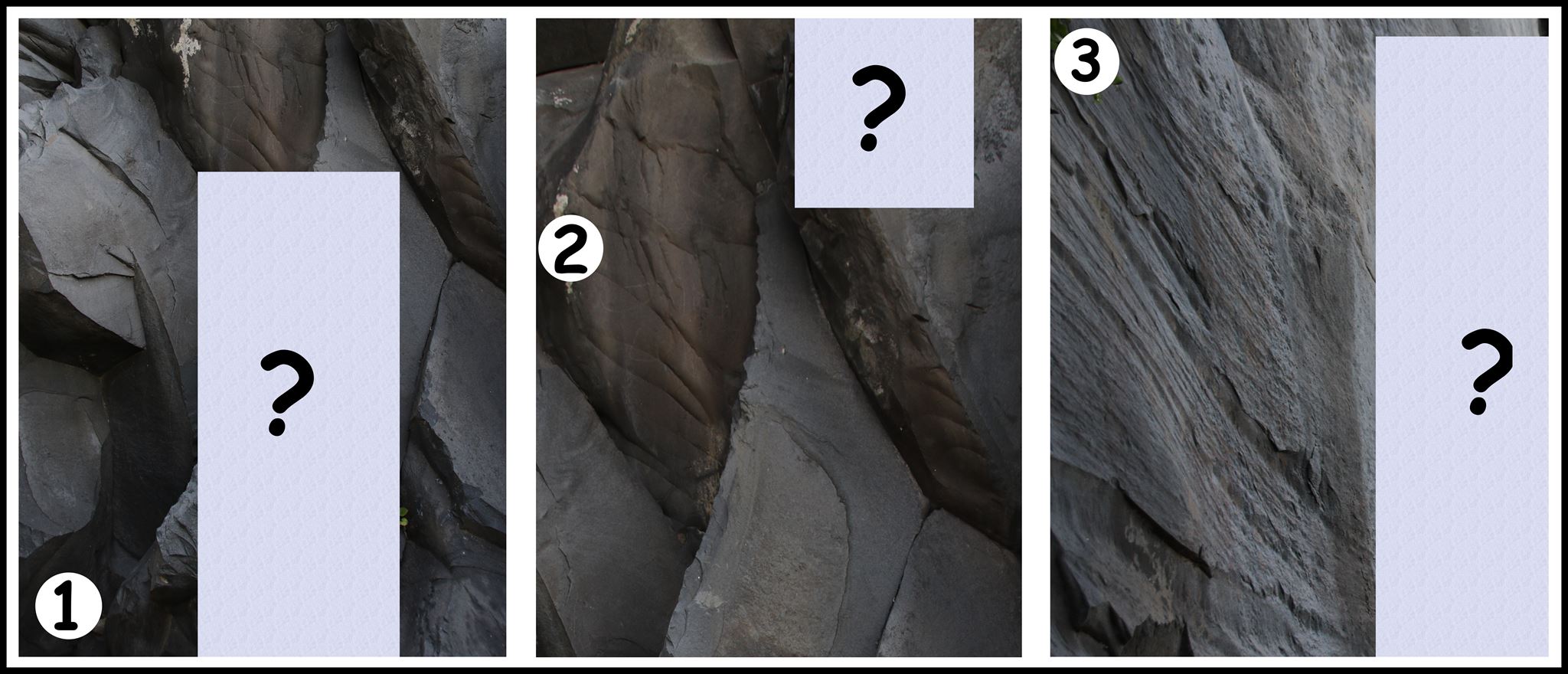
La Playa de los Roques (con el Roque Chico y el Roque Grande) está bordeada al oeste por una bonita formación basáltica. Durante una caminata alrededor del roque notamos algunas inclusiones hermosas y claramente reconocibles en el basalto. Ya que no es tan fácil ni siquiera para nosotros como no expertos identificar los diferentes tipos de roca, las preguntas aquí tratan solo la forma y el color de las inclusiones. La numeración de las preguntas se refiere a la numeración de las imágenes.
Para registrar esta caché como encontrado, por favor dirigete al WP1 y responde las siguientes preguntas:
- 1) Mida o estime la altura de esta inclusión.
- 2) ¿Cuál es la forma y el color de la pequeña inclusión directamente encima de la primera?
- 3) Detrás de la barandilla a la izquierda hay una otra inclusion grande en la roca. Describe la forma y el color.
- 4) Obligatorio desde 01.07.2020: Sube una fotografía tuya y / o del tuyo GPS con basalto detraz. (¡Ninguna fotografia de las inclusiones, por favor!)
Envía tus respuestas (en español, inglés o alemán, por favor) por correo a flinxinflux@web.de o utiliza el centro messages. Puedes registrar tu visita inmediatamente. No tienes que esperar la nuestra respuesta. Te vamos contactar en caso que haya problemas.
---------------------

Basalt is already mentioned in ancient Roman records (Pliny the Elder), the name probably comes from Egyptian or even older from Ethiopian.
Basalt is the rock with the greatest distribution when one considers both the continents and the bottom of the sea. It is an effusive rock with low SiO2 content. It consists mainly of a mixture of calcium-iron-magnesium-silicates (Pyroxene) and calcium- and sodium-rich feldspar (Plagioklas) as well as olivine. When low-viscosity magma exits it cools relatively quickly to basalt lava on the earth's surface or in the ocean. The slower this cooling takes place, the more geometric and angular the resulting basalt finally becomes.
The minerals entrained in the melting of the earth's mantle are not only homogeneously distributed in the solidified rock, which is called vulcanite or plutonite because of its volcanic origin, but often can also be recognized macroscopically as inclusions. The inclusions are furthermore distinguished between rocks that only solidified earlier from the same magma mass during the formation of the vulcanite (autolith) and inclusions of foreign rocks (xenolith), the formation of which is not directly related to the formation of the vulcanite or plutonite.
For example, olivine inclusions are very common and can be recognized by their bright green colour when fresh. Due to the high iron content, however, olivine weathers quite quickly and then turns reddish to brown. Zeolites form white inclusions in basalt. A large number of minerals with different crystal structures belong to the zeolite group. Obsidian inclusions, a black glassy mineral, are rarely found. They are formed by rapid cooling of lava with a maximum water content of 3-4 %. If the cooling is slower pitchstone is formed instead of obsidian, also black but not glassy.
The Playa de los Roques (with the Roque Chico and the Roque Grande) is bordered to the west by a pretty basalt formation. When we walked around we noticed some beautiful and clearly recognizable inclusions in the basalt. Since it is not so easy even for us as laymen to identify the different types of rock, we just ask about shape and colour here. The numbering of the questions refers to the numbering of the pictures.
To register this cache as found, please go to WP1 and answer the following questions:
- 1) Measure or estimate the height of this inclusion.
- 2) What is the shape and color of the small inclusion directly above?
- 3) Behind the railing to the left there is another inclusion in the rocks. Describe shape and color.
- 4) Mandatory since 01.07.2020: add a picture of you and/or your GPS. (Please no pictures of the inclusions!)
Send your answers (in english, german or spanish, please) by mail to flinxinflux@web.de or use the message centre. You may log immediately, you don't have to wait for our answer. We'll contact you in case of problems.
---------------------

Basalt wird schon in alten römischen Aufzeichnungen (Plinius d. Ältere) erwähnt, der Name stammt vermutlich aus dem Ägyptischen oder noch älter aus dem Äthiopischen.
Basalt ist, betrachtet man sowohl das Festland als auch den Grund der Meere, das Gestein mit der größten Verbreitung. Es handelt sich um SiO2-armes Ergussgestein. Es besteht vor allem aus einer Mischung von Calcium-Eisen-Magnesium-Silikaten (Pyroxene) und calcium- und natriumreichem Feldspat (Plagioklas) sowie meist auch mit Olivin. Dünnflüssiges Magma erkaltet an der Erdoberfläche oder im Ozean beim Austritt relativ schnell zu Basaltlava. Je langsamer diese Abkühlung stattfindet, desto geometrischer und kantiger stellt sich der entstehende Basalt schließlich dar.
Die beim Aufschmelzen des Erdmantels mitgerissenen Mineralien finden sich nicht nur homogen verteilt im erstarrten Gestein, das wegen seines vulkanischen Ursprungs als Vulkanit oder auch Plutonit bezeichnet wird, sondern sind oft auch makroskopisch als Einsprenglinge oder Einschlüsse zu erkennen. Die Einlagerungen werden auch noch unterschieden in Gestein, das bei der Bildung des Vulkanits lediglich früher aus der gleichen Magmamasse erstarrt ist (Autolith), und in Einschlüsse von Fremdgestein (Xenolith), dessen Entstehung mit der Bildung des Vulkanits oder Plutonits in keinem direkten Zusammenhang steht.
Man findet zum Beispiel sehr häufig Olivin-Einschlüsse, die frisch an ihrer leuchtend grünen Farbe gut erkennbar sind. Auf Grund des hohen Eisengehaltes verwittert Olivin jedoch recht schnell und zeigt sich dann eher rötlich bis braun. Zeolithe bilden weiße Einschlüsse in Basalt. Zur Zeolithgruppe gehört eine Vielzahl von Mineralien mit unterschiedlichen Kristallstrukturen. Selten findet man auch Obsidian-Einschlüsse, ein schwarzes glasiges Mineral, das bei rascher Abkühlung von Lava mit einem Massenanteil an Wasser von maximal 3–4 % entsteht. Geschieht die Abkühlung langsamer, entsteht statt Obsidian Pechstein, ebenso schwarz, aber nicht glasartig.
Die Playa de los Roques (mit dem Roque Chico und dem Roque Grande) wird nach Westen von einer hübschen Basaltformation begrenzt. Bei einer Umrundung fielen uns ein paar schöne und deutlich erkennbare Einschlüsse im Basalt auf. Da es auch für uns als Laien nicht unbedingt einfach ist, die verschiedenen Gesteinsarten zu identifizieren, werden hier lediglich Fragen nach Form und Farbe gestellt. Die Numerierung der Fragen bezieht sich auf die Numerierung der Bilder.
Um diesen Earthcache zu loggen, begib Dich bitte zu WP1 und beantwortedie folgenden Fragen:
- 1) Messe oder schätze die Höhe dieses Einschlusses.
- 2) Welche Form und Farbe hat der kleine Einschluss direkt darüber?
- 3) Wenn man sich über das Geländer beugt, gibt es links am Fels einen weiteren großen Einschluss. Beschreibe Form und Farbe.
- 4) Pflicht seit 01.07.2020: Füge Deinem Log ein Bild von Dir und/oder Deinem GPS an. (Bitte keine Bilder der Einschlüsse!)
Sende Deine Antworten per mail an flinxinflux@web.de oder verwende das Message Center. Du kannst dann unmittelbar Deinen Besuch loggen, ohne auf eine Antwort von uns zu warten. Sollte es Unstimmigkeiten geben, melden wir uns.
Fuentes:/Sources:/Quellen:
[1] Wikipedia®
[2] Fahnen und Flaggen von Nationalflaggen.de
[3] Traducción realizada con el traductor/Übersetzt mit Unterstützung von DeepL: https://www.deepl.com/translator