Granite
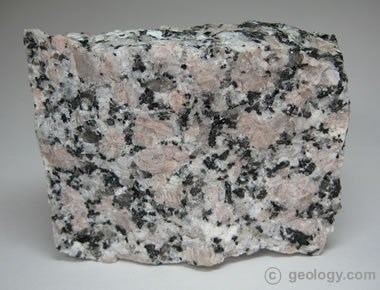 is the most widespread of igneous rocks, underlying much of the continental crust. Granite is an intrusive igneous rock. Intrusive rocks form from molten material (magma) that flows and solidifies underground, where magma cools slowly. Eventually, the overlying rocks are removed, exposing the granite. Granites usually have a coarse texture (individual minerals are visible without magnification), because the magma cools slowly underground, allowing larger crystal growth.
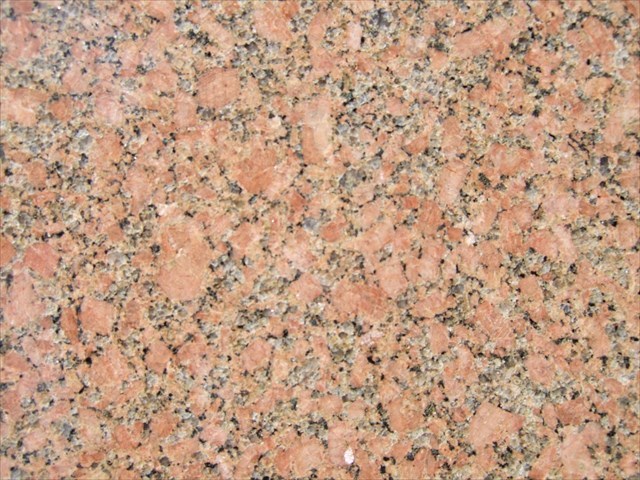 Granites are most easily characterized as light colored and coarse grained as a result of cooling slowly below the surface. Color variation is a response to the percent of each mineral found in the sample. The crystals in granite provide a variety of mixed colors — feldspar (pink or red), mica (dark brown or black), quartz (clear pink, white, or black) and amphibole (black).
Granite is high in quartz (about 25%), feldspar, and mica. It is widely used for architectural facades, construction materials, ornamental stone and monuments. Over 40% of dimension stone quarried is granite. Crushed granite is used as a durable construction material in asphalt and concrete used in highway and infrastructure projects.
How Granite Forms
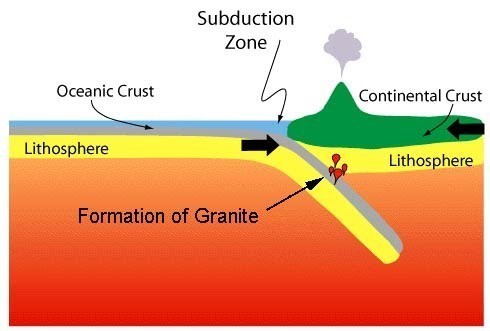 Granite is found in large plutons on the continents, in areas where the Earth's crust has been deeply eroded. This makes sense because granite must cool very slowly at deeply buried locations to produce such large mineral grains. Plutons smaller than 100 square kilometers in the area are called stocks, and larger ones are called batholiths.
Lavas erupt all over the Earth, but lava with the same composition as granite (rhyolite) only erupts on the continents. That means that granite must form by the melting of continental rocks. That happens for two reasons: adding heat and adding volatiles (water or carbon dioxide or both).
Continents are relatively hot because they contain most of the planet's uranium and potassium, which heat their surroundings through radioactive decay. Anywhere that the crust is thickened tends to get hot inside (for instance in the Tibetan Plateau).
And the processes of plate tectonics, mainly subduction, can cause basaltic magmas to rise underneath the continents. In addition to heat, these magmas release CO2 and water, which helps rocks of all kinds melt at lower temperatures. It is thought that large amounts of basaltic magma can be plastered to the bottom of a continent in a process called underplating. With the slow release of heat and fluids from that basalt, a large amount of continental crust could turn to granite at the same time.
Two of the most well-known examples of large, exposed granitoids are Half Dome and Stone Mountain.
Kok Beach Langkawi
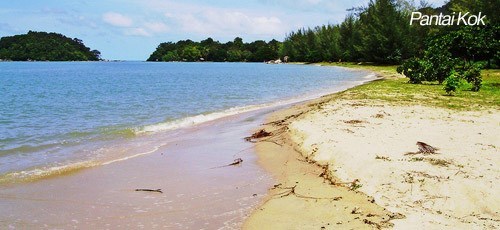 is a wonderful, serene and secluded public beach located at Pantai Kok along the western coast line of Langkawi. The beach with its crystal clear blue water and white sand looks picture perfect on a sunny day. The approach to this beach is from the road Jalan Pantai Kok.
There are naturally formed trails through the park to go up to the sands. You can actually see the beach from the road. And unlike Pantai Cenang or Pantai Tengah beaches, there are no hotels or resorts on this public beach (other than two luxury resorts tucked in a corner), neither any eateries to spoil the natural beauty, thus making it very quiet and secluded.
However on a weekend or public holiday, the beach can get crowded mostly by the local families who come here to picnic. There are actually no restrictions on Langkawi public beaches for picnics. Despite that, the beach is very well maintained and quite clean.
On a normal day when the beach is at its romantic best, just sit under a tree, hear the sounds of the waves pounding under your feet and look into the Andaman sea as the sailing boats and catamarans pass by - it's a wonderful experience. The sandy beach here is about 20 yards wide and has a curved stretch of about 700 meters long.
source:
- https://mineralseducationcoalition.org/minerals-database/granite/;
- https://www.langkawi-insight.com/langkawi_000023.htm;
- https://www.thoughtco.com/what-is-granite-1440992;
- https://flexiblelearning.auckland.ac.nz/rocks_minerals/rocks/granite.html
- http://geologylearn.blogspot.com/2015/03/granite.html
- http://www.idesign.wiki/granite/
To log this earthcache:
The best time for solving this earthcache is by lowtide, otherwise large parts of the granite will be hidden by the water.
- On certain granite rocks you see straight deep grooves. Granite is a very hard rock. How do these grooves get into the rock? Give at least 2 reasons.
- There are a lot of granite rocks lying on the beach. Each rock contains plenty of crystals. Estimate the average size (mm, cm or feet) of a crystal.
- Look for a piece of coral and granite of the same size. How many times heavier is granite compared to the piece of coral? (There are often some pieces of coral in the bushes behind the beach)
- Near the stairs which lead to the beach, there is a small infoboard about granite. According to the infoboard, to what does granite look like?
- Optional: Add a picture of yourself with granite on the background.
You are welcome to log your answers straight away to keep your TB's and Stats in order but please message us with your answers within 1 week of your log. Cacher’s who do not fulfil the Earth Cache requirement will have their logs deleted.
