You cannot walk by these cliffs without noticing all the colours in the stone. This EarthCache will allow you to work out why there are so many colours to be seen here in such a relatively small area.
This is an observational EarthCache - this means to answer the questions you only need to observe what you see here and use the information included in the listing to form your answers. No other research or previous knowledge is required so please do give this EarthCache a try!
Background to Sedimentary Rocks
It should be fairly obvious when you arrive here to see the rock is in very well defined layers and this means these are sedimentary rocks. Sedimentary rocks can be formed from particles of sand, shells, pebbles, and other fragments of material. Together, all these particles are called sediment. Gradually, the sediment accumulates in layers and over a long period of time hardens into rock. An example might be millions of years ago a flood caused a layer of sand to be deposited. This might create one layer of the rock you see here. Then maybe a few years or many years later another flood left another layer of sand. Again, another layer is created. This process continued for millions of years, the lower layers gradually getting squeezed more and more by the heavy deposits above them. The thickness of the layer is determined by the amount of sediment deposited, therefore a bigger and longer flood would deposit more sediment creating a thicker layer.
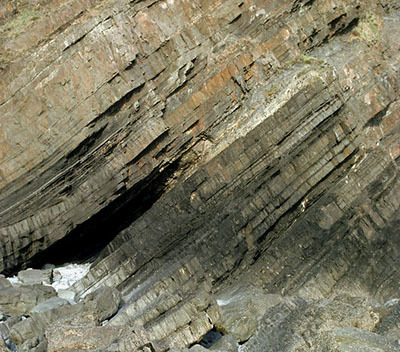
The sedimentary rocks you see before you here were deposited in a shallow sea during the Carboniferous period – about 320 million years ago. Sedimentary rock is not always consistent because each layer is formed at a different time and from a different 'batch' of sediment. This means some layers may be strong whilst some are more weak and therefore more susceptible to erosion forces many years later. The predominant rock you will see here is sandstone.
Colours of Sandstone
Sandstone can become coloured in different ways depending on a variety of factors. These are some of the colours you might see here.
White / light grey
Freshy cut sandstone is often a bluey grey colour or quite a pale white when first quarried/eroded. This could then later change to one of the other colours listed below when it has been exposed to the environment for a while - but this isn't always the case, the stone may retain it's original colour as it depends on the ingredients found within the stone. Once the stone is cut open it becomes exposed to the oxidants produced by oxygen and water and they could react with the stone and cause the colour to change.
Yellow / tan
The most common cementing materials in sandstone are silica and calcium carbonate, which are often derived either from dissolution or from alteration of the sand after it was buried. If this is the case, the sandstone will usually be tan or yellow in colour.
Red / Pink / Orange
Another frequently seen colourant in the cementing material is iron oxide, which provides reddish tints ranging from pink to dark red (terracotta). This may provide a permanent colour from the beginning of the life of the stone, however, iron oxide rusts when exposed to air and water over time so has the potential to stain over time.
Purple
Something else that can be found in the cementing material of sandstone is manganese and if manganese is present this would provide the sandstone with a purplish hue.
Blue / grey
Most sandstones are composed of quartz or feldspar (both silicates) because they are the most resistant minerals to weathering processes at the Earth's surface. This makes them the best choice for building materials. When there is a significant amount of clay or silt, geologists refer to the rock as argillaceous sandstone. Argillaceous sandstones are often gray to blue. This would be evidence in the texture of the stone and would be a weaker stone likely to erode more quickly making it a poor choice as a building material.
Green
Green sand is a sand or sandstone which has a greenish color. This term is specifically applied to shallow marine sediment, that contains noticeable quantities of rounded greenish grains. These grains are called glauconites and consist of a mixture of mixed-layer clay minerals, such as smectite and glauconite mica. Greensand forms in marine environments that are depleted of dissolved oxygen but rich in organic detritus and low in sedimentary input. Deposits of copper in non-marine sandstones are numerous and widespread as well and this can provide green patches within the stone. This is not to be confused with anything green that might be growing on the stone.
Black
Black sandstone isn't usually natural. The right mix of components might create a dark brown, dark red, dark blue or even a dark grey but if you are seeing black it most likely a crust on the rock caused by pollution. Most likely, it is a result of the deposition of particulate matter such as soot, something that was frequently a problem in bygone industrial times urban areas when industries were burning coal in very large quantities. You would expect this to be most noticeable on surfaces exposed to the pollution for extended periods of time. Some experts believe the right layer of pollution may be quite tough to the extent that it may protect the stone beneath from the elements. If this was the case, the blackened outer layer could be cleaned off to reveal the original colour of the stone (such as when they cleaned the pollution from the Houses of Parliament in London). In specific circumstances oil or volcanic material could also be responsible for blackening the stone but that isn't likely to be the case here.
Biological Colouring
If an organism grows on a stone it may look at a glance like the stone has been discoloured, but in fact the stone itself has not been discoloured as the organism is growing on top of it and provides the colour. This is not of any interest to us for the purposes of this EarthCache so if you see anything you believe isn't actually a colour of the rock, please disregard it.
Logging Requirements (Questions to Answer)
Take the riverside path to the listed coordinates beneath a sandstone cliff. It has been eroded, in some places quite recently, which helps to expose different colours. There is no need to go right up to the cliff, please view the rock from the path. The questions all relate directly to the information provided in the listing so you should be able to answer everything from GZ with no extra reading required. Please ensure you send in the answers at the time or soon after you log your find, as logs may be deleted if no attempt at the answers are made.
Q1 - Look for the most recently eroded bits of the rock - where it looks really fresh and new. Identify the colour of the stone when freshly eroded. What is the colour and what does this tell you about the stone?
Q2 - Now look for stone from the cliff that has been exposed to the air for some while (stone that has perhaps detached from the cliff a while ago). This is still displaying a natural colour but it is different to what you identified in question 1 - what colour is it and why has it changed?
Q3 - The presence of minerals can change the colour of the stone and this is definitely the case here. What other colours can you see different to the ones you have already identified and what minerals do you think are responsible?
Please note. Non spoiler photos are always welcomed. At the time of publication if you are in an area where there is no signal and you write your answers into the message center it will not queue the message to be sent later as it does with logs - instead it will be deleted immediately by the app if it fails to send. Please be aware of this as I need to receive your answers. If you don't get a pop up saying 'message sent' then it hasn't!
Thank you for visiting the 'Colours of Oswald' EarthCache