Background
The boulders and rocks you see littering the hill up here have long been believed to be the remnants of a mighty battle between two Saddleworth giants called Alphin and Alder. The giants lived across from each other on the two hills that mark the entrance to the Upper Tame Valley – Alderman's Hill and Alphin Pike. Sadly their friendship dissolved over their rivalry for the love of a beautiful water nymph called Rimon who lived in Chew Brook down in the valley below. Rimon took a fancy to Alphin, and as is the way with giant/water nymph love triangles – a fierce fight ensued that saw the two giants casting enormous boulders at each other across the valley from their respective hillside homes. Alphin lost, (he is buried near Giants Rock on Greenfield Moor), and Rimon, distraught, threw herself to her death from the top of the hill.
The Pots and Pans Stone is one of the reminders of that ferocious battle. Also known locally as the ‘Druids stone’, the rock you visit here is famous for the pots and pans-shaped bowls in the top - rumoured to have been used to catch the blood from human sacrifices. Legend also has it that water collected from these bowls can cure eye diseases.
Ok, that's what local legend says but geologists have taken a look and are quick to point out a more natural explanation. This EarthCache brings truth and shatters legends so you can leave here understanding the real reason these holes have formed in the stones here. This is an observational EarthCache - this means to answer the questions you only need to observe what you see here and use the information included in the listing to form your answers. No other research or previous knowledge is required so please do give this EarthCache a try!
Gritstone
To understand what has happened here we need to firstly understand the basic background to the rock that you see here. The northern Peak District is bounded on east and west sides by sandstone scarps. They are made of a rock often called "Millstone Grit". This is in fact a catchall for a variety of coarse sandstones, referred to here as "grits". The name "Millstone Grit" came about because certain varieties of Gritstone were commonly used to make millstones. Gritstone is actually a variation of sandstone and is made from sand, grit and rounded pebbles of quartz and some feldspar. The name ‘grit’ is used for many local sandstones and indicates the coarseness of the quartz grains in the rock, although the size of the particles in the sandstone is variable. Most of the sandstones of the Millstone Grit are coarse, with grains larger than 0.5mm and there are white quartz pebbles up to 10mm, especially in the Kinderscout Grit.
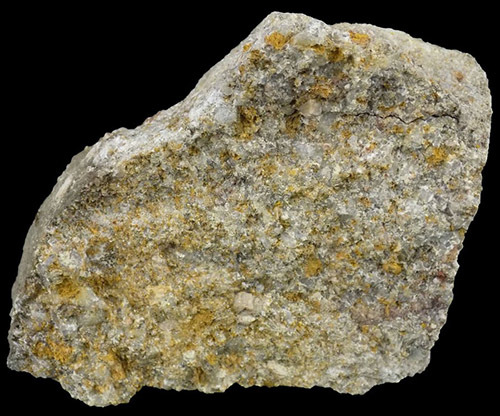
Gritstones were laid down in the delta of an immense river which flowed from a mountainous area. The land was below the sea, and every tide, every flood, dumped sand onto the sea floor. Generally the layers were thin and/or disturbed by currents. Occasionally some event would occur which laid down layers many metres thick in a very short time. All this happened around 300 million years ago, long before the dinosaurs. Eventually the grits were buried by muds, coal, and limestones. The layers of sand, under pressure and subject to chemical change, became rock. Eventually what is now England was pushed up out of the sea and erosion began creating all the gritstone formations you see up here today.
Pots and Pans - Rock Basins
The locals like to call them 'pots and pans' but elsewhere you'll often find similar features described as 'rock basins'. We now know that these basins are in fact naturally occurring and are a result of weathering. As explained above, gritstone is comprised of Quartz and Feldspar Crystals. It is the weaker Feldspar Crystals within the gritstone that are the key to the formation of these pots and pans. The weaker Feldspar Crystals are more susceptible to weathering by frost. This is similar to freeze thaw but on a smaller scale. Instead of large, visible to the naked eye, cracks within the rock this frost action specifically breaks down the crystalline structure of the Feldspar Crystal. The resulting small fragments that have been eroded from the rock are subsequently blown away by the wind. Over time this process repeats itself leaving a smooth hollow. This process continues to erode away at the base of the basin, as well as the sides, ever widening and deepening the basin.
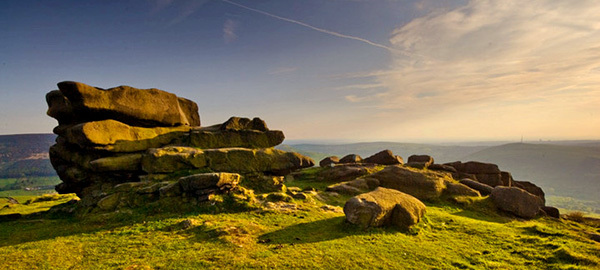
Because the exact ingredients of gritstone vary and the amounts of feldspar are not always the same, this type of weathering is not consistent across all gritstones and this explains why it occurs more frequently in some places than others. It is also important to note that, like freeze thaw weather, the creation of Rock Basins is reliant on water collecting on the surface, and later inside the hollow. For a significantly large basin to form, as are found here, the surface of the gritstone must also be flat, as well as containing weak Feldspar Crystals.
Questions to Answer (Logging Requirements)
Please visit the listed coordinates. You will need to get up onto the rock to see the basins, note the terrain rating. The questions all relate directly to the information provided in the listing so you should be able to answer everything from GZ with no extra reading required. Although there are a few questions, you only need a few words to answer them. Please ensure you send in the answers at the time or soon after you log your find, as logs may be deleted if no attempt at the answers are made.
1) How many basins bigger than 10cm wide are there here?
2) Describe the diameter and depth of the biggest of the rock basins.
3) Do you see anything smaller than 10cm that might be a basin starting to form? How many approximately?
4) Do the basins vary in size? What does this tell you about the ages of the basins?
5) Are all the basins still capable of holding water? If not, why not?
6) Why does this rock have these basins when others nearby do not?
7) Finally, the top surface has been damaged in another way that is not natural and not giants - what has happened to it?
Please note. Non spoiler photos are always welcomed. At the time of publication if you are in an area where there is no signal and you write your answers into the message center it will not queue the message to be sent later as it does with logs - instead it will be deleted immediately by the app if it fails to send. Please be aware of this as I need to receive your answers. If you don't get a pop up saying 'message sent' then it hasn't!
Thank you for visiting the Pots and Pans EarthCache