Gunung Raja
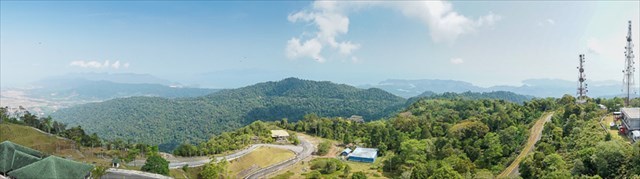
Gunung Raya is the highest mountain in Langkawi with an altitude of 881 meters. It is located in central Langkawi and has the sprawling Gunung Raya Golf Course at the base. The mountain is covered with dense rainforest which is full of amazing flora & fauna. The forest reserve spreads over an area of over 5000 hectares.
The peak is essentially a granite formation. There is a resort on top known as the D'Coconut Hill Resort. On a clear day, you get awesome panoramic view of the island and the Andaman sea from the peak. There is a watch tower that belongs to the resort but also open to the public.
Granite
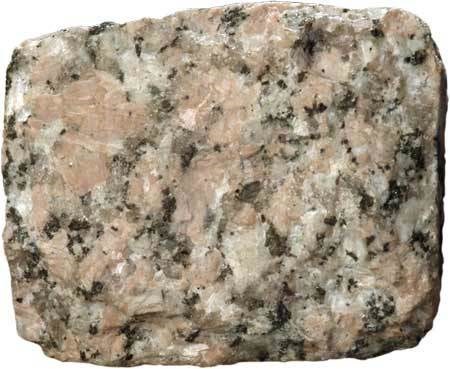 is a common type of felsic intrusive igneous rock that is granular and phaneritic in texture. Granites can be predominantly white, pink, or gray in color, depending on their mineralogy. The word "granite" comes from the Latin granum, a grain, in reference to the coarse-grained structure of such a holocrystalline rock. Strictly speaking, granite is an igneous rock with between 20% and 60% quartz by volume, and at least 35% of the total feldspar consisting of alkali feldspar, although commonly the term "granite" is used to refer to a wider range of coarse-grained igneous rocks containing quartz and feldspar.
The term "granitic" means granite-like and is applied to granite and a group of intrusive igneous rocks with similar textures and slight variations in composition and origin. These rocks mainly consist of feldspar, quartz, mica, and amphibole minerals, which form an interlocking, somewhat equigranular matrix of feldspar and quartz with scattered darker biotite mica and amphibole (often hornblende) peppering the lighter color minerals. Occasionally some individual crystals (phenocrysts) are larger than the groundmass, in which case the texture is known as porphyritic. 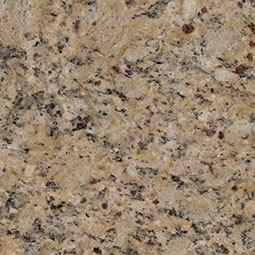 A granitic rock with a porphyritic texture is known as a granite porphyry. Granitoid is a general, descriptive field term for lighter-colored, coarse-grained igneous rocks. Petrographic examination is required for identification of specific types of granitoids. The extrusive igneous rock equivalent of granite is rhyolite.
Granite is nearly always massive (i.e., lacking any internal structures), hard, and tough. These properties have made granite a widespread construction stone throughout human history. The average density of granite is between 2.65 and 2.75 g/cm3 (165 and 172 lb/cu ft),[3] its compressive strength usually lies above 200 MPa, and its viscosity near STP is 3–6·1019 Pa·s.
The melting temperature of dry granite at ambient pressure is 1215–1260 °C (2219–2300 °F); it is strongly reduced in the presence of water, down to 650 °C at a few kBar pressure.
Granite has poor primary permeability overall, but strong secondary permeability through cracks and fractures if they are present.
1. Quartz
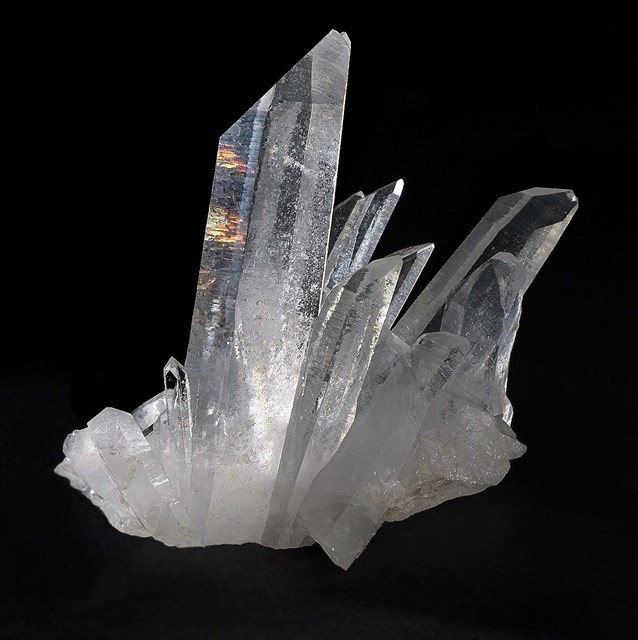 Quartz is one of the most well-known minerals on earth. It occurs in basically all mineral environments, and is the important constituent of many rocks. Quartz is also the most varied of all minerals, occurring in all different forms, habits, and colors. There are more variety names given to Quartz than any other mineral. Although the Feldspars as a group are more prevalent than Quartz, as an individual mineral Quartz is the most common mineral.
Some forms of Quartz, especially the gemstone forms, have their color enhanced. Almost all forms of the yellow-brown variety Citrine are in fact heat treated. Much Amethyst is also heat treated to intensify color, and a green transparent form known as "Green Amethyst" or "Prasiolite" is formed by heat treating certain types of Amethyst. There is also a transparent sky blue form of Quartz crystals, as well as a wildly iridescent type that are synthetically colored by irradiation of gold. In some localities, Hematite forms a thin red or brown layer internally in the Quartz crystal, giving it a natural bright red to brown coloring, and sometimes even a mild natural iridescence.
2. Feldspar
Feldspar is the name given to a group of minerals distinguished by the presence of alumina and silica (SiO2) in their chemistry. This group includes aluminum silicates of soda, potassium, or lime. It is the single most abundant mineral group on Earth. They account for an estimated 60% of exposed rocks, as well as soils, clays, and other unconsolidated sediments, and are principal components in rock classification schemes. The minerals included in this group are the orthoclase, microcline and plagioclase feldspars.
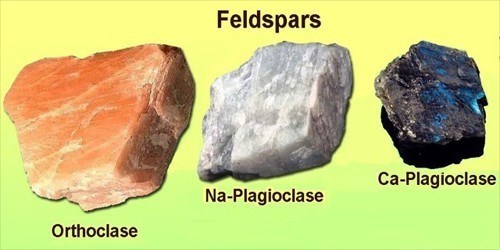
Feldspar is mined from large granite bodies (called plutons by geologists), from pegmatites (formed when the last fluid stages of a crystallizing granite becomes concentrated in small liquid and vapor-rich pockets that allow the growth of extremely large crystals), and from sands composed mostly of feldspar.
3. Mica
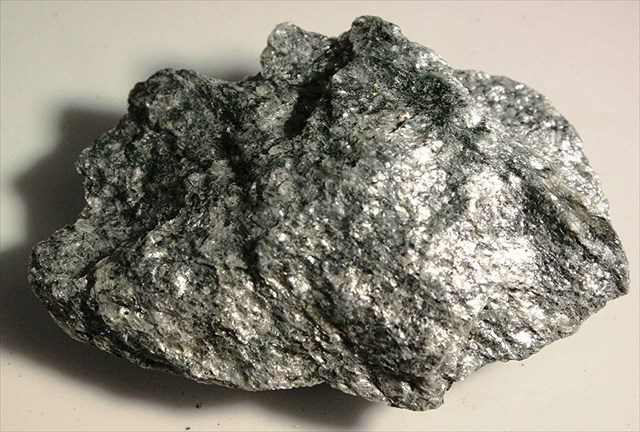 Mica is a mineral name given to a group of minerals that are physically and chemically similar. They are all silicate minerals, known as sheet silicates because they form in distinct layers. Micas are fairly light and relatively soft, and the sheets and flakes of mica are flexible. Mica is heat-resistant and does not conduct electricity. There are 37 different mica minerals. The most common include: purple lepidolite, black biotite, brown phlogopite and clear muscovite.
The mica industry can be divided into two distinct but interdependent industries: those that produce sheet mica, and those that produce flake mica. Each industry, although somewhat dependent on the other, produces different end products.
Source
- https://www.langkawi-insight.com/langkawi_00006c.htm
- https://en.wikipedia.org/wiki/Granite
- https://www.minerals.net/mineral/quartz.aspx
- https://mineralseducationcoalition.org/minerals-database/feldspar/
- https://mineralseducationcoalition.org/minerals-database/mica/
- https://geology.com/rocks/granite.shtml
- http://www.assignmentpoint.com/geographic-minerals/feldspars.html
- https://www.onlinesciencemall.com/products/fine-grained-muscovite-mica-schist-rock-2-pieces-of-mineral-specimen
- http://www.langkawi-info.com/attractions/gunung-raya.htm
- https://timesofindia.indiatimes.com/travel/destinations/Gunung-Raya-Forest-Reserve/ps47813896.cms
To log this earthcache:
To the right of the viewing platform (left of you), you can see a big rock of granite. Pls try to solve the next questions:
- Can you see the difference between natural erosion and secundary erosian (processed by humans)? Explain.
- At the vertical edge of the rock you can see a long tortuous vein of quartz. Pls measure the lenght of this vein in cm or feet.
- You can spot a concentration of Mica crystals in the rock. Pls measure the lenght and the width in cm or feet.
- What's the altitude of the viewing platform?
- Optional: Add a picture of yourself at the viewing platform with the rock of granite in the background.
You are welcome to log your answers straight away to keep your TB's and Stats in order but please message us with your answers within 1 week of your log. Cacher’s who do not fulfil the Earth Cache requirement will have their logs deleted.
