The posted coordinates place you on the northern edge of the beautifully rugged Possil Marsh Wildlife Reserve, directly in front of a memorial to the little-known High Possil meteorite fall.
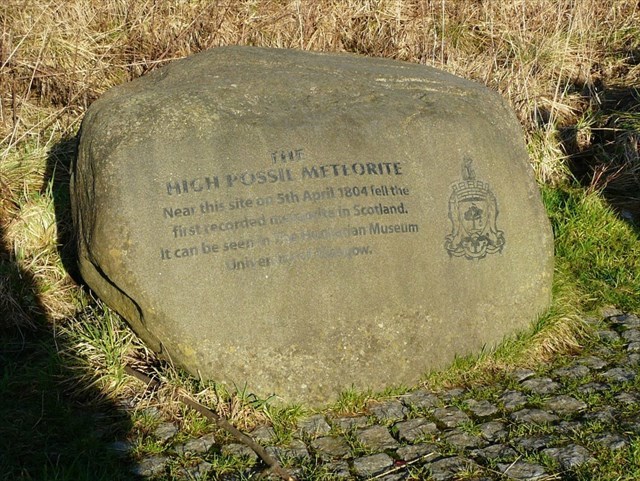
The High Possil meteorite memorial, in Possil Marsh Wildlife Reserve.
Somewhere nearby, though not within the Wildlife Reserve itself, a cache is hidden. However, you will have to answer some questions about the impact in order to find it! The answers to all these questions can be found within the text below.
The High Possil Impact
Most meteorites fall to the Earth completely unobserved and are only identified, often years later, by virtue of the fact that they stick out from their surroundings like a sore thumb. About 98% of the 55,000 meteorites currently on record were discovered in this way, mostly in flat and desolate areas of the planet such as Antarctica and the Sahara desert.
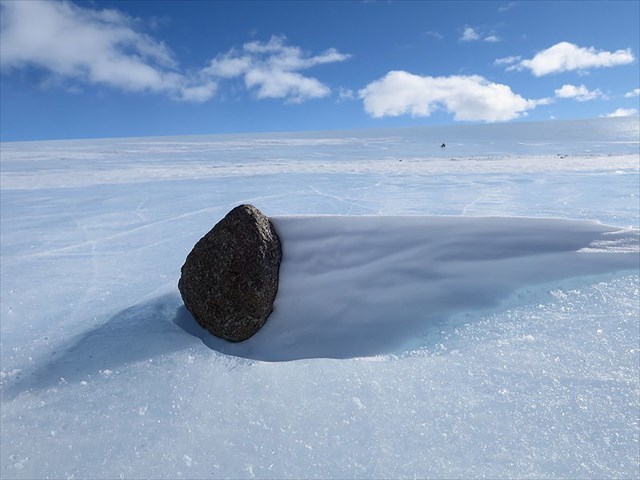
A recent meteorite "find" in antarctica.
The remaining 2% of meteorites are actually observed falling through the sky and hitting the ground. The High Possil meteorite was the first meteorite of this kind to be observed in Scotland, and it was instrumental in convincing scientists of the time that meteorites were, indeed, rocks that fell from space. The High Possil meteorite fell to the ground on the cold and cloudy morning of Thursday 5th April, 1804.
Records from the time are patchy so nobody now knows exactly where the High Possil meteorite hit the ground. However, based on the few surviving reports, it probably made impact in a quarry just south-east of the Balmore Road Bridge over the Forth and Clyde Canal, in the modern-day area of Lambhill. The quarry has long since been filled in and redeveloped (with all records of its exact location being lost) and the High Possil memorial is probably about a kilometre north of the impact site. A story about the impact was published in The Herald and Advertiser newspaper on Monday April 30th, 1804, and this is where most of our current understanding about the impact comes from.
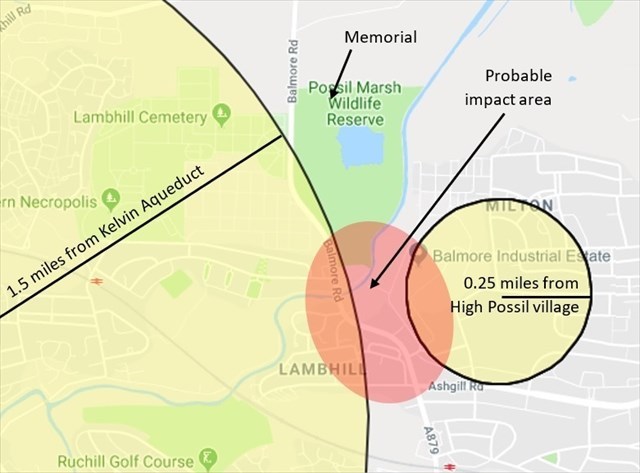
Records suggest that the meteorite impacted a quarry 1.5 miles from the Kelvin Aqueduct and 0.25 miles from the now non-existent High Possil village. On the basis of this information, the most probable impact area is highlighted in red.
According to The Herald and Advertiser, three men at work in a field on a cold, cloudy afternoon were alarmed by a "singular noise, which continued, they say, for about two minutes.”. The noise was also heard by some quarrymen who described it as initially sounding like "three or four cannon had been fired off” with the sound later evolving into a “violent rushing, whizzing noise”. Similar reports were made from all over Glasgow and the meteorite fall appears to have been heard from as far afield as Falkirk, some 24 miles away.
The overseer of the quarry, who heard the noise and then looked up into the sky, observed the atmosphere to be in “a misty commotion” whilst a nearby boy says that he “observed the appearance of smoke in it, with something of a reddish colour moving rapidly through the air.” The overseer was so alarmed by what he heard and saw that he reportedly called out to a college, who was sitting in a nearby tree, "come down, I think there is some judgement coming upon us".
The meteorite made landfall around 100m away from the overseer, landing in a drain and “splashing mud and water for about twenty feet around”. The overseer immediately ran up to the place where the splashing was observed and “saw a hole made at the bottom of the drain” which was about 40cm (15 inches) in diameter. The hole was filling with water so the overseer “having made bare his arm, thrust his hand and arm into the hole” and immediately “felt something hard, which he could not move with his hand”. The hole was then cleared out “with the expectation that a cannon ball might be found” but nothing was observed except for two pieces of smooth, black stone (together, about half the size of a brick) that had penetrated a few inches through the rock. Believing the stones to be common whinstone, they were discarded “as of no interest” with the rest of the quarry’s rubble.
Unknown to the quarry men, the two pieces of stone found at the bottom of the hole were actually the fractured remains of the High Possil meteorite, sitting at the bottom of a water-logged impact crater. It was not until some days later, when the story had spread to the ears of local scientists, that the true identity of the stones was realised. At this point, the scientists and the owner of the quarry organised a careful search for what was left of the fragments. Unfortunately not all of the meteorite could be found again and, today, only about 380g of the estimated 4.5kg meteorite still exists, shared between various small pieces held by scientific institutions around the world. The largest fragment remained in the possession of the quarry owner, Robert Crawford, until it was donated to the Huntarian Museum in 1810, shortly after Robert died.
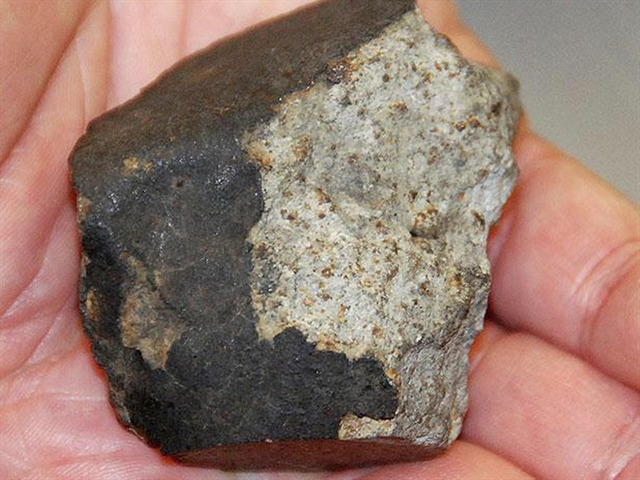
The fragment of the High Possil meteorite held by the Hunterian Museum. The grey coloured rock is the original meteorite, exposed to view when it broke in half. The black material is a "crust" of glass formed as a result of the outer layers of the meteorite heating up to around 15,000°C as it traveled through our atmosphere.
A scientific analysis of the meteorite fragments has revealed a great deal about the mineralogical composition and origin of the meteorite. Technically, the High Possil meteorite is classified as an L6 ordinary chondrite, meaning it has a low iron content (5-10%) and indistinct chondrules. The Flora family of asteroids, located in the inner region of the asteroid belt, have a similar composition and it is currently believed that both the Flora asteroids and the High Possil meteorite were formed, around 100 million years ago, when a much older and much larger asteroid (originally over 100km in diameter) broke apart in a collision.
QUESTION 1
Express the date of the High Possil meteorite fall in the form ddmmyyyy.
Digit 2 = A
Digit 4 = B
QUESTION 2
The minimum number of “cannon” heard by the quarrymen is C.
QUESTION 3
The remaining fragments of the original meteorite have a total mass of DE0g.
QUESTION 4
The diameter of the impact crater, in inches, is FG.
QUESTION 5
The total number of meteorites currently on record is HI,000.
QUESTION 6
The asteroid collision that probably formed the High Possil meteorite occurred approximately 1J0 million years ago.
FINAL COORDINATES
The cache is located at N55° AB.CDE, W004° FG.HIJ