
 ESPAÑOL |
 ENGLISH
| VERSIÓN EN ESPAÑOL |
01 / EL LUGAR
Una torre junto al Guadalquivir
La Torre del Oro es una torre albarrana situada en la margen izquierda del Guadalquivir, en Sevilla, cerca de la plaza de toros de la Real Maestranza. Unos lienzos de muralla la unían a la Torre de la Plata y, a través de la coracha, al Alcázar; defendía el acceso fluvial y el paso al Arenal.
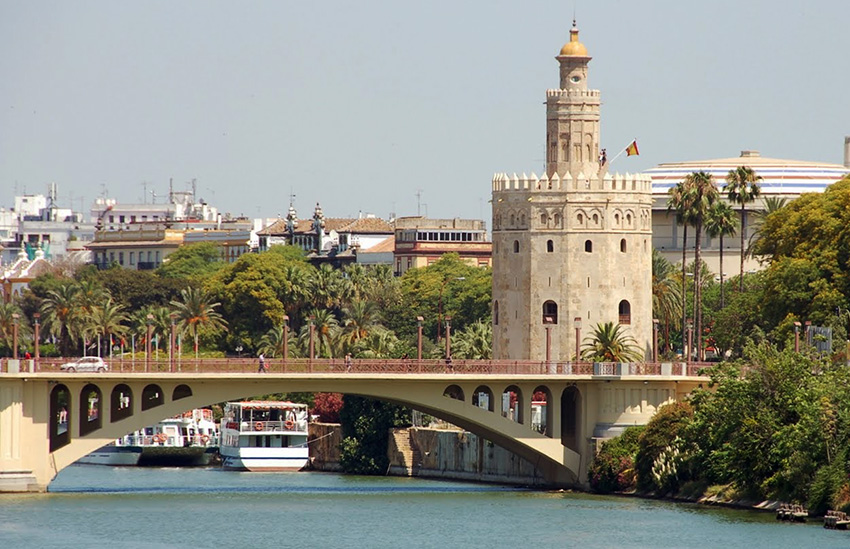
El río, la torre y los materiales que observarás · Foto: Turismo de Sevilla
36 m
altura actual |
s. XIII
origen almohade |
1931
declaración monumental |
Según la tradición, el nombre se debía a reflejos producidos por un antiguo revestimiento de azulejos. Las investigaciones realizadas durante la restauración de 2005 atribuyen aquel brillo al mortero de cal y paja prensada. Fue declarada monumento histórico-artístico en 1931.
02 / LA CONSTRUCCIÓN
Tres cuerpos, tres formas de mirar
Dos cuerpos inferiores dodecagonales de época almohade y un remate superior cilíndrico, con cúpula, añadido en 1760 por Sebastián Van der Borcht. El primero comenzó a construirse hacia 1220–1221; en la actualidad la torre mide unos 36 metros.

Compara los tres cuerpos del esquema con los de la torre real · Dibujo ilustrativo, no a escala
Los materiales cambian según la altura: el cuerpo inferior es de tapial sobre un basamento de sillares, con refuerzos de piedra en las esquinas; el cuerpo intermedio y el remate son principalmente de ladrillo. Cuando respondas sobre el tacto de la piedra, busca el basamento o los sillares visibles, sin alterar el monumento.
03 / GEOLOGÍA
¿Cómo se desgasta la piedra?
La meteorización altera o fractura la roca en el mismo lugar. La erosión desprende y desplaza material mediante agentes como agua, viento o gravedad. Ambos procesos pueden combinarse; observar una superficie áspera o agrietada no demuestra por sí solo qué agente la produjo.

Meteorización → desprendimiento y transporte · Esquema conceptual
Estos son ejemplos generales de agentes y subtipos. No significa que todos hayan actuado sobre esta torre: en tu respuesta relaciona lo que veas con una explicación razonada.
AGUA / EROSIÓN HÍDRICA
Marina: el oleaje puede tallar acantilados.
Fluvial: los ríos y algunas corrientes subterráneas desgastan materiales a su paso.
Pluvial: la lluvia puede golpear y arrastrar partículas.
Glaciar: el hielo en movimiento puede desgastar el terreno.
Congelación en grietas: el agua al helarse puede fracturar la roca; esa fractura es meteorización. El transporte posterior de fragmentos sí es erosión. |
VIENTO / EROSIÓN EÓLICA
Acción del viento: desplaza partículas sueltas.
Abrasión: los granos transportados por el aire pueden golpear y desgastar superficies. |
GRAVEDAD / TRANSPORTE GRAVITATORIO
La gravedad favorece que bloques o granos ya desprendidos se desplacen hacia abajo. |
04 / PREGUNTAS Y REGISTRO
ENVÍA TUS RESPUESTAS
Envíanos las respuestas preferentemente por el Centro de Mensajes de Geocaching o, si lo prefieres, por correo electrónico a igeie.cache@gmail.com. Una vez enviadas, puedes registrar el EarthCache como encontrado sin esperar nuestra respuesta. Si necesitamos alguna aclaración, nos pondremos en contacto contigo. |
01 · Al tacto, ¿la piedra de la torre es suave o áspera?
|
| 02 · ¿Qué tipo o tipos de erosión se pueden apreciar en la torre y por qué? Menciona algún subtipo. |
| 03 · Foto opcional. Si quieres, puedes subir una foto del lugar con tu registro. |

| ENGLISH VERSION |
01 / THE PLACE
A tower beside the Guadalquivir
The Torre del Oro is a detached defensive tower (torre albarrana) on the left bank of the Guadalquivir in Seville, near the Real Maestranza bullring. Sections of wall linked it to the Torre de la Plata and, through the fortified wall, to the Alcázar. It guarded access by river and to the Arenal on land.
The river, the tower and the materials you will observe · Photo: Turismo de Sevilla
36 m
present height |
13th c.
Almohad origins |
1931
heritage designation |
Traditionally, the name “Tower of Gold” was explained by reflections from an earlier tile covering. Research during restoration in 2005 attributed the gleam instead to a mixture of lime mortar and pressed straw. The tower was declared a historic-artistic monument in 1931.
02 / THE CONSTRUCTION
Three sections, three ways to look
Two lower, twelve-sided sections from the Almohad period and an upper cylindrical section with a dome, added in 1760 by Sebastián Van der Borcht. Construction of the first section began around 1220–1221; today the tower stands about 36 metres tall.
Compare the diagram with the actual tower · Illustrative drawing, not to scale
Its materials also change with height: the lower section has rammed-earth walls over a stone-block base, with stone reinforcements at the corners; the middle and upper sections are mainly brick. For the question about how the stone feels, find the visible base or stone blocks without damaging the monument.
03 / GEOLOGY
How does stone wear away?
Weathering changes or breaks rock in place. Erosion removes and moves material through agents such as water, wind and gravity. These processes can work together. A rough or cracked surface alone does not tell you which agent caused it.
Weathering → removal and transport · Conceptual diagram
The following are general examples of agents and subtypes. They have not all acted on this tower: base your answer on the features you actually see and explain your reasoning.
WATER / WATER EROSION
Marine: waves can carve cliffs.
Fluvial: rivers and some underground streams wear away material along their course.
Rainfall: raindrops can strike and carry away particles.
Glacial: moving ice can wear away the ground.
Freezing in cracks: water expands as it freezes and can fracture rock; that fracture is weathering. Any later movement of fragments is erosion. |
WIND / WIND EROSION
Wind action: moving air displaces loose particles.
Abrasion: wind-blown grains can strike and wear away surfaces. |
GRAVITY / GRAVITATIONAL TRANSPORT
Gravity helps carry detached stones or grains downhill. |
04 / QUESTIONS AND LOG
SEND YOUR ANSWERS
Please send us your answers, preferably through the Geocaching Message Center or by email to igeie.cache@gmail.com. Once you have sent them, you may log the EarthCache as found without waiting for our reply. If we need any clarification, we will contact you. |
| 01 · To the touch, is the stone of the tower smooth or rough? |
| 02 · What kind or kinds of erosion can you see in the tower, and why? Mention a subtype |
| 03 · Optional photo. If you wish, you may add a photo of the place to your log. |