The International
System of Units (SI), commonly known as the metric system, is the
international standard for measurement. The SI plays an essential role
in international commerce and is commonly used in scientific and
technological research and development. This cache is part of the
SI geoart that allows you to learn about the SI units.
Visit the introduction cache to
learn more about this geoart.
Electric potential
difference: volt (V)
The volt is the SI
base unit of electric potential, electric potential difference, and
electromotive force. It is defined as the difference in electric
potential between two points of a conducting wire when an electric
current of one ampere
dissipates one watt of power
between those points. Electric potential difference, one of the measured
quantities, is also named voltage.
Mains electricity in different countries may have different voltages
and frequencies. For
example:
- Japan: 100V 50Hz.
- United States: 120V 60Hz.
- China: 220V 50Hz.
- Italy: 230V 50Hz.
Consequently, appliances sold in one country may not work in another
country.
Batteries, on the other hand, are fairly universal:
- Alkaline battery: 1.5V.
- Cellphone battery: 3.7V.
- USB power bank: 5V.
Therefore, you can use a battery from any country to open gadget
caches, as long as they have the same voltage!
Electrical capacitance: farad
(F)
The farad is the SI
derived unit of electrical capacitance. It is defined as the capacitance
across which, when charged with one coulomb, there is a potential
difference of one volt.
Electrical capacitance is the ability of an object to store
electrical charge. A device designed to store electrical energy between
two terminals is called a capacitor. In general electronics
design, capacitor values range from 1 picofarad (pF) (10-12F)
to 1 millifarad (mF) (10-3F).
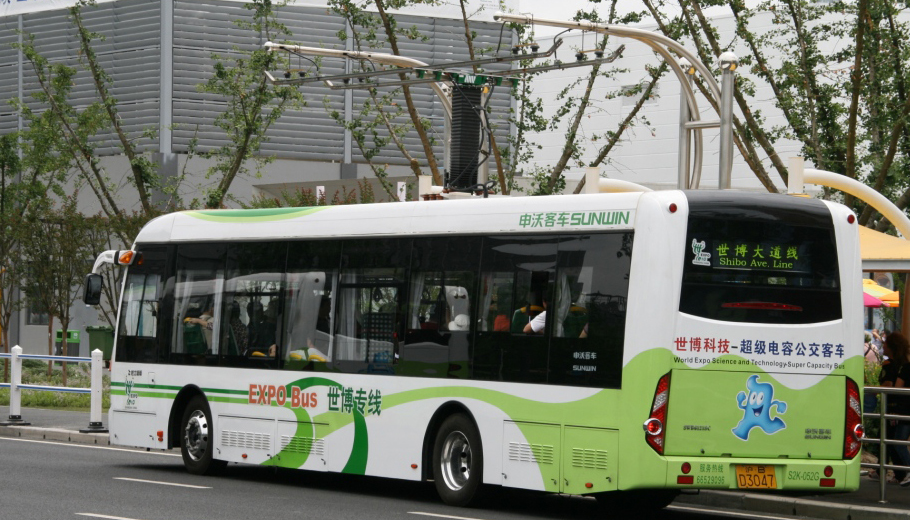
A supercapacitor
is a high-capacity capacitor. Its capacity can be over 100F, enough for
operating a vehicle. While supercapacitors can store much less energy
than batteries, they can recharge very fast, so they are suitable for
city buses that stop frequently at fixed locations.
A flux
capacitor is a device that enables time travel.
yoursunny is unable to find specifications of its capacity
in farads.
This Geocache
What’s the voltage used by the tram system near GC7B6MM? Multiply by ⅚ to get
ABC.
188 microamperes of electric current flows into an uncharged
capacitor for 601298 nanoseconds, it gains a potential difference of 236
volts. What’s the capacitance in picofarads? Round to an integer to get
DEF.
Final coordinates: N 39° 08.ABC W 077° 08.DEF

You can validate your puzzle solution with
certitude.
Cache container is a baby-nano with tiny log sheet. A pair of tweezers
is mandatory for log retrieval. To conserve space, please omit the date
and write the first two letters of your username only.
Some hides are located along a road without sidewalk. For your safety,
please walk on the grass out of the car lanes, and avoid going at night
without wearing a safety vest.
Lists of Caches in SI geoart
-
introduction
-
second and hertz
-
metre
-
kilogram
-
m/s and km/h
-
mole
-
radian and steradian
-
m/s² and newton
-
m² and pascal
-
joule and watt
-
ampere and coulomb
-
volt and farad
-
ohm
-
kelvin
-
candela, lumen, and lux
-
bushel
-
foreword & afterword
-
prize distribution