Local information
Here is a view of two drastically looking different creeks. Hell creek coming in from the north northeast and going under the bridge here has vastly minimal down-cutting evidence compared to the when you look west from the bridge. Looking west you see very steep cliffs caused by down-cutting. The down-cutting there is caused by the West and South Papio creeks. You can notice the drastic elevation difference between Hell and creek and the other two. It is here at the confluence of West Papio Creek, South Papio Creek, and Hell creek that humans have experienced great loss. History shows us that many lives have been taken due to flooding along these creeks. In fact, in the summer of 1964 eight inches of rain fell on this watershed in a span of only three hours. This storm created a flood that killed seven people and created a roaring torrent of water with white capped waves that where five feet high. Humans have gone to great lengths to try and tame these creeks. Located under the bridge is a down-cutting stabilization control. By allowing Hell creek to run over the top of the structure it slows the creek down and prevents down-cutting. If this structure was not in place the creek bed here would be just as deep as the other two and upstream there would greater loss of infrastructure. Over time it is down-cutting like this that creates vast valley's.
Downcutting: is a geological process by hydraulic action that deepens the channel of a stream or valley by removing material from the stream's bed or the valley's floor. The speed of downcutting depends on the stream's base level, the lowest point to which the stream can erode. Sea level is the ultimate base level, but many streams have a higher "temporary" base level because they empty into another body of water that is above sea level or encounter bedrock that resists erosion.
What is Erosion?
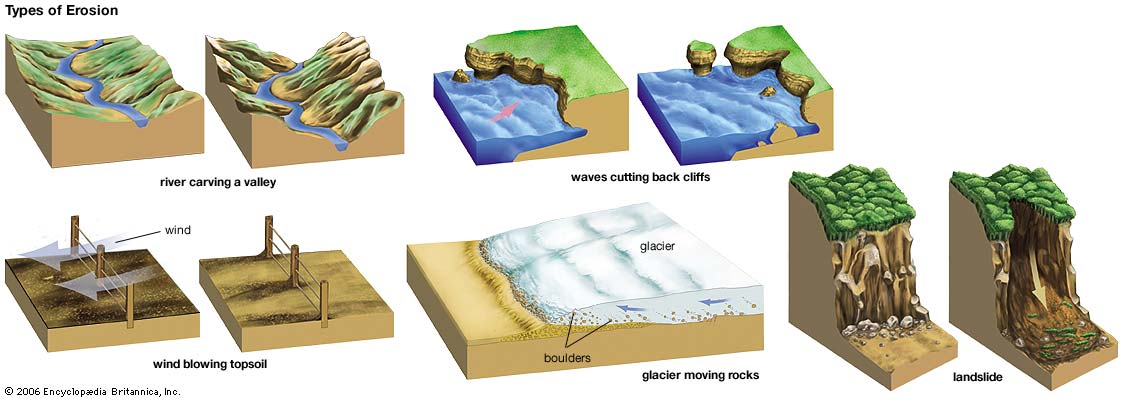
Erosion is the process by which soil and rock are removed from the Earth's surface by natural processes such as wind or water flow, and then transported and deposited in other locations.
Types of Erosion:
Splash Erosion: Small soil particles are detached and sent airborne through the impact of raindrops on soil.
Sheet Erosion: Raindrops break apart the soil structure and it's moved down-slope by water that flows overland as a sheet rather than definitive channels. This occurs frequently during cloud bursts.
Rill Erosion: This process develops small, short-lived, concentrated flow paths. These paths create a sediment source and delivery system for hill-slope erosion. Areas where precipitation rates exceed soil infiltration rates are more prone to this type of erosion.
Gully Erosion: Water flows in narrow channels during or directly following heavy rains or melting snow. The gullies can erode to considerable depths.
Valley or Stream Erosion: Continual water flow alongside land (along a linear feature) creates this type of erosion. It extends downward, deepening a valley, and head-ward, extending the valley into the hillside. This occurs most frequently in times of flooding.
Bank Erosion: Over time, banks of rivers and streams are naturally worn down.
Freezing and thawing: Cold weather causes water trapped in tiny rock cracks to freeze and expand, breaking the rock into several pieces.
Wind erosion is a major geomorphological force, especially in arid and semi-arid regions. Wind erosion is of two primary varieties: deflation, where the wind picks up and carries away loose particles; and abrasion, where surfaces are worn down as they are struck by airborne particles carried by wind.
Mass movement is the downward and outward movement of rock and sediments on a sloped surface, mainly due to the force of gravity. Mass movement is an important part of the erosional process, and is often the first stage in the breakdown and transport of weathered materials in mountainous areas. It moves material from higher elevations to lower elevations where other eroding agents such as streams and glaciers can then pick up the material and move it to even lower elevations. Mass-movement processes are always occurring continuously on all slopes; some mass-movement processes act very slowly; others occur very suddenly, often with disastrous results.
Source: (water)
**Logging requirements**
DO NOT POST ANSWERS IN YOUR LOG.
Send the following answers to me via email.
- The text "GC86F0X Down-Cutting" on the first line
- How many steps are in the main down-cutting control structure?
- What color are the quartz rocks used below the down-cutting control structure, right before Hell creek dumps into the other two creeks?
- How much more deeper do you think the down-cutting is between hell creek and the other two?
| I have earned GSA's highest level: |
   |