This earthcache will take you to Second Beach, also known as Surfers End. In summer months you will need to pay a parking fee.
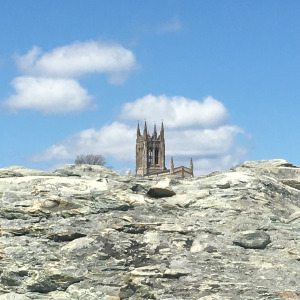
You will be walking around and taking observations of the rocks at this location. Geologists especially like this area because this rock outcrop seems out of place for its location on a beach. This rock is classified as a Conglomerate rock. A nickname for this type of rock is also known as Puddingstone. Conglomerate rocks are made up of pebbles, cobbles, or small boulders that are rounded or subangular in shape. The pebbles, cobbles, or small boulders get rounded by moving water. At some point, other smaller bits of rock fragments came together and cemented around the pebbles keeping them locked in place to form an even larger rock. This type of rock at this location can also be seen at Purgatory Chasm and Hanging Rock. In the above photo, you can see this location has a terrific view of the St. George church spires.
You will need to answer the following questions and email me your findings:
1. Standing at the listed coordinates, what cardinal direction are the cobbles all pointing towards? What may this tell you about the direction the cobbles traveled in order to get to their current position?
2. Describe the texture of the small 'cobbles'? Are they smooth or jagged? Are they circular, elongated, have any shape at all to them? What about the texture of the area around the rocks? What does that look / feel like? What do you think that material is?
3. Go to stage 2 coordinates where you will get to stand in between 2 rocks and see the cross sections for both. Walk around the 2 rocks and take a look at the hollows/voids and overall shape. Based on your findings, what can you hypothesize about these two rocks?
4. OPTIONAL: Take a photo of yourself and GPS at this location!