Welcome to Laginha Beach on Porto Grande (sometimes called Mindelo Bay).
The 15 x 25 km island of Sao Vicente contains mafic lavas covering prominent peninsulas on the eastern and NE sides. The largest indentation on this island with an irregular shoreline is formed by a caldera on the NW coast that is breached by the sea and forms the setting for the port of Mindelo, the island's largest village.1
Geology
The islands in the Cape Verde Archipelago are overwhelmingly of igneous constitution, with basic volcanics and pyroclastics comprising some 83% of the total area, and sedimentary rocks amounting to some 9%. Volcanics and plutonics are distinctly basic in character, the archipelago representing a soda-alkaline petrographic province, with a petrologic succession similar to that in other Atlantic islands.2
Harbours
Harbours may be natural or artificial. An artificial harbour can have deliberately constructed breakwaters, sea walls, or jettys or they can be constructed by dredging, which requires maintenance by further periodic dredging. A natural harbour is surrounded on several sides by prominences of land.3
Beaches
A beach is a dynamic geologic feature that can fluctuate between advancement and retreat of sediment. The natural agents of fluctuation include waves, tides, currents, and winds. Man-made elements such as the interruption of sediment supply, such as a dam, and withdrawal of fluid can also affect beach stabilization. Static equilibrium refers to a beach that is stable and experiences neither littoral drift nor sediment deposition nor erosion. Waves generally diffract around the headland(s) and near the beach when the beach is in a state of static equilibrium. Dynamic equilibrium occurs when the beach sediments are deposited and eroded at approximately equal rates. Beaches that have dynamic equilibrium are usually near a river that supplies sediment and would otherwise erode away without the river supply. Unstable beaches are usually a result of human interaction, such as a breakwater or dammed river. Unstable beaches are reshaped by continual erosion or deposition and will continue to erode or deposit until a state of equilibrium is reached in the bay.4
Winds
The prevailing trade winds here are from the NE, at Force 3 to 5, and are pretty much constant. The harbour is subject to strong gusts, especially in winter.5
Coastal sediment processes
The term “coastal sediment processes” refers to the forces that erode, transport and deposit sediment along shorelines. The coastal environment consists of constantly changing conditions, caused by the forces of wind, waves, currents and tides. Beaches are composed of sediment of various sizes, from large boulders to fine sand or mud. Erosion occurs when sediment is removed from a particular location (e.g. by wind, rain or waves); deposition occurs where sediment is added to a location.6
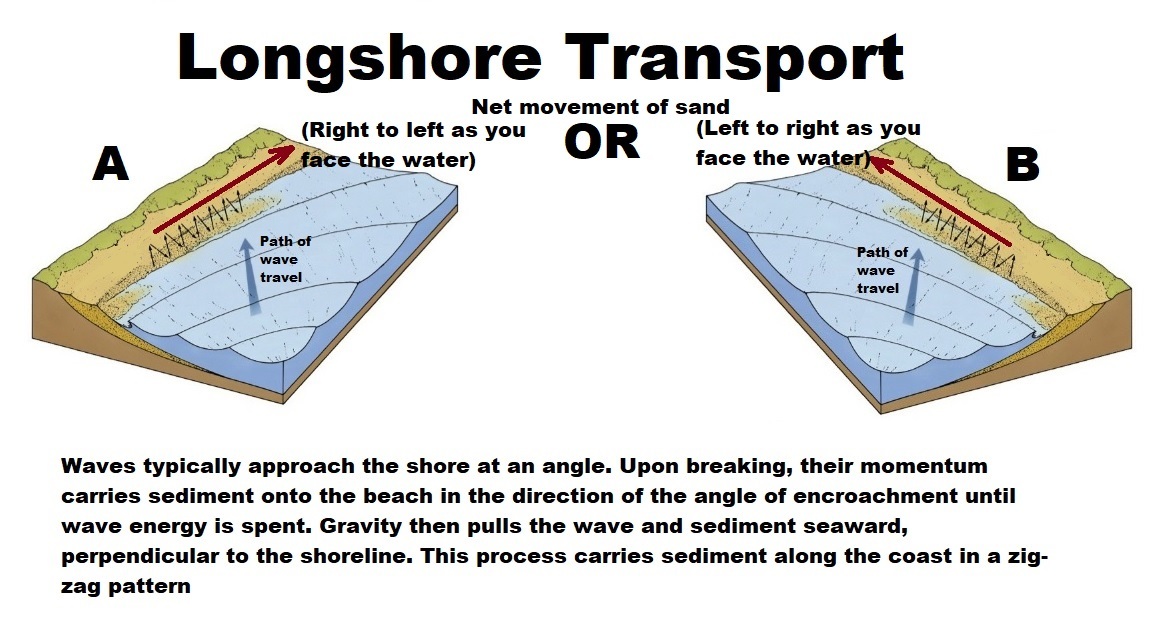
Refraction causes waves to bend to meet the shoreline. Yet, when waves initially contact the shoreline on an angle, their energy creates a long shore current that travels parallel to the shore, between the breaking waves and the shoreline. As these waves break and recede along a shoreline, they erode and deposit sediment in a zigzag pattern called long shore transport (see Figure below).
To log this earthcache, please answer the following questions:
- The water in front of you is part of Porto Grande (sometimes called Mindelo Bay). Is Porto Grande a natural harbour or an artifial harbour? Why? Give 3 examples of natural harbours. Give 3 examples of artificial harbours.
- What colour is the sand at this beach? Why do you think the sand is this colour when all the islands in the Cape Verde archipelago are predominately composed of black basalt? Is the grain size of the sand very fine, fine, coarse or very coarse? Is the texture of the sand smooth, rounded grains or rough, angular grains?
- Examine the waves as they come into the beach. Can you detect the angle of approach? Is the longshore current very weak, weak, strong or very strong? Looking at the Longshore Transport figure above which case do you think applies to the conditions at this beach Figure A or Figure B? Can you see any evidence of longshore transport to support this choice?
- There is a small island about 1.6 miles to the northwest. What is the profile shape of this island? How do you think it was it formed?
Sources:
- Smithsonian Institution, National Museum of Natural History
- Outline of the geology of the Cape Verde Archipelago, November 1972 by Raoul C. Mitchell-Thomé
- https://en.wikipedia.org/wiki/Harbor
- https://en.wikipedia.org/wiki/Headlands_and_bays
- Mindelo (Sao Vicente) - Profile at https://www.noonsite.com/Countries/CapeVerdes/Mindelo
- https://www.crd.bc.ca/education/our-environment/geology-processes/coastal-sediment