

Los Barruecos. La Bomba, la Gárgola y la...
¡Bienvenidos a los Barruecos! Si estáis aquí seguramente sepáis ya que nos encontramos en uno de los parajes más especiales y singulares de Extremadura. Escenario de los atardeceres más bonitos, memorables picnis o incluso un campo de batalla de Juego de Tronos.

Os diría que no os voy a dar la chapa con qué es o no un Berrocal... Qué tipo de rocas lo componen... ¿Cuál es su origen?... ¡Pero tengo que hacerlo! ¡Esto es un Earthcache!
En cualquier caso voy a ser breve. Porque el objetivo además de enseñar, es disfrutar de este paraje y pasar a conocer algunas de sus formaciones más curiosas. ¿Te atreves?
Se conoce como bolón o berrueco a una roca granítica de importante tamaño y formato más bien redondo, que puede aparecer apoyada en la superficie del suelo o bien sobre otra roca de la misma índole. Normalmente estas rocas son el resultado de la descomposición y la erosión que sufre el granito tras el proceso de meteorización. Aunque el granito es una roca impermeable y muy dura al mismo tiempo es híper sensible a la descomposición química. Como consecuencia el agua penetra en sus fisuras y el hielo provoca que la piedra estalle.
Estas particulares rocas graníticas son comunes de hallar en zonas que se conocen como berrocales, porque justamente hay un predominio de las mismas. Podemos definir por lo tanto berrocal, como la acumulación de gran cantidad de rocas dispersas, formando un paisaje conocido popularmente como Caos de bolas.
Sin dudas, los berrocales se erigen como uno de los paisajes rocosos más singulares del planeta y como tales despiertan una enorme atención y asombro de los visitantes a la hora de descubrirlos. Incluso y como no podía ser de otro modo constituyen auténticas atracciones turísticas.
Para nuestro disfrute y aprendizaje la erosión forma en los berrocales algunas de las formaciones más llamativas y caprichosas de la geología terrestre. Principalmente formadas por la erosión del viento y la lluvia, siendo esta última la acción del agua la más incipiente en las formaciones que encontramos.
Entre algunas de las estructuras más peculiares se encuentran las Setas, Piedras Caballeras, Rocas Pedestal, Bolos, Taffoni, Pans o Piletas, Alveolos, y Rillen o Canales.
Los Barruecos es un rincón perfecto para descubrir estas formaciones. Antes de ello nosotros os mostramos algunos ejemplos para que vayáis abriendo los ojos y la visita sea memorable:
Seta:
Existen varios tipos, algunas se forman por erosión y otras por la superposición de Piedras Caballeras con forma de T

Seta Piedra Caballera:

Piedra Caballera:

Taffoni:
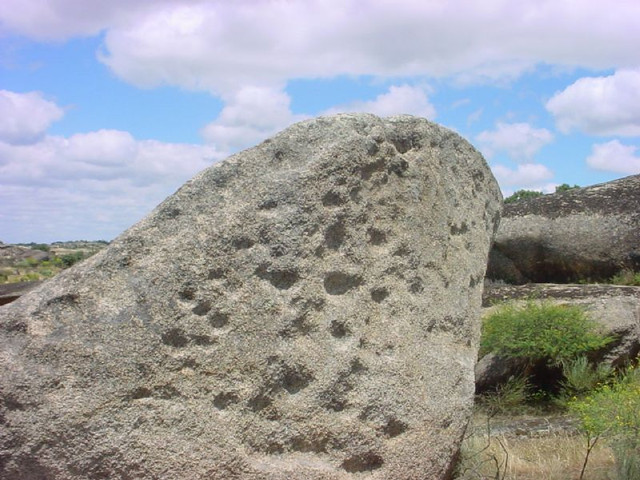
Gran Taffoni:
La erosión termina a veces por originar estos grandes Taffonis o agujeros
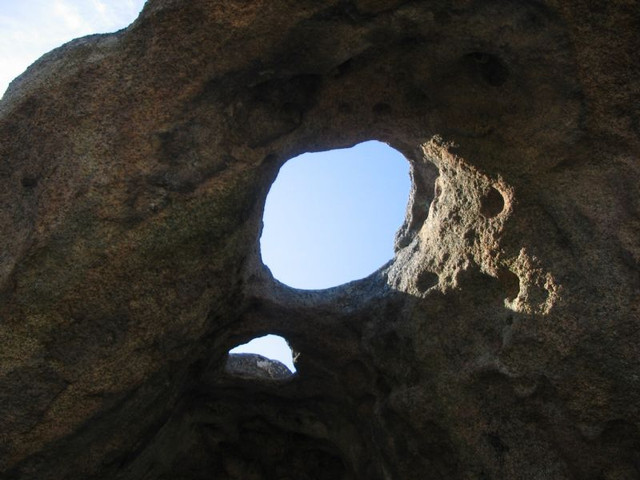

Alveolos:

Seta con Rillen:

Cazoletas:

Piletas:
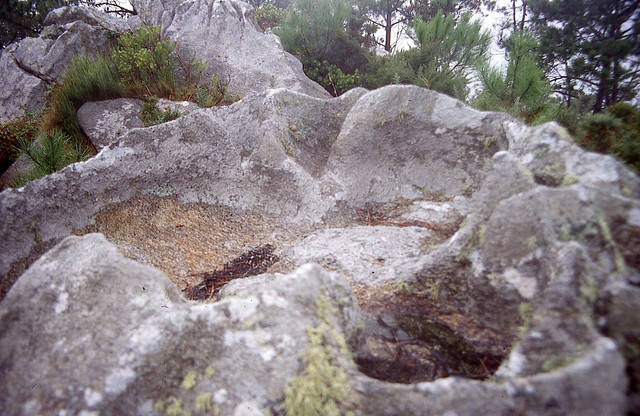
La Bomba, la Gárgola y la...
Hay tanto por aprender y ver en este lugar. En "Los Barruecos" tenemos Alveolos, Piedras Caballeras, Peñas Huecas, Rocas con formas casi reales, pinturas rupestres... ¿Es que se puede pedir algo más?
Si se puede pedir. Seguro que está en este lugar pues en este tramo encontramos tres peñas-rocas singulares: La Bomba, La ___ y la Gárgola.
La Peña en cuestión presenta _____ en su superficie debido a procesos erosivos. Al lado se sitúa una Peña Caballera hueca. ¿Hueca? ¡Sí! Puedes entrar en ella. (Hay algunas más en los Barruecos). Si te adentras en la misma podrás descubrir una serie de grabados antropomorfos. En las fechas de los equinoccios 20 o 21 de marzo y 22 o 23 de septiembre, cuando el sol está en lo más alto, la luz se cuela por el círculo que presenta la parte superior de la roca y pasa iluminando los grabados, un hombre y dos mujeres más algunas cazoletas, durante varios minutos.
Hacia la izquierda se pueden ver los restos de un asentamiento romano que comenzamos a vislumbrar desde el aparcamiento y gran cantidad de tumbas antropomorfas.
¿Cómo firmo este Earthcache?
Seguramente ya sabéis como funciona. Pero es nuestro deber recordarlo. Este tipo de caches no cuentan con un contenedor físico para firmar. Solo es necesario un registro online. Para poder firmar digitalmente tenéis que responder correctamente a las siguientes preguntas. Una vez resueltas debéis enviárselas al propietario del Earthcache y esperar su confirmación para firmar digitalmente.
Este es el proceso. Los registros que no cumplan las normas, o no respondan correctamente serán borrados. Aunque intentaremos en la medida de lo posible que reenviéis las preguntas.
1. ¿Cuál es la tercera peña? Fíjate en las formaciones mencionadas en la ficha. ¿Es alguna de ellas?
2. ¿Qué otra formación observamos en la superficie de La Peña?
3. Por último entra a buscar los grabados antropomorfos que la Peña Caballera Hueca. ¿Cuánto miden?
ENGLISH VERSION

Welcome to the Barruecos! If you are here, you surely know that we are in one of the most special and unique places in Extremadura. Place of the most beautiful sunsets, memorable picnis or even a battlefield of Game of Thrones.
I would say that I'm not going to give you the sheet with what Berrocal is or not ... What kind of rocks make it up ... What is its origin? ... But I have to do it! This is an Earthcache!
In any case I will be short. Because the objective in addition to teaching, is to enjoy this place and go to know some of its most curious formations. Are you ready?
It is known as "bolón or berrueco" to a granite rock of important size and rather round format, which may appear resting on the surface of the ground or on another rock of the same nature. Normally these rocks are the result of the decomposition and erosion that the granite undergoes after the weathering process. Although granite is a waterproof rock and very hard at the same time it is hyper sensitive to chemical decomposition. As a result the water penetrates its fissures and the ice causes the stone to explode.
These particular granite rocks are common to find in areas that are known as "berrocales", because there is just a predominance of them. We can define Berrocal, as the accumulation of large amounts of scattered rocks, forming a landscape popularly known as Ball Chaos.
Undoubtedly, "the Berrocales" stand as one of the most unique rocky landscapes on the planet and as such arouse enormous attention and amazement of visitors when it comes to discovering them. Even and how could it be otherwise are authentic tourist attractions.
For our enjoyment and learning, erosion forms some of the most striking and capricious formations of terrestrial geology in the Berrocales. Mainly formed by the erosion of wind and rain, the latter being the action of water the most incipient in the formations that we find.
Among some of the most peculiar structures are Mushrooms, Knight Stones, Pedestal Rocks, Bowling, Taffoni, Pans or Piletas, Alveolos, and Rillen or Canales.
Los Barruecos is a perfect place to discover these formations. Before that we show you some examples so that you can open your eyes and the visit is memorable:
Seta- Mushroom:
Seta Piedra Caballera- Mushroom stone knight:
Piedra Caballera- Knigt Rock:
Taffoni:
Gran Taffoni- Big Taffoni:
Alveolos:
Seta con Rillen- mushroom with Rillen:
Cazoletas- Small casserole:
Piletas- Water pile:
The bomb, the gargoyle and ...
There is so much to learn and see in this place. In "Los Barruecos" we have Alveolos, Knight Rocks, Rocas with almost real forms, cave paintings ... Can we ask for something more?
If you can ask. Surely it is in this place because in this section we find three unique rock-rocks: La Bomba, La ___ and Gargoyle.
The Rock in question presents _____ on its surface due to erosive processes. Next to it there is a hollow Peña Caballera. Hollow? Yes! You can enter it. (There are some more in the Barruecos). If you go into it you can discover a series of anthropomorphic engravings. On the dates of the equinoxes on March 20 or 21 and September 22 or 23, when the sun is at the top, the light slips through the circle that presents the upper part of the rock and passes illuminating the engravings, a man and two women plus some cups, for several minutes.
To the left you can see the remains of a Roman settlement that we began to glimpse from the parking lot and a large number of anthropomorphic tombs.
How do I sign this Earthcache?
Surely you already know how it works. But it is our duty to remember it. This type of caches do not have a physical container to sign. Only an online registration is necessary. To be able to sign digitally, you must correctly answer the following questions. Once resolved you must send them to the owner of the Earthcache and wait for their confirmation to sign digitally.
This is the process. Records that do not meet the standards, or do not respond correctly will be deleted. Although we will try as much as possible to send the questions back.
1. What is the third rock? Look at the formations mentioned in the description. Is it any of them?
2. What other formation do we see on the surface of La Peña? Remember we have not mentioned the name of one of the three. It is in that in which you must look.
3. Finally, look for the anthropomorphic engravings that the Peña Caballera Hueca. How much is measured in centimeters? (cm)