
La faille du Vallon de la Chambre au Loup
Rappel concernant les Earthcaches :
Il n'y a pas de conteneur à rechercher ni de logbook à signer. Après avoir été sur les lieux pour chercher les réponses aux questions, loguez cette cache "Found it" et envoyez-moi vos propositions de réponses, en précisant le code GC de la cache, soit via mon profil, soit via la messagerie geocaching.com (Message Center), et je vous contacterai en cas de problème.
Questions :
1- Comment s'est formé le vallon ?
2- Aux coordonnées, quel type de faille observez-vous ?
3- Aux coordonnées, sur quelle partie de la faille êtes-vous ?
4- Décrivez-moi la roche qui vous entoure, quelle est sa particularité ?
Descriptif de l'earthcache
Le vallon de la Chambre au Loup est situé sur la commune d'Iffendic en Ille et Vilaine, c'est une vallée très encaissée qui est surnommé "Le Grand Canyon Breton" car on retrouve des falaises dont les hautes mesurent environ 35m de hauteur. En partenariat avec le département, la commune d'Iffendic a aménagé cet espace naturel pour le rendre accessible avec notamment la création de chemins de randonnées.
Situation géologique
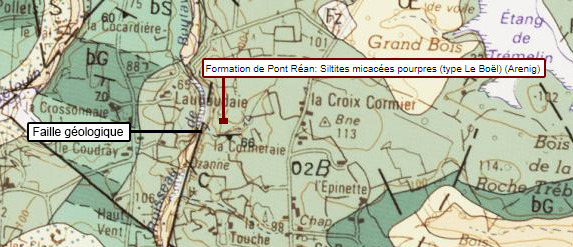
D'après la carte géologique, on remarque que le vallon de la Chambre au Loup suit le tracé d'une faille géologique. Les falaises sont constituées de schistes rouges que l'on retrouve également à Pont-Réan.
Le vallon a été créé suite à un effondrement lié aux failles apparues dans les plissements du schiste et aussi grâce à l'érosion du ruisseau de Boutavent.
Rappels géologiques
En géologie, une faille est une structure tectonique consistant en un plan ou une zone de rupture le long duquel deux blocs rocheux se déplacent l'un par rapport à l'autre. Ce plan divise un volume rocheux en deux compartiments qui ont glissé l'un par rapport à l'autre.
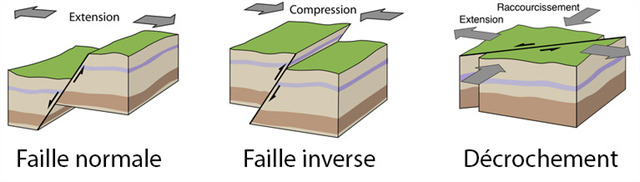
Il existe différents types de failles suivent le type de mouvement tectonique. En voici 3 exemples :
- La faille normale accompagne une extension ; le compartiment au-dessus de la faille ("toit") descend par rapport au compartiment situé en dessous de la faille ("mur").
- La faille inverse, ou chevauchement accompagne une compression ; le compartiment au-dessus de la faille ("toit") monte par rapport au compartiment situé en dessous de la faille ("mur").
- Le décrochement accompagne un mouvement de coulissage essentiellement horizontal; les décrochements purs (faille verticale et déplacement horizontal) ne s'accompagnent d'aucun mouvement vertical. Les décrochements peuvent être dextre ou sénestre, suivant que le compartiment opposé à l'observateur se déplace vers la droite ou la gauche (respectivement).
En géologie, un graben est la partie basse lors d'un effondrement d'une faille. L'inverse, la partie surélevée s'appelle un horst.

The fault of Vallon de la Chambre au Loup
Reminder about Earthcaches:
There are no containers to search or logbooks to sign. Once you've been to the site to look for the answers to the questions, log this cache “Found it” and send me your suggested answers, specifying the cache's GC code, either via my profile or via geocaching.com (Message Center), and I'll contact you if there's a problem.
Questions :
1- How was the valley formed?
2- At the coordinates, what kind of fault do you observe?
3- At the coordinates, on which part of the fault are you?
4- Describe me the rock that surrounds you, what is its particularity?
Earthcache description
The valley of the House Wolf is located in the town of Iffendic in Ille et Vilaine, it is a very deep valley which is nicknamed "Grand Canyon Breton" because there are cliffs whose highs measure about 35m high. In partnership with the department, the municipality of Iffendic has developed this natural area to make it accessible with the creation of hiking trails.
Geological situation
According to the geological map, the valley of the Chambre au Loup follows the course of a geological fault. The cliffs are made of red shales that are also found at Pont-Réan.
The valley was created following a collapse linked to the faults that appeared in the shale folds and also thanks to the erosion of the Boutavent brook.
Geological reminders
In geology, a fault is a tectonic structure consisting of a plane or zone of rupture along which two boulders move relative to each other. This plan divides a rocky volume into two compartments that have slipped relative to each other.
There are different types of faults following the type of tectonic movement. Here are 3 examples:
- The normal fault accompanies an extension; the compartment above the fault ("roof") descends from the compartment below the fault ("wall").
- The inverse fault, or overlap accompanies a compression; the compartment above the fault ("roof") rises from the compartment below the fault ("wall").
- The recess accompanies an essentially horizontal sliding movement; the pure recesses (vertical fault and horizontal displacement) are not accompanied by any vertical movement. The recesses can be dextral or sinistral, depending on whether the compartment opposite the observer moves to the right or the left (respectively).
In geology, a graben is the lower part when a fault collapses. The opposite, the elevated part is called a horst.