Cache is available
9am - 5pm Monday through Friday
COVID-19 Trail Guidelines
1. All visitors over the age of two must wear a mask when near other visitors.
2. Keep a minimum of 6’ between you & other visitors.
3. Follow the directional signs along the trail.
Newman Wetlands Center
The Newman Wetlands Center is the focal point of the Clayton County Water Authority’s community education efforts. NWC was conceptualized by Melvin L. Newman, then the general manager of CCWA, as a place for free community education about the crucial role wetlands play in the cycle of water.
ˈdraɡənˌflī - noun - plural: dragonflies
a fast-flying long-bodied predatory insect with two pairs of large transparent wings which are spread out sideways at rest. The voracious aquatic larvae take up to five years to reach adulthood.
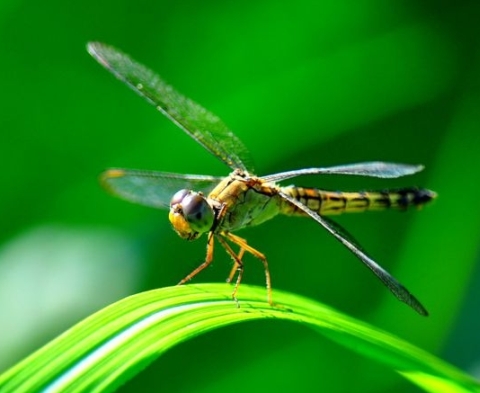
Finding the Letterbox
To find the Letterbox, go to the listed coordinates. You should find an informational sign about Mosqito Hawks, take a little time to read about these wonderous creatures. Then, while facing the sign, turn to your right and follow the path counting each time your left foot hits the ground. When you get to about 150 (300 total steps) you should be near a viewing area. The Letterbox is located in this viewing area. You may wish to SIT and gaze out over the wetlands and hopefully you will see some of these Dragonflies while you find the container.
The Dragonfly Stamp and Ink Pad are part of the Letterbox and are not for trade.
FUN FACTS
1 ) Dragonflies were some of the first winged insects to evolve, some 300 million years ago. Modern dragonflies have wingspans of only two to five inches, but fossil dragonflies have been found with wingspans of up to two feet.
2 ) Some scientists theorize that high oxygen levels during the Paleozoic era allowed dragonflies to grow to monster size.
3 ) There are more than 5,000 known species of dragonflies, all of which (along with damselflies) belong to the order Odonata, which means “toothed one” in Greek and refers to the dragonfly’s serrated teeth.
4 ) In their larval stage, which can last up to two years, dragonflies are aquatic and eat just about anything—tadpoles, mosquitoes, fish, other insect larvae and even each other.
5 ) At the end of its larval stage, the dragonfly crawls out of the water, then its exoskeleton cracks open and releases the insect’s abdomen, which had been packed in like a telescope. Its four wings come out, and they dry and harden over the next several hours to days.
6 ) Dragonflies are expert fliers. They can fly straight up and down, hover like a helicopter and even mate mid-air. If they can’t fly, they’ll starve because they only eat prey they catch while flying.
7 ) Dragonflies catch their insect prey by grabbing it with their feet. They’re so efficient in their hunting that, in one Harvard University study, the dragonflies caught 90 to 95 percent of the prey released into their enclosure.
8 ) The flight of the dragonfly is so special that it has inspired engineers who dream of making robots that fly like dragonflies.
9 ) Some adult dragonflies live for only a few weeks while others live up to a year.
10 ) Nearly all of the dragonfly’s head is eye, so they have incredible vision that encompasses almost every angle except right behind them.
11 ) Dragonflies, which eat insects as adults, are a great control on the mosquito population. A single dragonfly can eat 30 to hundreds of mosquitoes per day.
12 ) Hundreds of dragonflies of different species will gather in swarms, either for feeding or migration. Little is known about this behavior, but the Dragonfly Swarm Project is collecting reports on swarms to better understand the behavior.
13 ) Scientists have tracked migratory dragonflies by attaching tiny transmitters to wings with a combination of eyelash adhesive and superglue. They found that green darners from New Jersey traveled only every third day and an average of 7.5 miles per day (though one dragonfly traveled 100 miles in a single day).
14 ) A dragonfly called the globe skinner has the longest migration of any insect—11,000 miles back and forth across the Indian Ocean.