Submit your answers by E-Mail before logging your find.
Logs submitted without emailing an answer will be Deleted.
If you are doing this earth cache as a group, each person logging a find must submit their own answers to each earth cache question.
Please do not post any pictures of the monument in your logs.
1: Is the monument hollow or solid?
2: Is it pre or post 1879?
3: What five words are around the very top of the monument?
4: Why does this monument look different from the other monuments of the same age.
Zinc has been an important mineral in the mining history of New Brunswick. The Brunswick #12 mine was an underground lead-zinc-copper mine in the Bathurst Mining Camp of northern New Brunswick, Canada. It was discovered in January, 1953 and entered production in April, 1964. The Brunswick #12 ore body was one of the largest underground zinc mines in the world well into the late 1990s. The mine was officially closed at the end of April, 2013.
Zinc is a chemical element with the symbol Zn and atomic number 30. Zinc has a blue-silvery appearance when oxidation is removed.
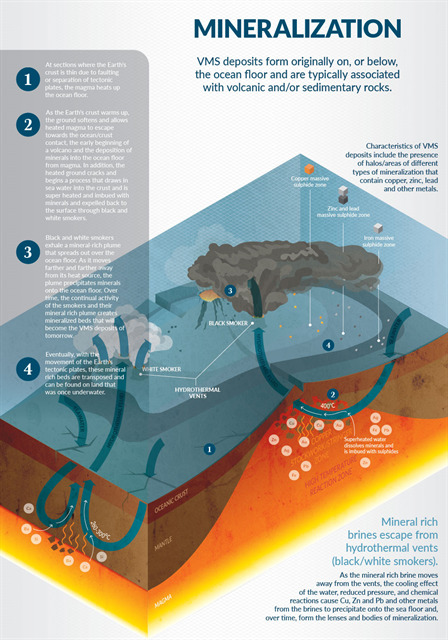
The giant Brunswick #12 deposit was a volcanic- and sediment-hosted massive sulfide (VSHMS) deposit rich in lead, zinc, and copper. VMS deposits occur around the globe and often form in clusters or camps, following the tectonic plate boundaries in areas of ancient underwater volcanic activity. At sections where the Earth’s crust is thin due to faulting or separation of tectonic plates, the magma heats up the ocean floor.
As the Earth’s crust heats up, the ground softens and allows heated magma to escape towards the ocean or crust. This is the early beginnings of a volcano, and the deposition of minerals into the ocean floor from magma. Also, the heated ground cracks and begins a process that draws in sea water into the crust which becomes super-heated and mixed with minerals. Black and white smokers expel this seawater back to the surface in a a mineral rich-plume that spreads out over the ocean floor. As it moves farther and farther away from its heat source, the plume precipitates minerals onto the ocean floor. Over time, the activity of the smokers and their mineral rich plumes create mineralized beds that become VMS deposits. With the movement of the Earth’s tectonic plates, these mineral rich beds are transposed and can be found on land that was once underwater.
Zinc is most commonly used as an anti-corrosion agent,and galvanization (coating of iron or steel) is the most familiar form.
Zinc is reactive and will attract almost all local oxides. A protective surface layer of oxide and carbonate (Zn5(OH6(CO3)2) forms as the zinc corrodes with atmospheric carbon dioxide.
The ability to attract oxidation to itself makes it an efficient sacrificial material in corrosion protection. Zinc is also used to protect metals that are exposed to sea water. A zinc disc attached to a ship's iron rudder will slowly corrode while the rudder stays intact. Zinc is also used as an anode or negative terminal in batteries.
The Zinc Monument History:
The technique for constructing zinc monuments was developed in 1873 by M.A. Richardson of Chautauqua, New York. Richardson, along with two business partners tried to get a company off the ground but failed. In 1879, the rights were sold and a new company, the Monumental Bronze Company. The Canadian distributor was in St. Thomas, Ontario.
To create a white bronze monument required several steps. An artist would begin the process by carving similar designs used on traditional granite and marble headstones into wax forms. Plaster would be poured into the wax forms and allowed to set, creating a plaster cast. A second, identical plaster cast would then be made. This would be the cast that the sand molds were made from and cast in zinc. The zinc castings were then assembled and fused together with molten zinc. Once assembled and fused, the monuments were sandblasted to create a stone-like finish. And the final step, a secret lacquer would be applied to chemically oxidize the monument, creating the bluish-grey patina – hence the name white bronze.
Monuments ranged in size from a few inches for name ‘stones’ to over 25 feet high with statues.
In an attempt to boost sales, the Monumental Bronze Company changed the "finish" on the metal base so it would resemble stone. The sandblasting roughened the surface and speed up the natural formation of protective oxide coating. Many pre 1879 monuments are smooth with a grayish colour while the post 1879 monuments have rough surface and are more bluish-silver in colour.
Although white bronze monuments weathered well, they have one flaw known as ‘creep.’ This occurs when the weight of the top of the monument bears down onto the base and it begins to bow or bulge – very slowly, over the years. The only way to rectify this is to place a stainless steel armature inside the base to help support the upper weight.
If you are looking to find a White Bronze monument they were made for only forty years, from 1874 to 1914. With the advent of World War One production halted. Zinc was needed for the war effort and the Monumental Bronze Company was taken over by the US government to manufacture gun mounts and munitions. Although the company did continue to exist until 1939, they never produced another monument. Instead, they tried to maintain the industry by crafting panels for existing monuments.
Unfortunately, these markers do suffer abuse. An urban myth involves people hiding their money behind the white bronze panels - to take it with them. Vandals then knock them out "just to see." This monument has been untouched and is in very good condition.