Submit your answers by E-Mail before logging your find.
Logs submitted without emailing answers will be Deleted.
If you are doing this earth cache as a group, each person logging a find must submit their own answers to each earth cache question.
Examine the Old Post Office building at 115 Prince William Street built between 1877 and 1880, with "G R" etched into the Roman arch above entrance (Gratia Regina).
1. Has any of the mortar been replaced?
2. Are any of building stones cracked?
3. What colour is the lime mortar?
4. Examine the brickwork in the alleyway on left side of the building. Why do you think the brick work and mortar is in better shape than the sandstone out front?
Examine the Old City Hall ,across the street at 116 Prince William Street, which was built between 1877 and 1879. The street side walls are built of yellow sandstone from an Albert County quarry.
1. Has any of the mortar been replaced?
2. Are any of building stones cracked?
3. What colour is the lime mortar?
4. Examine the brickwork on the Jarvis Building next door at 120 Prince William Street. Why do you think the brick work and lime mortar is in better shape than the sandstone next door?
Post a picture in your log with a personal item or hand in picture to prove you were there.
[REQUIRED] In accordance with the updated guidelines from Geocaching Headquarters published in June 2019, photos are now an acceptable logging requirement and WILL BE REQUIRED TO LOG THIS CACHE. Please provide a photo of yourself or a personal item in the picture to prove you visited the site.
Limestone mining in Saint John
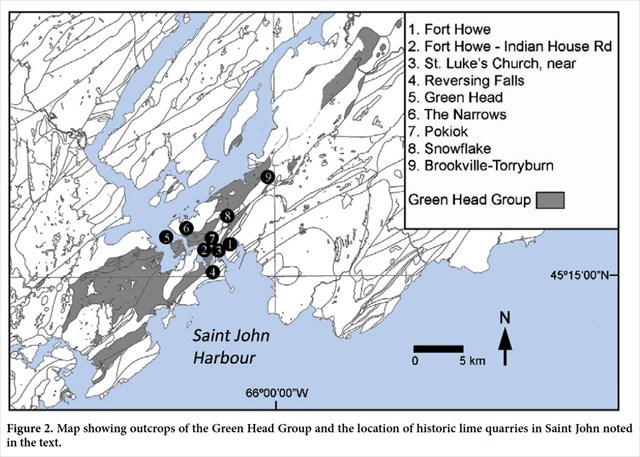
Limestone has been mined in Saint John since the early 1700's. The 1800's were the busiest periods with limestone being mined to make lime in lime kilns for building construction. There were 9 limestone quarries in the Saint John area. With the introduction of Portland cement during the 19th century, the use of lime mortar in new constructions gradually declined. The Brookville quarry, in what was known as Torryburn, is the only one still in production.
GEOLOGY OF THE LIME RESOURCE
The rock quarried in Saint John to produce lime was from the Precambrian Ashburn Formation of the Green Head Group. The Ashburn Formation (the basal or first member of the Green Head Group) consists of marble, low-grade metamorphosed limestone of variable colour and texture that outcrops in a belt trending east-west across the city. It is described as deposited in a shallow-marine environment, as indicated by the presence of stromatolites (formed by the growth of layer upon layer of cyanobacteria in water). It is typically white to grey and light green, banded, and locally stromatolitic, calcareous to dolomitic marble interbedded with fine-grained sedimentary pelite, fine-grained quartzite, minor conglomerate, and mica schist.
THE GREENHEAD QUARRY
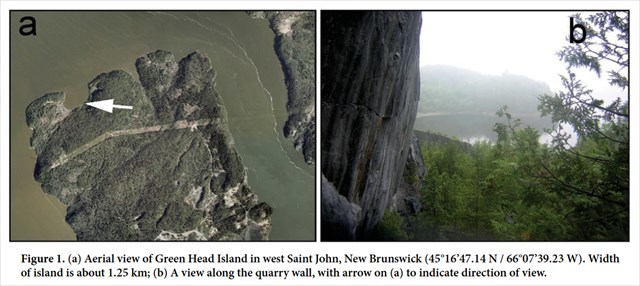
The quarry at Greenhead was the largest in the area. A good deal of the wood necessary for the burning of lime was available on Green Head Island and easily delivered to the site from upriver. Quarrying at the site was relatively straightforward, the quarry was so near the kilns, the rock only had to be wheel-barrowed a short distance and dumped into the kilns.
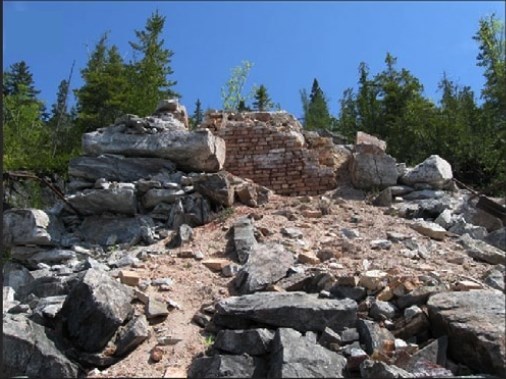
The first kilns in the area were round, replaced later by larger square kilns. Both round and square kilns were constructed as stone houses, into which the pieces of lime rock were piled. Fires were lit in openings in the rock piles and left to burn continuously for five days before allowing them to cool off, allowing the lime to be removed. Most of the lime that was produced here was used to create mortar.
The Great Fire was an urban fire that devastated much of Saint John, New Brunswick in June 1877. It destroyed two-fifths of the city of Saint John. Many of the buildings in Uptown Saint John built after the Great Fire were mortared together with Green Head lime.
A walk along historic Prince William Street, rebuilt after the fire, allows an ‘urban’ geologist to examine Upper Carboniferous sandstone quarried from Albert, Westmorland and Northumberland counties which were constructed using lime mortar.
All too often lime mortar that has disintegrated over time has been replaced with cement based mortars. This has a detrimental effect on the building as cement is often harder than the stone in the walls. Any moisture in the walls will evaporate through the most porous material, in this instance, the stone. This in turn can cause the stone to begin to fracture. Rain and frost can then penetrate the stone making matters worse.