NEWRY CANAL
The newry canal was opened in 1742 and was built to bring coal from Tyrone to the Irish Sea. The coming of railways in the 1850s saw the canal go into decline. While Newry continued to prosper as a port, the traffic on the canal had halved by 1888. Declining income and increasing maintenance costs meant that commecial traffic ceased in 1936. By 1956 the canal was closed as far as Newry and by 1966 the section to Victoria lock was abandoned when Warrenpoint replaced the port of Newry.
Today the lower section is used for fishing with platforms along a 3.5 mile stretch. A greenway walk now stretches from Victoria all the way to Newry. Above Newry the towpath has been incorporated into both the Ulster Way and the National Cycle Network
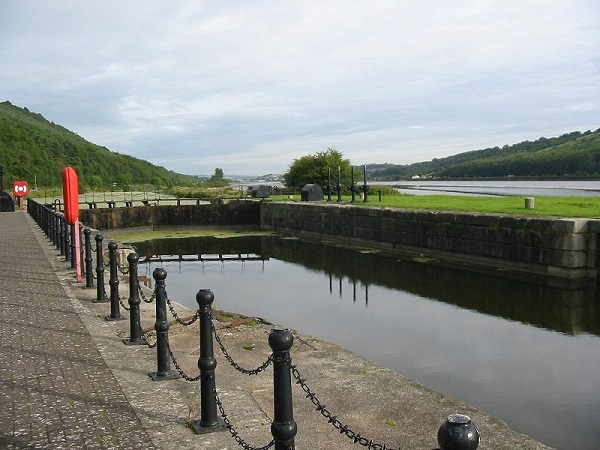
This Earthcache will take you to a piece of the Canal wall, it is made of very solid granite blocks, we will discuss what makes up granite, why it is a fantastic building material, and how it has weathered after 250 years in situ.
So Granite, what is it?
Granite is a common type of felsic intrusive igneous rock that is granular and with visible crystals in its texture. Granites can be found in white, pink, or grey in colour, depending on their mineralogy. The “normal” %-numbers given in the granite stone is between 20% and 60% quartz, referred to as the white glassy mineral, and at least 35% of the total feldspar, found as white till red pink-ish colour, consisting of alkali feldspar, and the biotite (black mica). Commonly the term "granite" is used to refer to a wider range of coarse-grained igneous rocks that containing quartz and feldspar and may have more reddish colours. While a less or non-reddish colour refers more to a medium-grain, light grey, grey or blue-grey rock species.
Feldspar is crystallized (made/occurs) from magma in deep and extrusive. The size of the crystals tells us where and how far down into the crust they were made and formed. Easy said and explained, the larger the crystals are, the longer they have been forming, and the deeper into the crust they origin from. Feldspar is a vital element in magmatic rocks where the proportion and type of feldspar are used to classify the rock..
Granite is nearly always massive (lacking any internal structures), hard and tough, and therefore it has gained widespread use throughout human history as a construction stone. The average density of granite is between 2.65 and 2.75 g/cm3 (165 and 172 lb/cu ft), its compressive strength usually lies above 200 MPa, and its viscosity near STP is 3–6·1019 Pa·s.
The melting temperature of dry granite at ambient pressure is 1215–1260 °C (2219–2300 °F); it is strongly reduced in the presence of water, down to 650 °C at a few kBar pressure.
Granite has poor primary permeability overall, but strong secondary permeability through cracks
The blocks you are dealing with will almost certainly have come from the Mourne mountains which you will have been able to see on your way here, on a nice day anyway. So lets see what you have learned today, time to open those eyes.
To claim a find on this Ec please send me the answers to the following questions, no need to wait for a reply just log the find, if I have an issue I shall let you know..
1 On average how wide and heigh are the blocks,
2 What if any weathering can you see after 250 years of being here.
3 What percentage is the quartz element?
4 Will the water have seeped into the stone ?, is granite permeable ?.
Lastly, I would love to see a picture of you in your craft, this is not a logging requirement, just a bit of fun
THIS SERIES
This is part of a large series that has been placed along the Canal. It requires a mix of walking, kayaking, climbing and cycling to find the six different types of caches.
A suggested launch point for your watercraft can be found at NC001 - Slipway.
COMPLETE YOUR DT GRID
This is also one of the eighty one caches that will enable you to complete your DT in the Newry/Carlingford area. This link will take you to a spreadsheet which will show you the other 80 caches in the series. A bookmark list is also available.
This cache was placed using a kayak. Please ensure you have the appropriate skills and equipment before attempting to find this cache.