
National Monument
This is an earthcache, so there is NOT a container to 'find', but you will learn something about Larvikite.
The National Monument in Kuala Lumpur is a 48,562 sq meter space with 5 major components, namely the monument, the pavilion, the surrounding gardens, the fountains and the war memorial. It was designed by American architect named Felix de Weldon who also designed the famous Iwo Jima Memorial.
The National Monument was completed and officially opened on 8 February 1966, by Sultan Ismail Nasiruddin of Terengganu, then Yang di-Pertuan Agong. It was proclaimed a memorial park dedicated to the 11,000 people who died during the 12-year Malayan Emergency(1948–1960). On 27 August 1975, the monument suffered extensive damage due to an explosion set off by a terrorist. It has since been restored to its original state with the renovated statues unveiled on 11 May 1977.
The sculpture depicts 7 figures, 5 of the figures [1. holding the Malaysian flag, 2. armed with a rifle and bayonet (left), 3. armed with a machine gun (right), 4. soldiers tending to fifth wounded compatriot] represents the victorious allied forces while the other 2 figures that lie on the ground represents that of the defeated communist forces. The monument depicts the victory of the forces of democracy, peace and freedom over that of communism. Each of the bronze figures symbolises leadership, suffering, unity, vigilance, strength, courage and sacrifice. The stones that the soldiers are standing on were from the Karlshamn in South Eastern Sweden while the base is blue granite like cladding called larvikite from Norway. It is shiny and reflects light from inside the rock.
The granite base of the sculpture bears the Malaysian Coat of Arms, flanked on either side by inscriptions in English, Latin script, and also in Malay in Jawi script:
Opening hours : 7:00 am to 6:00 pm
THE EARTHCACHE
Type of Earthcache: Igneous Rocks – Larvikite
Igneous Rocks
Igneous rocks are one of the 3 main categories of rocks, the other 2 being sedimentary and metamorphic. Igneous rocks are magmatic in origin: formed through the cooling and solidification of magma or lava.
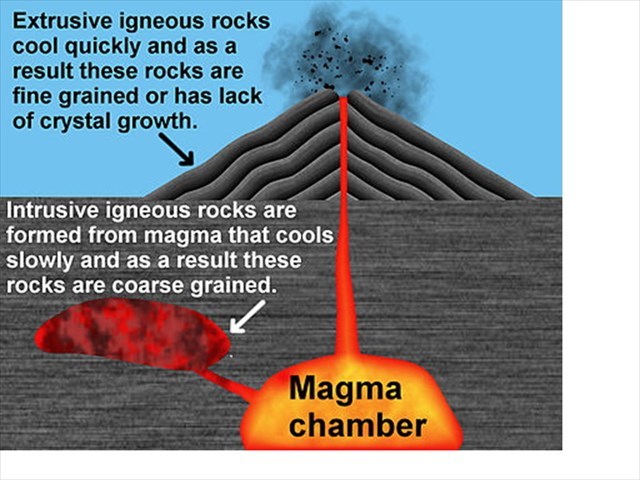
Formation of Igneous Rock(Source: Wikimedia Commons)
Intrusions of larvikite in Norway forms part of the suite of igneous rocks that were emplaced during the Permian period, associated with the formation of the Oslo Rift. The crystallisation of a ternary feldspar indicates that this rock began to crystallise under lower crustal conditions.
_________________________________________________________________________________
Intrusive vs Extrusive
Intrusive rocks are rocks that cool down and crystallises underground. This results in a slower and steady cooling process, which causes the crystalline structures of the rock to be larger. These rocks are usually coarse grained, or in geological terms, these rocks are phaneritic.
Extrusive rocks are the opposite, magma flows out and cools above ground, causing the magma to cool and crystallise faster. This causes the crystals to be smaller and fine-grained. In other words, the rock is aphanetic.
_________________________________________________________________________________
Felsic vs Mafic
Felsic is a portmanteau of feldspar and silica, the 2 minerals that are predominant in igneous rocks of this type, with silica being found in the form of quartz. These rocks are generally lighter in colour.
Mafic on the other hand, is a combination of magnesium and ferric, ferric being the latin term for iron (Fe). These rocks are usually darker in colour.
__________________________________________________________________________________
Larvikite
Larvikite is generally found in Norway, in the vicinity of the town of Larvik, where the rock gets it's name from. It is a variety of monzonite, which is composed of approximately equal amounts of plagioclase and alkali feldspar, with less than 5% quartz by weight. Larvikite is usually rich in titanium, which is found in the forms of titanaugite or titanomagnetite, the latter of which is a highly magnetic ore.
An interesting thing to note is that the feldspar crystals in larvikite are ternary: it contains significant amounts of all three end members of the feldspar group - potassium feldspar, anorthite and albite
The larvikite used here shows a neon blue reflection, termed "labradorescence" due to the presence of perthite, an intergrowth of 2 feldspars - in this case, plagioclase and alkali feldspar. This would usually be marketed as "Blue Granite" although it is not a granite.
Blue granite is a popular cladding material thanks to its beautiful shimmering appearance, but it is not technically a granite. But its properties and use is similar to that of granite. The true name of this blue granite is "Larvikite".
Both granite and Larvikite are coarse grained igneous rocks, but whilst granites by definition, contain a large amount of free quartz, Larvikite only contains a small amount, and is therefore a "Syenite". The most popular use for this rock is as you see here, as a decorative cladding for building.
With luck, you will be visiting this earthcache on a sunny day where you will be able to see the pearlescent sheen produced as the sun reflects on it. This is known as the Schiller effect. The effect of schiller or shiller, also commonly referred to as adularescence, is best described as a milky, bluish luster or glow originating from below the surface of the gemstone. The crystals producing this effect are formed of k-feldspar, by far the most common constiutuent of Larvikite.
These crystals formed slowly as magma cooled 30km below the earth’s surface almost 300 million years ago, as the original supercontinent Pangea broke up. Over time, the rock was brought to the surface where conditions are very different and as a result, the large crystals which formed so far below the surface are no longer stable. As a result of this, there are microscopic changes in the feldspar which allow for the beautiful shimmering. This effect does not happen by chipping off a random chunk. Experts must analyse each block to decide in which direction it should be cut to best produce the shimmering effect. Because of the nature of the cooling, the crystals formed on similar planes, and as a result the nature of the cut can either allow for shimmering from most crystals, or from very few.
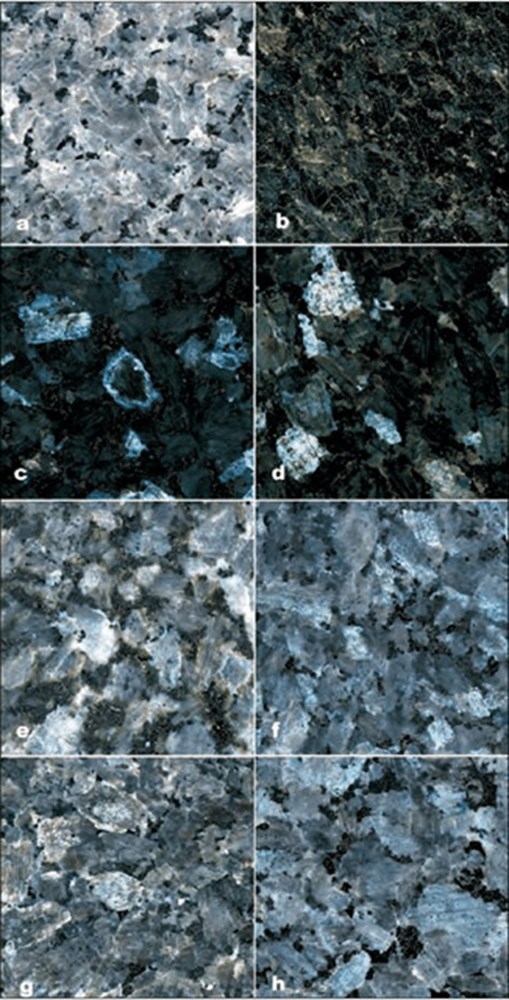
Variety of Larvikite(Source: Research Gate)
The above picture depicts the various kinds of larvikite.
• (a) Kjerringvik • (b) Bergan • (c) Klåstad strong blue (Emerald Pearl) • (d) Klåstad silvery to light blue • (e) Stålaker (Marina Pearl) • (f ) Tvedalen (Blue Pearl) • (g) Bassebu • (h) Malerød (Royal Blue).
_________________________________________________________________________________
Logging Tasks
Send the answers to the following questions via my profile, and log. I will get back to you if there are problems with your answers.
1. Is the rock intrusive or extrusive? Explain and describe the crystal size.
2. Is the rock felsic or mafic? Explain
3. Look closely at the feldspar crystals. How might be we be able to tell that they cooled slowly?
4. What is causing the stone to reflect light? Name the 2 components as well.
5. What is the name of said phenomenon?
6. Based on the image above, which variety of larvikite does the wall belong to?
7. Finally, to prove that you have been here, please stand facing the National Monument. Is the name of Felix de Weldon to your left or to your right?
8. As with all earthcaches, a photo from the site is appreciated.

Join us at Geocaching Malaysia
Reference
https://en.wikipedia.org/wiki/National_Monument_(Malaysia)
https://www.wikizero.com/en/National_Monument_(Malaysia)
https://en.wikipedia.org/wiki/Larvikite