Italiano: Informazioni sul Santuario, luogo del Geocache
Seguendo le indicazioni per il Santuario Madonna dell'Aiuto, presenti sulla SP71 della Val di Cembra, si percorre l'ultimo tratto di strada (asfaltata ma con qualche buca) tra alberi e cinguettii di uccellini e si raggiunge il Santuario della Madonna dell'Aiuto. Tale nome deriva dal fatto che all'interno del Santuario è conservato un quadro raffigurante una venerata immagine della Madonna col Bambino, dipinta ad olio su tela. Il quadro fu copiato dal dipinto presente nel Duomo di Passavia, a sua volta una copia dell'originale Mariahilf dipinto da Lucas Cranach il Vecchio nel 1514, ed attualmente conservato nella chiesa di San Giacomo ad Innsbruck. Il quadro del Santuario venne probabilmente commissionato dal barone Ferdinando Francesco a Prato, il quale era canonico a Passavia fra il 1676 e il 1702.
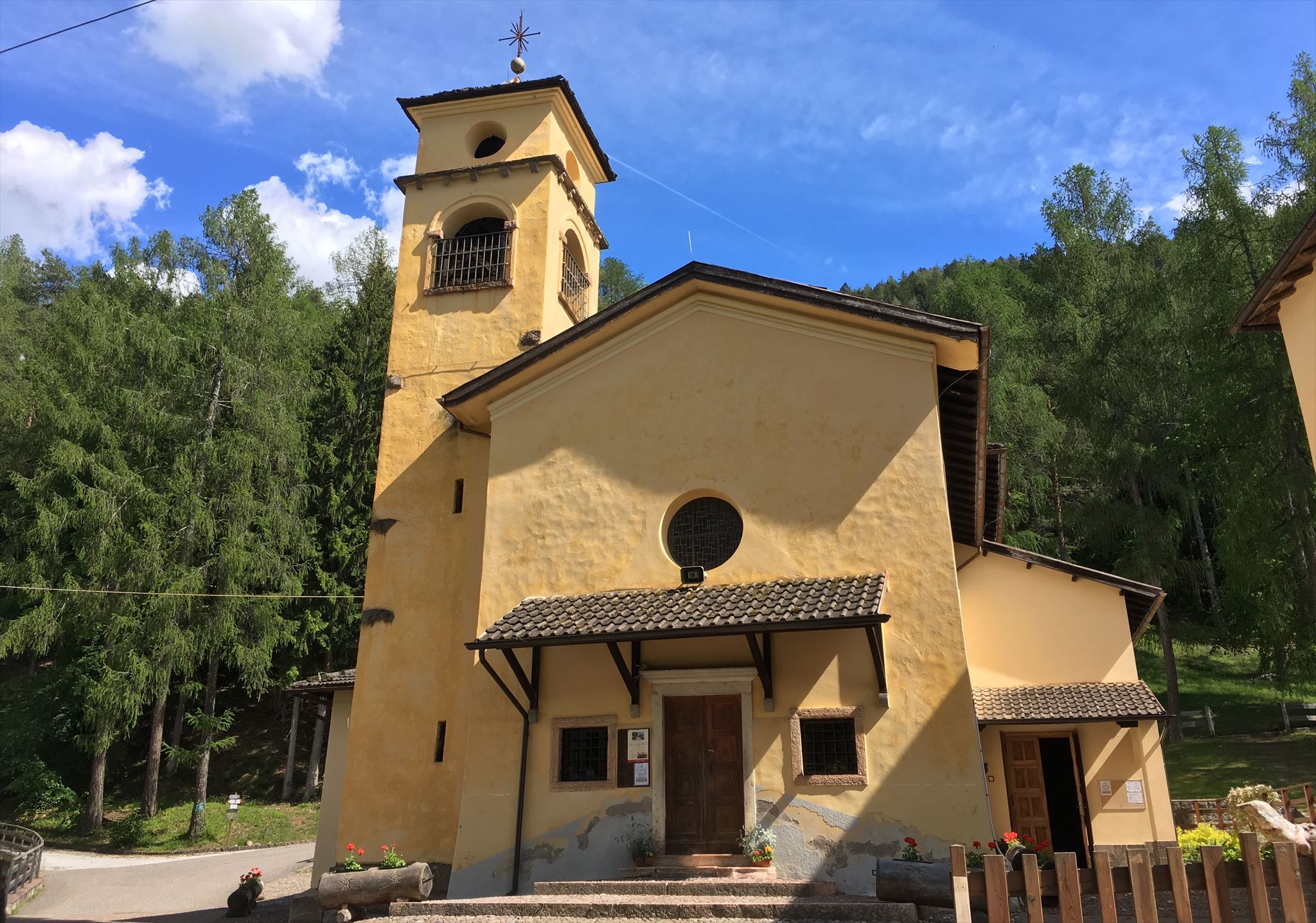
Il Santuario inizialmente era una semplice cappella devozionale (costruita probabilmente per conservare il quadro), poichè situata lungo la strada che collegava i paesi della sponda sinistra della Val di Cembra (molto trafficata prima della costruzione della attuale strada provinciale). La data esatta della costruzione della prima struttura è ignota, anche se si dice dovrebbe essere sorta intorno alla fine del XVII secolo (si meziona la cappella in un documento del 1710).
La cappella iniziò ad essere meta di pellegrinaggi locali, e venne benedetta verso il 1774-1775, quando l'edificio venne sottoposto ad un lievissimo ampliamento. Fra il 1807 e il 1808 venne celebrata per la prima volta la messa solenne della prima domenica di settembre, che verrà mantenuta anche negli anni successivi (viene festeggiata tutt'ora) e che ai tempi era particolarmente seguita da tutti i comuni circostanti, con processioni che partivano da Segonzano, Valda e Grumes. L'aumento del flusso di fedeli rese necessario un notevole ampliamento della struttura; l'ultimo, terminato nel 1961, ha portato il Santuario alle sue dimensioni attuali.
E possibile raggiungere il Santuario in auto o altro mezzo, parcheggiando direttamente al Santuario Waypoint P2; oppure si può parcheggiare al Campo Sportivo Waypoint P1, e percorrere la strada asfaltata per 1,4 km (circa 25 min a piedi) all'ombra degli alberi: è una passeggiata facile e tranquilla. Dal Santuario partono diverse strade forestali, percorribili a piedi o con mountain-bike. Al Santuario ci sono panchine per picnic, un bel prato e una saletta al coperto con un distributore per caffè e bevande calde e uno per snack.
Il geocache si trova vicino alle coordinate segnate: seguite l’indizio per raggiungere la posizione piu’ accurata; il geocache e' in un contenitore di vetro, portatevi una penna per firmare il logbook!
BUONA CACCIA!
English version: Infos about the Sanctuary and geocache
Driving on SP71, the main road in Val di Cembra, you have to follow the directions for the Sanctuary of the Madonna dell'Aiuto; the last part of the road is paved but with a few holes, then you reach the Sanctuary of the Madonna dell'Aiuto . The Sanctuary has this name because inside of it there is a painting depicting a venerated image of the Madonna and Child, painted in oil on canvas.
The painting was copied from a painting who is situated in the Cathedral of Passau; that painting was itself a copy of the original Mariahilf painted by Lucas Cranach the Elder in 1514, which is preserved in the church of San Jakob in Innsbruck. The painting in the Sanctuary was possibly commissioned by Baron Ferdinando Francesco in Prato, who was canonical in Passau between 1676 and 1702.
The Sanctuary was initially a simple devotional chapel (probably built to conserve the painting), as it was located along the road that connected the towns on the left side of the Val di Cembra (it has been very busy before the current provincial road was built). The exact date of construction of the first structure is unknown, although it is said to have arisen around the end of the 17th century (the chapel is mentioned in a document from 1710).
The chapel began to be the destination of local pilgrimages, and was blessed around 1774-1775, when the building was subjected to a very slight enlargement. Between 1807 and 1808 the solemn mass of the first Sunday of September was celebrated for the first time, and it will be maintained also in the following years (it is still celebrated). At the beginning it was particularly followed by all the surrounding municipalities, with processions that departed from Segonzano, Valda and Grumes. The increase in the flow of faithful made a considerable expansion of the structure necessary; the last, completed in 1961, brought the Sanctuary to its current size.
It is possible to reach the Sanctuary by car or other vehicles, parking directly at the Sanctuary Waypoint P2 ; or you can park at the Sports Field Waypoint P1 , and walk the paved road for 1.4 km (about 25 min on foot) in the shade of the trees: it is an easy and peaceful walk. Several paths depart from the Sanctuary, which can be traveled by walk or by mountain bike. At the Sanctuary there are picnic benches, a nice lawn and an indoor room with a hot drinks dispenser, and one for snacks.
The geocache is near the the marked coordinates: follow the hint to reach the right place; it's in a glass container, bring a pen to sign the logbook!
HAPPY HUNT!