Cette cache virtuelle a spécialement été publiée
pour la VIe édition du EWE.
par Ours Curieux, avec la collaboration de pic mineur
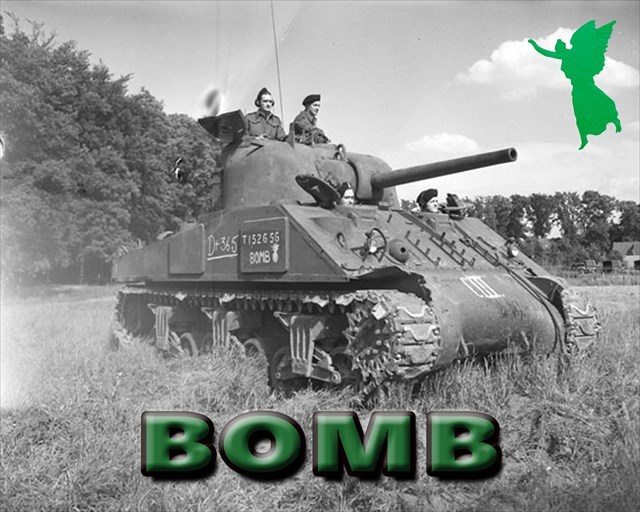
BOMB est un char Sherman de l'armée canadienne
du 27e Régiment blindé (régiment de fusiliers de Sherbrooke)
qui a atterri le jour J à Juno Beach, le 6 juin 1944,
avec le régiment de fusiliers de Sherbrooke à Bernières-sur-Mer
et a été presque immédiatement impliquée
dans les combats à Authie et Buron, où les Fusiliers ont détruit
41 chars au cours de leurs deux premiers jours de combats.
Des combats de chars encore plus intenses ont suivi
en Normandie, alors que les unités allemandes Panzer et SS
tentaient d'écraser la tête de pont alliée pendant
que les Alliés cherchaient à l'éclater.
Ce char a participé aux combats autour de Caen,
notamment aux coûteux combats sur la crête de Bourguébus
et à la capture et au défrichage de la ville de Falaise.
Ce char a commencé avec l'indicatif d'appel 22,
mais en juillet, les troupes du char Fusilier
ont été réorganisées et BOMB est devenu un char
de commandement de troupes avec l'indicatif d'appel
21 peint sur la tourelle. Après l'invasion alliée, BOMB
a parcouru 4 000 kilomètres dans le nord-ouest de l'Europe,
contribuant à la libération du nord de la France,
de la Belgique et des Pays-Bas. Après avoir combattu dans
la forêt de Hochwald en Allemagne, il mena
une reconnaissance sur les rives du Rhin.
Les Fusiliers ont improvisé et ont fait de BOMB un char
amphibie, en obturant toutes les ouvertures
des réservoirs et en les enveloppant avec des tuyaux
à air comprimé pour assurer leur flottabilité.
Les unités allemandes, situées de l'autre côté du Rhin,
ont été prises au dépourvu lorsque les chars sont
apparus derrière eux. Les régiments et leurs chars
ont dégagé des unités de l'armée allemande le long
de l'IJsselmeeret à travers le nord des Pays-Bas
et en Allemagne.
Le char a repoussé les attaques allemandes fanatiques
dans les derniers jours de la guerre, des attaques
frontales allemandes laissant les champs devant
les Fusiliers recouverts des corps des troupes allemandes.
Enfin, dans la ville frontalière d'Emden, le lieutenant Mingo
a reçu des nouvelles de la radio du char:
" Déchargez, dégainez les armes, la guerre est finie ! ".
Le jour de la Victoire en Europe, le char avait tiré
6 000 obus au combat. Il a survécu à deux impacts d'obus ennemis
et a été rapidement réparé par son propre équipage,
ne manquant jamais une journée d'action. BOMB a été
l'un des rares chars canadiens à combattre
sans interruption du jour J au jour de la Victoire en Europe.
BOMB a été sauvée d'une casse belge pour être expédié au Canada.
C'était l'un des quatre chars d'assaut canadiens du Nord-Ouest
de l'Europe à être conservés au Canada. Le char a été exposé
au parc du Champs de Mars à Sherbrooke, pour être
plus tard déplacé ici, sur la pelouse du manège militaire
de la rue William. Le char a été restauré en 2011,
recevant des plaques reflétant son service militaire.
Pour voir un film sur BOMB, cliquez ici !
RÉFÉRENCES : https://en.wikipedia.org/wiki/Bomb_(tank)
* * * * * * * * * * * * * * *
Pour valider cette cache virtuelle vous devrez vous rendre
aux coordonnées publiées, répondre aux questions
et me transmettre par courriel ou par messagerie,
vos réponses (ne pas les mettre dans votre log) avec le titre
de la cache : (BOMB) et son # : (GC88Z40).
1) Sur le Tableau d'honneur, quel nom retrouve-t-on
sous celui de RENO, G. V.?
2) À l'avant du char, il y a un nombre de 2 chiffres
de peinturé en rouge et blanc. Quel est ce nombre ?
Veuillez joindre à votre log, une photo prise sur les lieux
avec votre GPS (visage non obligatoire). Vous pourrez
inscrire votre trouvaille "Found" sans attendre mon acceptation.
Advenant une erreur de votre part, vous serez contacté.
* * * * * * * * * * * * * * *
* * * * * * * * * * * * * * *
(English version)
by Ours Curieux, with the collaboration of pic mineur
BOMB is a Canadian Army Sherman Tank of the
27th Armoured Regiment (The Sherbrooke Fusilier Regiment)
which landed at Juno Beach on June 6, 1944
at Bernières-sur-Mer and was almost immediately
involved in fighting at Authie and Buron where
the Fusiliers destroyed 41 tanks in their first two days
of fighting. Even more intense tank battlesfollowed
in Normandy as German Panzer and SS units
tried to crush the Allied beachhead while
the Allies sought to break out. This tank fought
in the actions around Caen including the costly fighting
on Bourguébus Ridge, and the capture and
clearing of the city of Falaise.
The tank started with the call sign 22 but in July
the Fusiliers tank troops were re-organized and BOMB
became a troop command tank with
the call sign 21 painted on the turret.
Following the Allied breakout BOMB travelled
4000 kilometers across northwestern Europe, helping to
liberate northern France, Belgium and the Netherlands.
After fighting in the Hochwald forest in Germany
it led a reconnaissance to the banks of the Rhine River.
The Fusiliers improvised an amphibious capacity
by sealing all openings on the tanks and wrapping
them with compressed air hoses to achieve buoyancy.
German units on the other side of the Rhine
were taken by surprise when the tanks suddenly
appeared behind them. The regiment and its tanks
cleared German army units along the
IJsselmeeret and through the northern Netherlands
and pushed into Germany.
The tank fought off fanatical German attacks
in the final days of the war, as German frontal attacks
left the fields in front of the Fusiliers covered with
the bodies of German troops. Finally, in the border town
of Emden Lieutenant Mingo received news
from the tank radio: "Unload, clear guns, the war is over !"
By VE Day, the tank had fired 6000 rounds in the battle.
It survived two hits from enemy shells and was
quickly repaired by its own crew, never missing a day in action.
BOMB was one of the few Canadian tanks
to fight without interruption from D-DAY to VE-Day.
BOMB was rescued from a Belgian scrapyard
to be shipped to Canada. It was one of four Canadian tanks
shipped from service in northwestern Europe to
preservation in Canada. The tank was on display at
the Champs de Mars Park in Sherbrooke, and later moved
here to the front lawn of the Williams Street Armoury.
The tank was restored in 2011, receiving
plaques to reflect its battle service.
REFERENCES : https://en.wikipedia.org/wiki/Bomb_(tank)
* * * * * * * * * * * * * * *
In order to register a Found for this Virtual you must
go to the published coordinates, find the answers to
the questions, and send them back to me by email or by
way of the geocaching.com messaging service (NOT in
your Found log) with the header reading (BOMB) followed
by the GC-number (GC88Z40).
1) On the Honor Roll what name is written immediately
after RENO, G. V. ?
2) On the front of the tank there is a two-digit number painted
in red and white. What is this number ?
Along with your log please attach a picture of yourself
with your GPS taken on the premises (seeing your
face is not mandatory). You may register
your Found log without waiting for my permission. If
something is wrong you will be noticed.


Virtual Rewards 2.0 - 2019/2020
This Virtual Cache is part of a limited release of Virtuals created between June 4, 2019 and June 4, 2020. Only 4,000 cache owners were given the opportunity to hide a Virtual Cache. Learn more about Virtual Rewards 2.0 on the Geocaching Blog.
Ibve zn abgr qh 18 abirzoer 2021 pbapreanag yr aba-nppèf à OBZO.